




















Join the Applied AI Summit | Free online conference | October 13-15, 2026
was successfully added to your cart.

Medical Data
De-identification

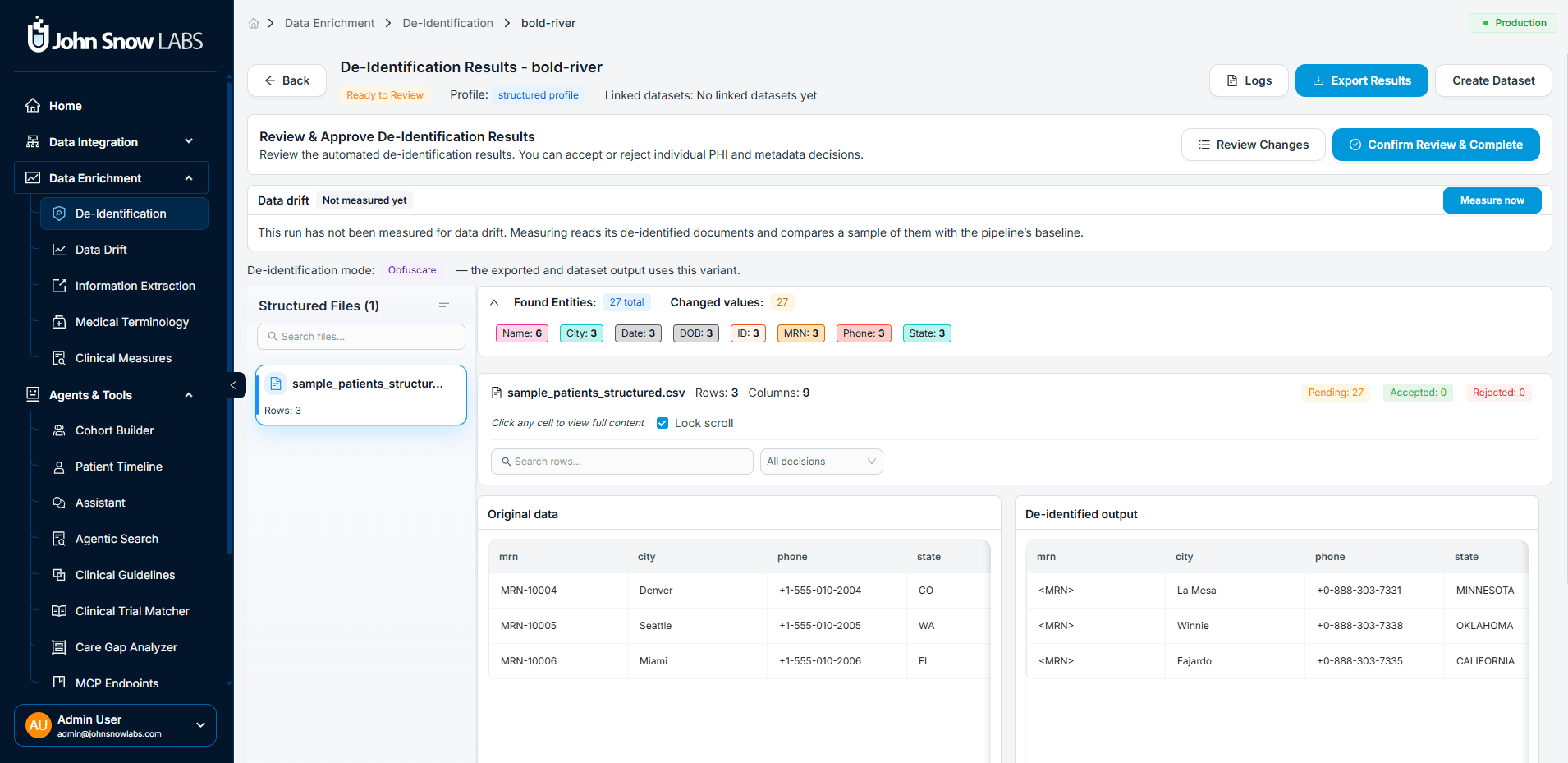
Notes, PDFs, DICOM, structured tables and FHIR - de-identified at regulatory grade accuracy, inside your own environment. Consistent tokenization and obfuscation across modalities for the same patient.

Proven at 2 billion notes

The largest validated de-identification
deployment in healthcare

Providence Health de-identified two billion patient notes with this pipeline: independently
validated, tested for model bias, and red-teamed for three months.
2B

Patient notes processed

99%+

PHI detection accuracy

0

Red Team Re-identifications

500K

Notes in 2.5 Hours

How it was validated
  • Three-month red-team exercise by an external security provider
  • Adversarial testing on 790 patients with zero re-identifications
  • Manual review of 35,000+ notes by the compliance team
  • Equity analysis across gender, age, ethnicity and geography
  • Consistent obfuscation, date shifting and tokenization per patient
  • Accuracy above triple manual review by domain experts

Deliver regulatory-grade accuracy

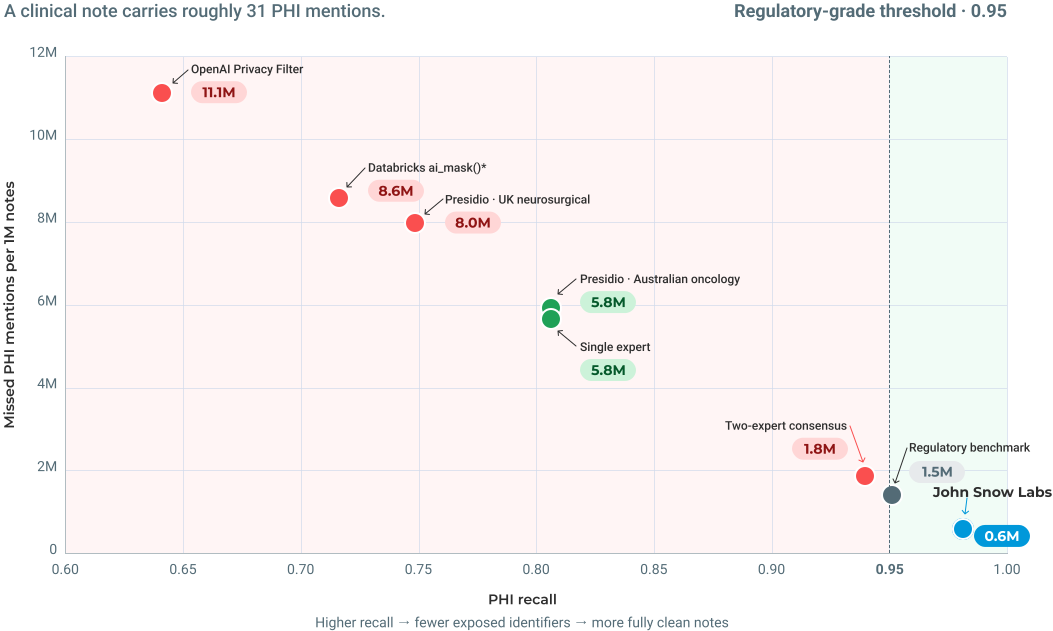
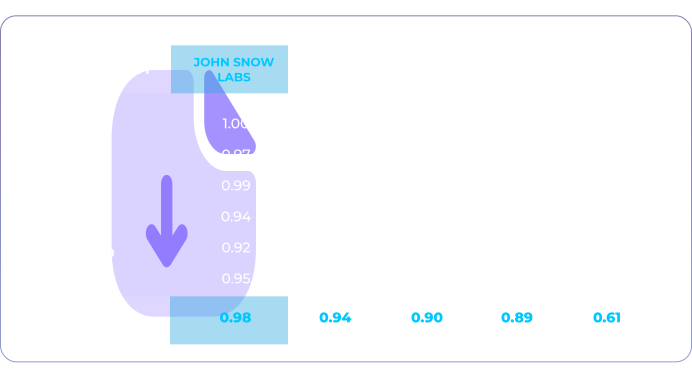
0.95 is the bar that expert manual review reaches. Below it, your data cannot be considered de-identified.
PHI recall on expert-annotated clinical text, projected onto a 1M-note corpus at ~31 PHI mentions per note. *Databricks ai_mask() as reported in the 2026 benchmark. Ground truth and scoring code are public. Full 2026 benchmark →

De-identify data where it lives

0.98

micro F1 on the official 2014 i2b2 test set

0.98

PHI recall at 381,959-token scale

80%+

cheaper than API-based alternatives

Fixed

licensing – no per-token fees

Zero

data movement – runs where your data lives

Deterministic

same PHI, same token, every run

See It In Action

De-identification across all medical data types

Works with every major healthcare data format — maintaining structure while removing PHI.

Clinical Notes

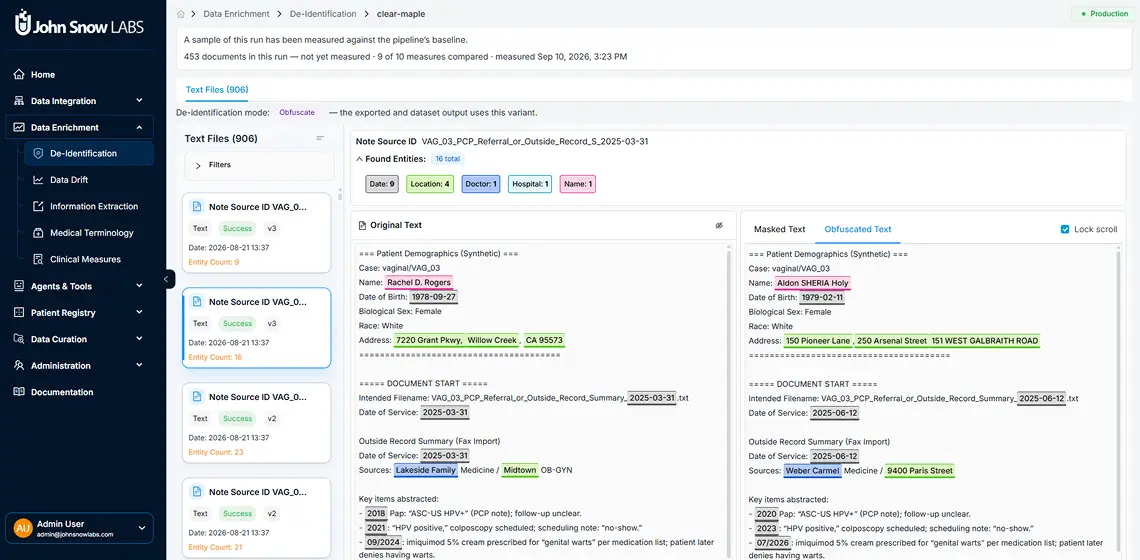
Automatically identify and obfuscate 23+ PHI entity types including patient names, doctors, hospitals, medical records, locations, dates, and contact information.

PDF Documents (Text & Scanned)

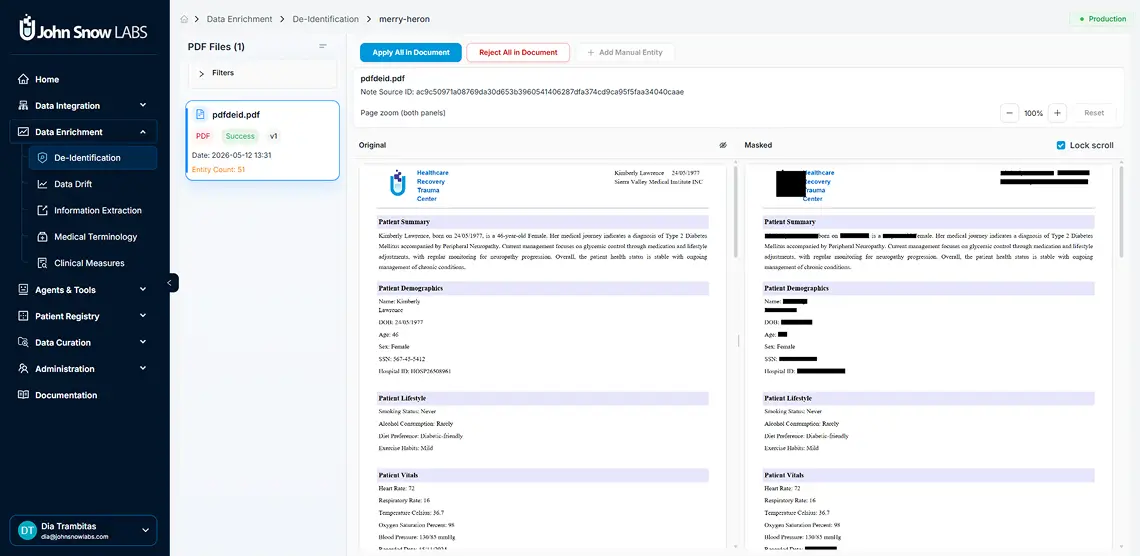
Process PDFs directly — original structure and formatting preserved, PHI removed with 94%+ accuracy. Built-in OCR handles digital and scanned documents without recreating the file.

DICOM Medical Images

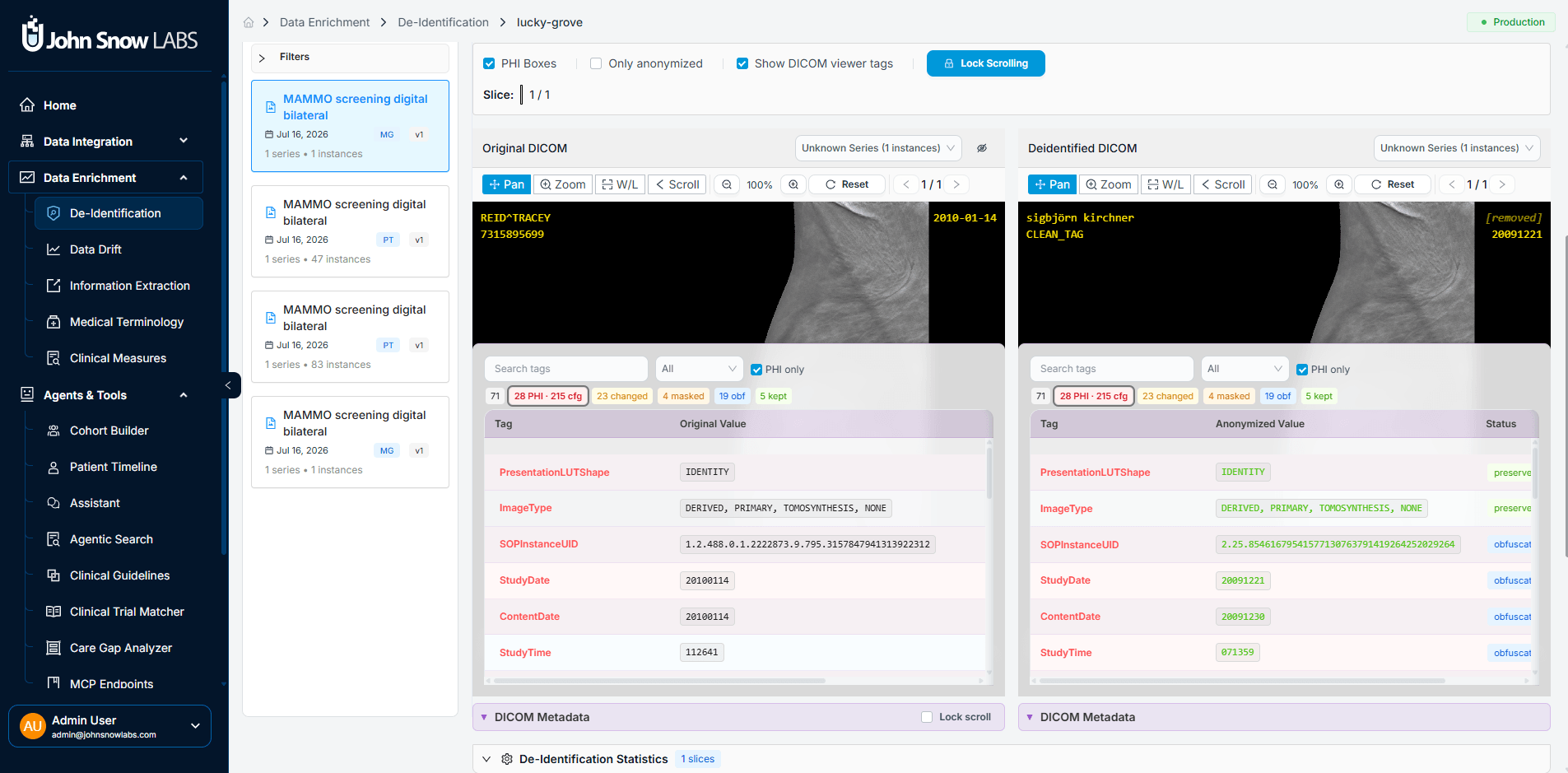
Redact burned-in PHI using intelligent pixel inpainting with complete metadata de-identification. Handles all DICOM modalities and saves back to DCM with image utility intact.

Structured Data & Databases

De-identify PHI from structured datasets automatically while enforcing GDPR and HIPAA compliance and maintaining clinical linkage across files, at millions of records.

Link All Data About Each Patient

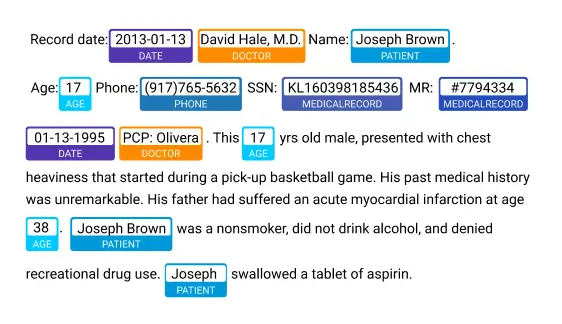
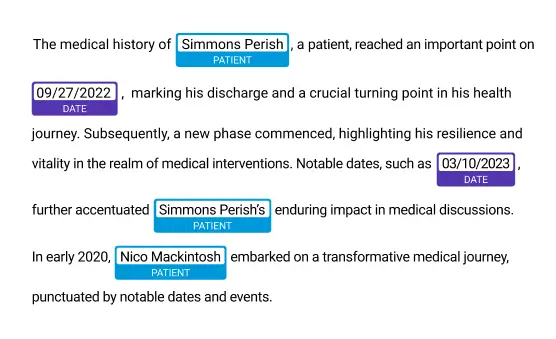
Masking gives you [PATIENT] and [DATE] which is safe but useless.
Make sure de-identified data stays usable instead.

Consistent Tokenization & Obfuscation

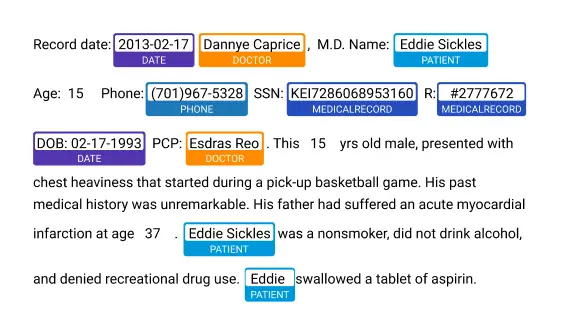
Protect privacy without breaking data relationships. The same individual receives an identical, realistic replacement value across every document, so referential integrity survives for research and analysis.

Original text annotated
Obfuscated text annotated
  • Deterministic
  • Cross-modal
  • Referential integrity

Link Multimodal Patient Data Over Time

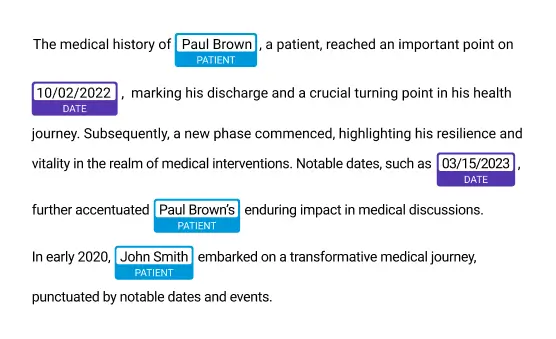
Maintain patient context across longitudinal records. Intelligent date shifting preserves temporal relationships, narrative continuity and linkability between notes, images and tables.

Original text annotated
Obfuscated text annotated
  • Date shifting
  • Temporal integrity
  • Multimodal linkage
HIPAA Expert Determination

Get an Expert Determination

We can evaluate and certify your de-identified dataset or pipeline: profile quasi-identifiers, compute k-anonymity risk, apply the least destructive mitigation, and produce full HIPAA Expert Determination documentation.
We perform it

Two analytical phases, both reproducible

Phase one scores the pipeline against a held-out Golden Set, held to a 0.94 PHI recall bar — the accuracy of a two-reviewer human process. Phase two measures the output: k-anonymity, l-diversity, t-closeness and prosecutor risk across several configurations.

You receive it ready

A signed report and the notebooks behind it

A formal report – credentials, methodology, metrics and the certifying statement — plus both executable notebooks, so your team can re-run the assessment whenever the data or the pipeline changes. No black boxes.

De-identify clinical text in multiple languages

Clinical documents de-identified at regulatory-grade accuracy across jurisdictions — with above 98% coverage of sensitive data reported across seven European languages, out of the box.
US

English

GB

English

ES

Spanish

FR

French

DE

German

IT

Italian

PT

Portuguese

NL

Dutch

RO

Romanian

SA

Arabic

Customizable for your unique requirements

Healthcare organizations have diverse data formats, custom identifiers, and specific compliance needs. Our solution flexibly adapts to your workflow – not the other way around.
Custom Entity Recognition

Define and train models to recognize your organization’s specific identifiers:

  • Internal patient ID formats
  • Custom medical record numbering
  • Facility-specific codes
  • Department identifiers
  • Study participant IDs
Flexible Policies

Configure granular policies that balance data utility with privacy protection:

  • Obfuscate names with realistic fakes
  • Mask specific fields with asterisks
  • Shift dates while preserving intervals
  • Generalize locations (city → state)
  • Tokenize for consistent linkage
Format-Specific Processing

Native support for every healthcare document format, preserving structure and content:

  • Custom PDF templates and forms
  • Proprietary EHR exports
  • Legacy system formats
  • Complex table layouts
  • Embedded images and charts
Regulatory Compliance

Configure policies to meet your regulatory requirements:

  • HIPAA Safe Harbor
  • HIPAA Expert Determination
  • GDPR compliance ready
  • CCPA and state privacy laws
  • Custom regulatory frameworks
Enterprise Integration

Seamless integration into your existing tech stack with robust API access:

  • RESTful API Integration
  • Real Time Processing
  • Batch Processing
  • Horizontal Scaling & High availability
  • Full Audit Logs and Monitoring
Enterprise Security

Secured solution with multiple deployment options for any security posture

  • End-to-end Data Encryption
  • On-premise or Cloud Deployment
  • Air-gapped Environments
  • Zero Data Retention by Default

Peer-reviewed, state-of-the-art accuracy

Can Zero-Shot Commercial APIs Deliver Regulatory-Grade Clinical Text DeIdentification?
Accepted at Text2Story Workshop at ECIR 2025
Beyond Accuracy: Automated De-Identification of Large Real-World Clinical Text Datasets
Machine Learning for Health (ML4H) 2023
Accurate Clinical and Biomedical Named Entity Recognition at Scale
Software Impacts, July 2022
Learn More

Watch real-world de-identification challenges solved

How healthcare teams tackle complex PHI removal — from messy clinical notes to billion-record databases, scanned PDFs to multimodal processing.
Powered by

The same products your teams already license

Available on the AWS, Azure, Snowflake and Databricks marketplaces, so the pipeline runs next to data you cannot move.

Learn more

Live demo

Paste a note in the browser and see the output.

Pipeline stages, entity coverage, configuration options.

The pre-trained de-identification pipeline, one click, your data.

Public annotations and scoring code — reproduce every number.

Try it on your own data

Run the pre-trained pipeline in a Colab notebook, or bring us a sample and we will show you the accuracy on your documents.

Frequently asked questions

No. The pipeline runs in-place inside Databricks, Snowflake, Azure, AWS, your own datacenter, or an air-gapped network. Processing happens in memory, with zero data retention by default.

Yes — the full process, including statistical risk analysis, auditable validation and the legal documentation, alongside Safe Harbor if that is your standard.

Yes. Tokenization is deterministic: identical PHI produces identical tokens across notes, PDFs, DICOM, tables and FHIR. Date shifting preserves intervals, so longitudinal analysis holds.

De-identifying transforms PHI; it does not by itself produce the statistical evidence HIPAA's Expert Determination method requires. That gap is what a formal report closes — and it is what unblocks legal, IRB and ethics review the next time you share data.

Both are supported. Safe Harbor's 18 categories are fully automated in the pipeline. Expert Determination is the right standard when you obfuscate rather than mask, because the question shifts from "did you remove the fields" to "what are the statistical properties of the output".

Fixed licensing rather than per-token pricing, and CPU inference at billion-record scale — reported at 80%+ below API-based alternatives, with predictable cost as volume grows.

Yes. The pipeline has been deployed for de-identification projects across four continents, each under its own privacy law — GDPR and national implementations in Europe, HIPAA in the United States, and equivalent regimes in the Middle East, Africa and Australia. Identifier sets, date-shifting rules, surrogate generation and retention policies are configured per jurisdiction, and because everything runs inside the customer's own environment, data residency requirements are met by default.

preloader