

















was successfully added to your cart.

State of the Art Clinical Data Curation

Transform unstructured clinical notes, pathology reports, and medical images into structured, actionable insights. Our healthcare-specific language models deliver document-level and patient-level data curation with regulatory-grade accuracy.

Trusted by Leading Healthcare Organizations
Leveraging Healthcare NLP Models in Regulatory Grade Oncology Data Curation
Advancing drug safety research by extracting real-world data from EHR clinical notes using NLP and machine learning
Identifying mental health concerns, subtypes, temporal patterns, and differential risks among children with Cerebral Palsy using NLP on EHR data
Using Generative AI for Data Extraction Clinical Support
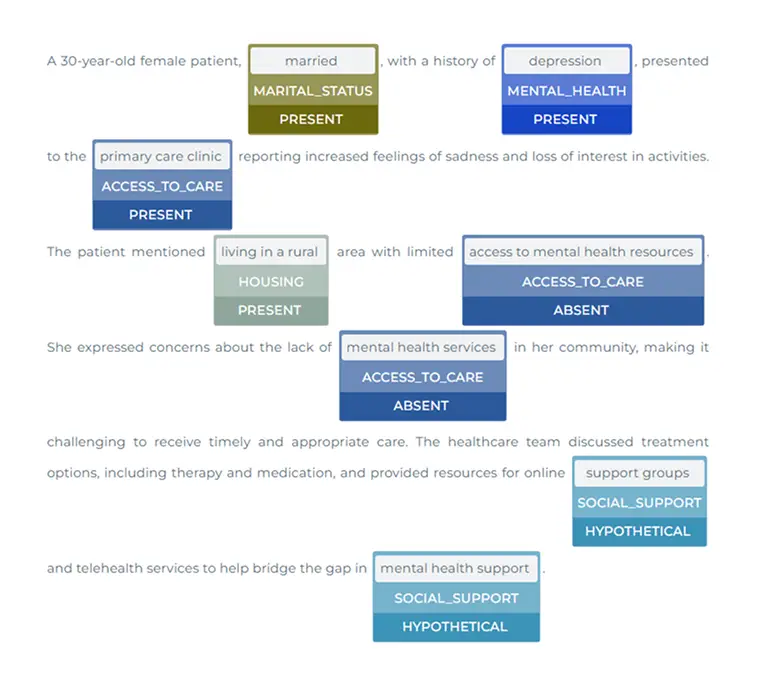
Identifying Housing Insecurity and Other Social Determinants of Health from Free-Text Notes
Transforming 200M+ clinical notes into research-ready data with de-identification, extraction, and coding at enterprise scale

State-of-the-Art Accuracy

Performance metrics validated on industry benchmarks and real-world clinical data
>99%

De-identification
Accuracy

>95%

Oncology NER F1 Score

>92%

SDOH Extraction
Accuracy

2,800+

Pre-trained Models

Validated by leading institutions: Our models have been benchmarked against public datasets (n2c2, i2b2) and validated in production deployments at Mayo Clinic, Stanford Medicine, and Roche Diagnostics.

We Train Our Own Language Models, Purpose-Built for Healthcare

Unlike general-purpose LLMs, our models are trained exclusively on clinical data for
healthcare-specific accuracy and compliance
Fewer Errors, Higher Accuracy

Healthcare-specific training from the ground up means our models understand medical context, abbreviations, and clinical patterns that general LLMs miss. No hallucinations on critical medical data.

Deterministic & Reproducible

Unlike probabilistic general-purpose LLMs, our models deliver consistent, reproducible results every time - essential for regulatory compliance and clinical decision support.

Runs in Your Private Environment

Deploy on-premise, in your VPC, or air-gapped environments. No data leaves your infrastructure. Full HIPAA and GDPR compliance with complete data sovereignty

Cheaper Inference, No GPU Required

Our efficient models run on commodity hardware with no GPU required for inference. Process millions of documents at a fraction of the cost of API-based LLMs.

Patient-Level Reasoning & Longitudinal Analysis

Build comprehensive patient timelines across multiple encounters. Track disease progression, treatment responses, and outcomes over time - essential for cancer registries, clinical trials, and longitudinal research.

Specialty-Specific Models, Out of the Box

Each medical specialty gets dedicated models trained on domain-specific data. Deploy production-ready oncology, cardiology, or mental health models immediately without custom training.

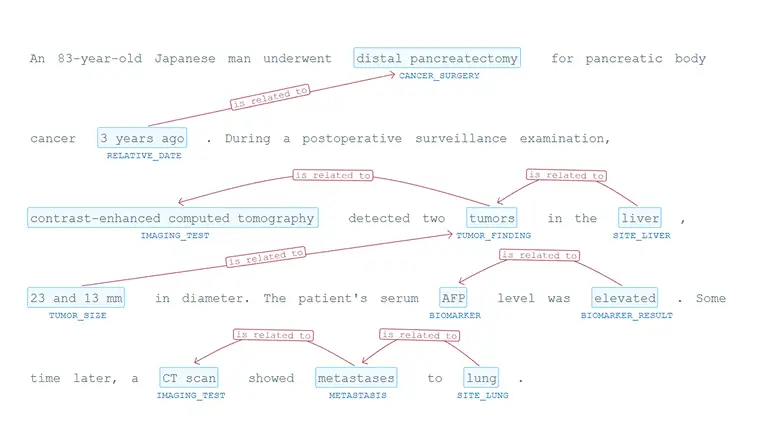
Oncology Models that Understand Everything on Cancer

Extract 40+ specialized oncology entities, from tumor classifications to treatment regimens, with regulatory-grade accuracy.

Capturing the complete cancer journey from diagnosis to outcome:

  • Histological types and tumor classifications
  • Cancer staging (TNM, pathological, clinical)
  • Biomarkers and genetic mutations
  • Treatment regimens and chemotherapy cycles
  • Diagnostic tests and procedures
  • Metastasis sites and progression events
Leveraging healthcare NLP models in regulatory-grade oncology data curation to enhance abstraction efficiency and data quality.
Unlocking insights from 1.4M+ physician notes with NLP and LLMs, achieving 93% F1 score for entity extraction and enabling clinical trial matching.
Harnessing causality and clinical knowledge to enable personalized cancer treatment decisions with transparent, patient-specific AI.
Building oncology patient timelines and matching patients with NCCN clinical guidelines using healthcare-specific LLMs.

Mental Health & Behavioral Analytics

Extract critical mental health indicators to improve patient safety, risk assessment, and care outcomes.

Capture 50+ specialized entities from psychiatric notes, therapy sessions, and behavioral health records, including:

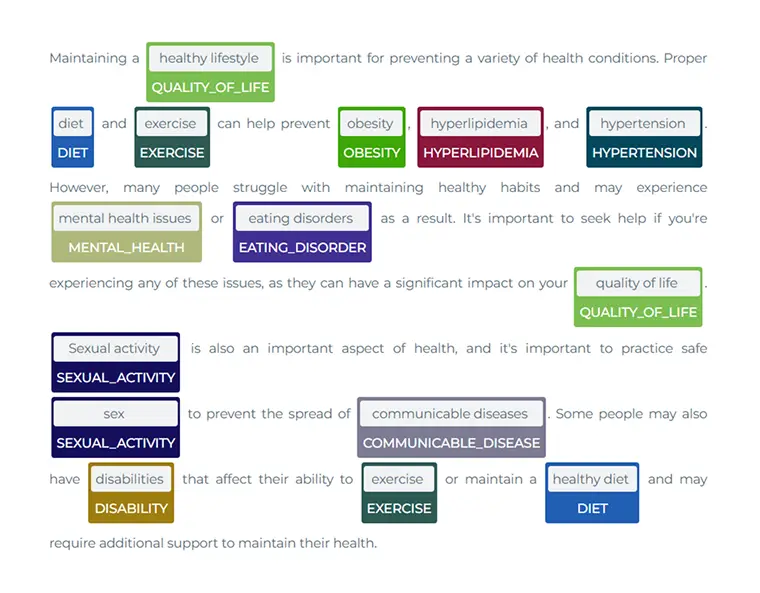
  • Diagnoses & Conditions: Depression, anxiety, PTSD, bipolar disorder, schizophrenia, OCD, eating disorders
  • Risk Indicators: Suicide ideation, self-harm behaviors, violence risk, substance abuse patterns
  • Symptoms & Behaviors: Mood changes, sleep disturbances, hallucinations, delusions, panic attacks
  • Treatment & Response: Medications, therapy types, treatment adherence, clinical outcomes
  • Social Factors: Family history, trauma exposure, social support, housing stability
Identifying opioid-related adverse events from unstructured text in electronic health records using rule-based algorithms and deep learning methods.
Advancing drug safety research for the FDA by extracting real-world data from EHR clinical notes using NLP and machine learning. The MOSAIC-NLP project links unstructured and structured data to improve pharmacoepidemiology studies.
Identifying emotional states and stressors of patients at different stages of disease journeys by analyzing social media conversations using NLP to uncover patient challenges and improve care strategies.
Identifying specific mental health phenotypes and risk factors in children with cerebral palsy by extracting 80+ clinical entities from 50 million EHR notes using NLP. Early detection models and personalized care insights improve outcomes for developmental and neurological conditions.

Social Determinants of Health (SDOH)

Identify social factors impacting health outcomes, readmissions, and care equity.

Our models detect 40+ social determinant categories:

  • Housing stability and homelessness
  • Food insecurity and nutrition access
  • Transportation barriers
  • Financial hardship and employment status
  • Education level and health literacy
  • Social support networks and isolation
  • Violence, abuse, and trauma exposure
  • Access to care and insurance status

Published Research & Validation

Our SDOH models have been validated in peer-reviewed research and deployed in production healthcare systems
Extracted 60,717 SDOH factors from 13,258 oncology documents with 0.88 F1 score accuracy, outperforming benchmark models by 5% in extracting 13 SDOH categories.
Population health analytics for veterans using SDOH extraction to reduce emergency visits and improve care coordination.
Identifying housing insecurity and social determinants from free-text clinical notes with >90% F1 score.

Advanced Medical Coding & Terminology Mapping

100+ pre-trained entity resolution models mapping clinical concepts to standard terminologies with accurately and consistently.

Our specialized models map clinical concepts to 15+ standard medical terminologies:

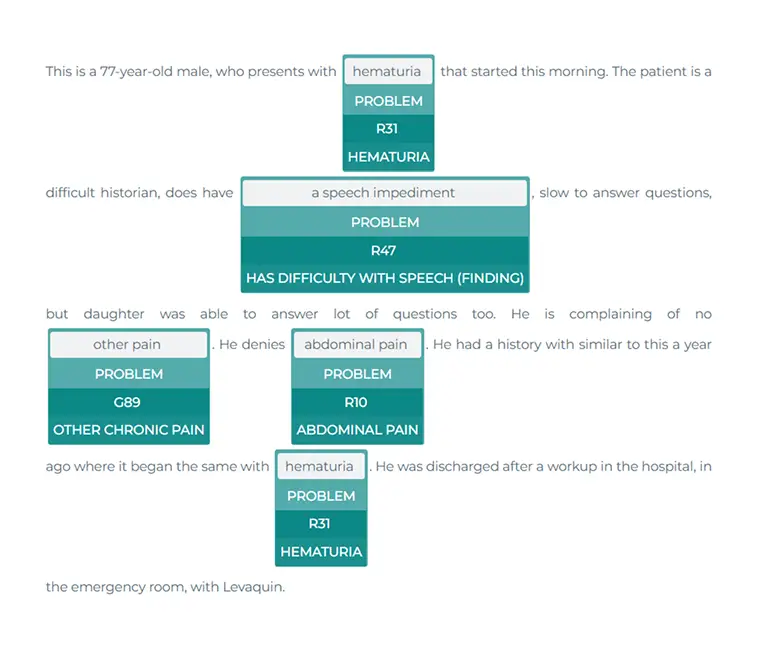
  • ICD-10-CM: Diagnoses and conditions
  • SNOMED-CT: Clinical findings and procedures
  • RxNorm: Medications and drug classes
  • CPT: Clinical procedures
  • LOINC: Laboratory tests and observations
  • NDC: National Drug Codes
  • MedDRA: Adverse events and safety reporting
  • UMLS CUI: Unified medical concepts
  • HPO: Human phenotype ontology
  • MeSH: Biomedical literature indexing
  • ICD-O: Oncology morphology and topology

Try It Yourself

Explore 300+ live demos and interactive notebooks
Oncology

Extract cancer types, staging, biomarkers, and treatments from pathology reports and clinical notes.

Check Demos →
Mental Health

Identify psychiatric diagnoses, substance use, and mental health indicators from clinical documentation.

Check Demos →
Social Determinants

Extract housing, employment, education, and social support information from free-text notes.

Check Demos →
Diagnoses & Procedures

Identify diagnoses, procedures, symptoms, and their assertion status (present, absent, uncertain) from clinical documents.

Check Demos →
Radiology

Extract anatomical locations, imaging findings, and observations from radiology reports with assertion status.

Check Demos →
Drugs & Adverse Events

Identify medications, dosages, adverse drug reactions, and drug-event relationships from clinical text.

Check Demos →
Labs, Tests & Vitals

Detect laboratory results, vital signs, test names, and clinical measurements from medical records.

Check Demos →
Medical Coding

Map clinical entities to ICD-10, SNOMED CT, RxNorm, and other standard terminologies.

Check Demos →
Risk Factors & HCC

Calculate Medicare HCC risk scores and identify clinical risk factors for value-based care programs.

Check Demos →

Ready to Transform Your Clinical Data?

Schedule a personalized demo to learn how you can deploy best-in-class automated clinical data abstraction at scale.

preloader