


















was successfully added to your cart.

Patient Journey Intelligence Platform

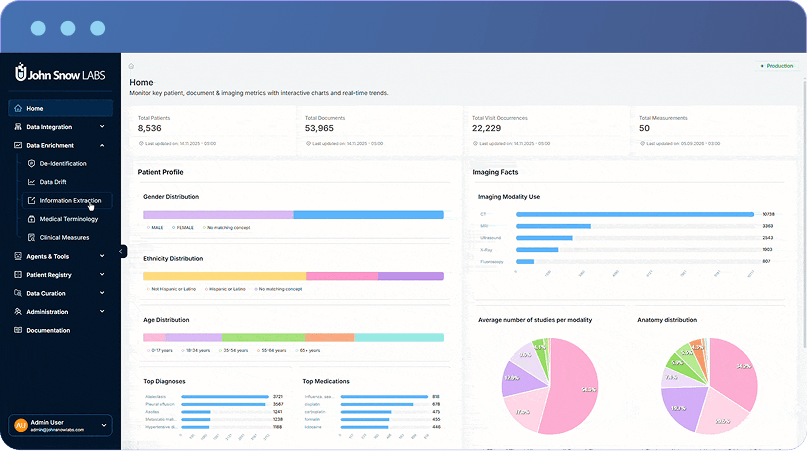
Messy in. Trusted out.Ingest any multimodal patient data (PDFs, notes, FHIR, DICOM, EHR). Get a unified, de-identified OMOP dataset with normalized data, resolved conflicts, and built-in confidence and provenance.

Unified foundation for secondary use. Power cohort building, AI agents, patient registries, and clinical research on top of trusted, enriched, standardized patient records.
Why Us

Regulatory-grade accuracy,
independently verified

Every capability on this platform is peer-reviewed and production-proven
with output that holds up in front of an auditor or a regulator.
99%+

de-identification accuracy,
blind-tested across 2 billion notes

96%+

Medical Information
Extraction Accuracy

98%

entity coding to standard
terminologies

#1 Customer Value Leadership Award
Healthcare Large Language Models

Trusted by leading healthcare organizations

THE CHALLENGE

Why your patient data is incomplete

Even in modern EHRs, critical patient information is buried in unstructured clinical notes and inaccessible.
Structured Fields Are Dangerously Incomplete

Even the data you trust from structured EHR fields has critical gaps that silently compromise research quality — disease severity (NYHA class, tumor grade), treatment response (adherence, effectiveness), functional status (ECOG score, mobility), etc.

See the details →
Most Clinical Context Exists Only in Notes

The most valuable clinical information—treatment rationale, symptom severity, functional status, patient preferences—exists exclusively in unstructured clinical narratives. Without a complete, multimodal patient journey over time, you operate on distorted inputs.

See the details →
Data Integration Is Prohibitively Complex

Combining data from disparate EHR systems, claims databases, pharmacy records, and lab interfaces results in incompatible formats, duplicate entries, conflicting or inconsistent information, all requiring specialized clinical expertise to resolve.

See the details →

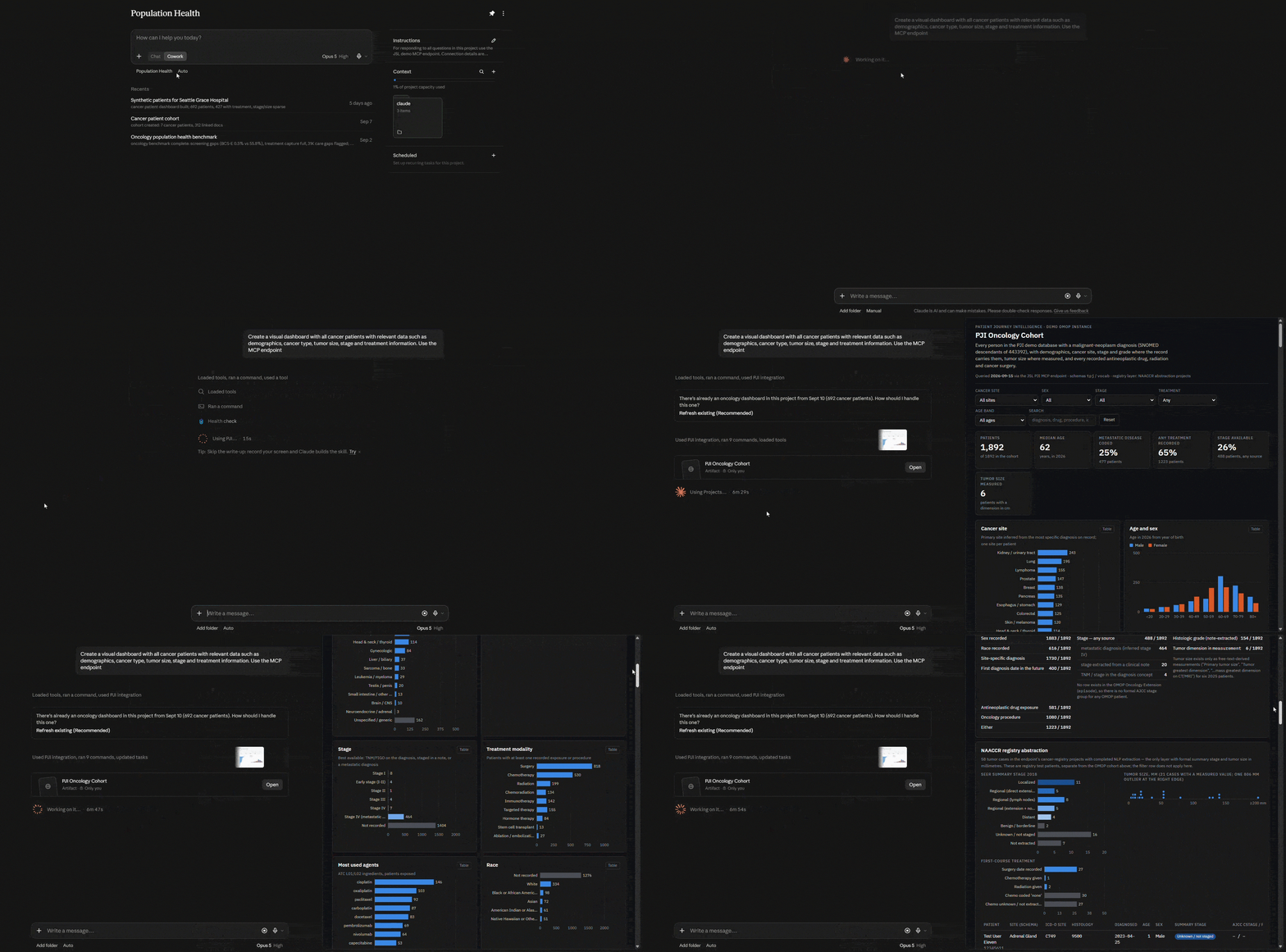
Prepare clinical data for AI agents

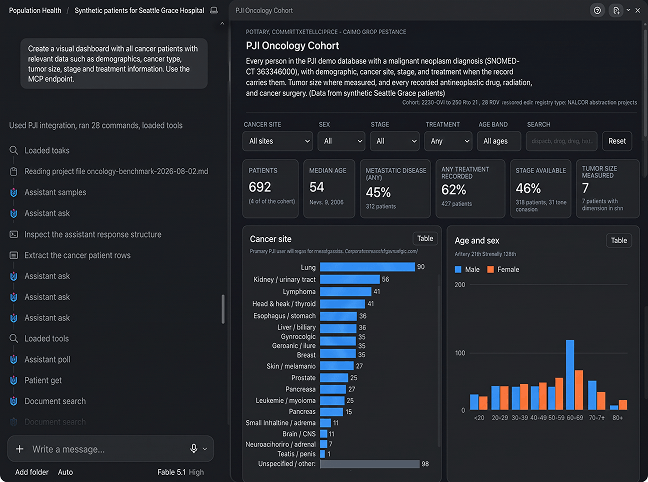
Agents inherit a governed, provenance-tracked OMOP foundation through MCP, REST
and SQL – instead of raw exports. Bring your own LLM without giving up governance.
Patient Journey Intelligence
MCP
Secure, governed access
  • Query
  • Retrieve
  • Analyze
  • Visualize
Natural language. Real insights
01
Cohort discovery

Find the right patients across real-world data

02
Patient-level evidence

Grounded in registry-grade data

03
Interactive dashboards

Turn insights into impact

Prebuilt AI agents

Ready-to-use agents and applications on top of the unified, OMOP-standardized data foundation.

Care-Gap Analyzer

  • The LLM narrates; SQL decides the clinical facts. Guidelines become discrete interventions, resolved to OMOP concept IDs and checked deterministically against patient records.
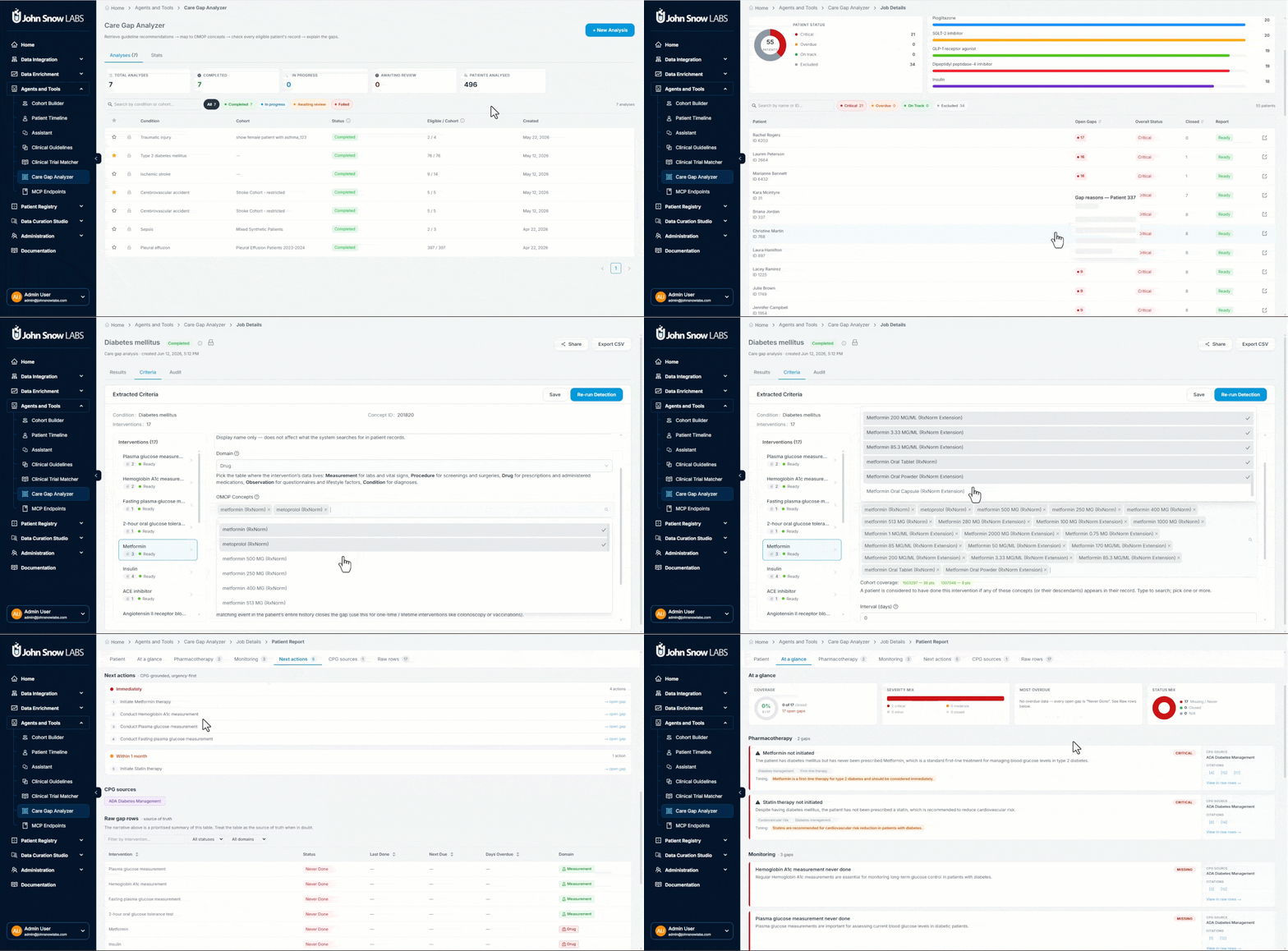
  • Four statuses: Closed, Never Done, Overdue, Excluded. Each traced to guideline and record.
  • Population-level dashboards expose adherence gaps at scale.
  • HEDIS
  • Care gaps
  • Clinical Guidelines
  • Clinical Measures
  • Automatic Analysis

Learn more

Matching Patients to Clinical Trials

  • Protocol to screened cohort in seconds, evaluated against each patient’s complete OMOP gold record.
  • Criteria OMOP cannot express route to a human reviewer instead of being silently resolved.
  • Every match traces back to its source note on the platform’s own audit trail.
  • Screening
  • Eligibility
  • Automatic Criteria Detection

Learn more

Intelligent Cohort Creation

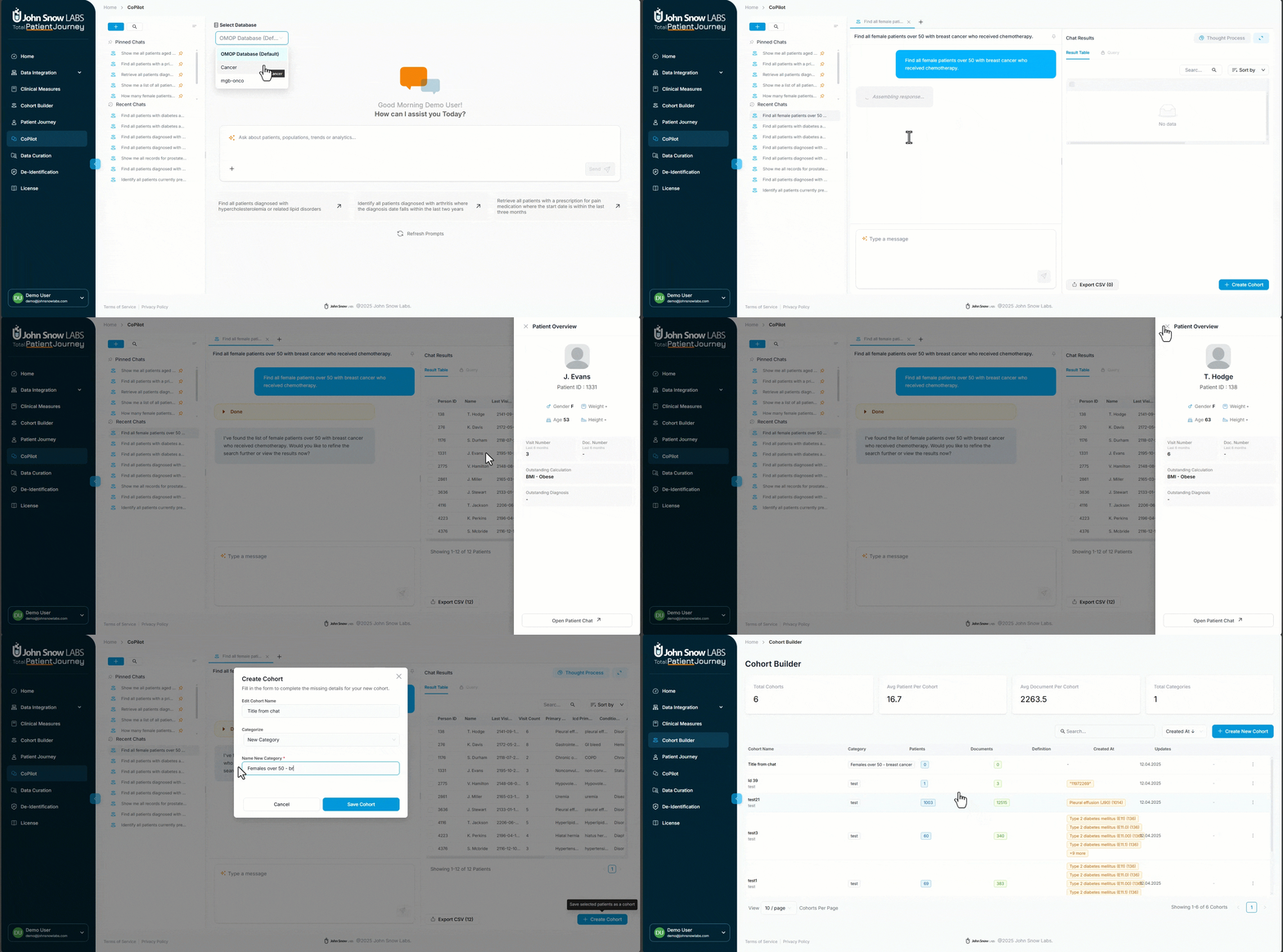
  • Plain-English queries across every clinical data source: “diabetes patients who started metformin in 2023 with HbA1c > 8”.
  • Inclusion and exclusion rules combining diagnoses, medications, lab values, procedures and note context.
  • Real-time results — candidates in minutes instead of months.

Learn more

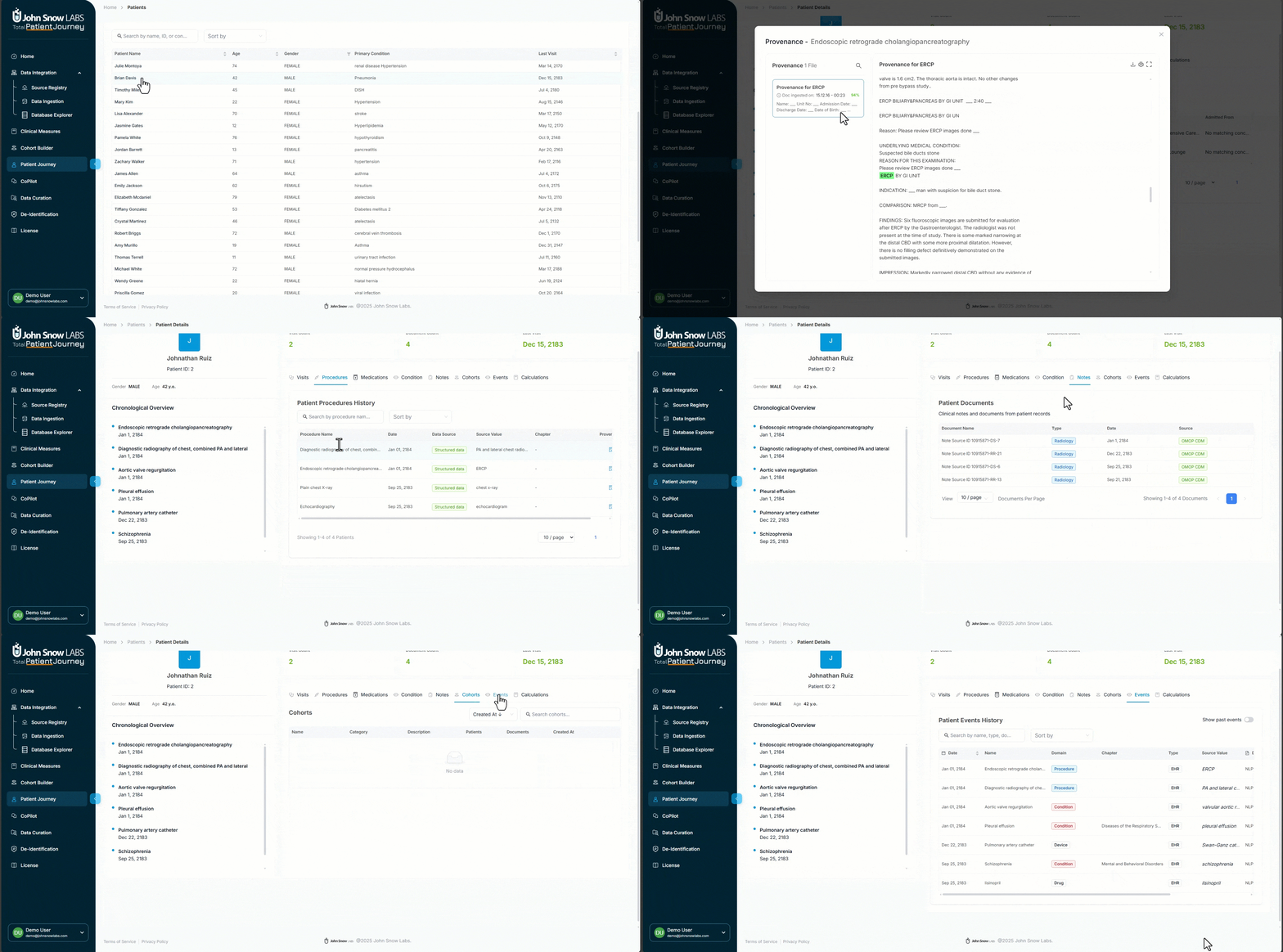
Complete Patient Timelines

  • Years of care assembled automatically across every encounter and data source.

  • Diagnoses, medications, procedures, lab trends and outcomes on one chronological axis.
  • Treatment rationale, response patterns and outcome trajectories visible at every point.

Learn more

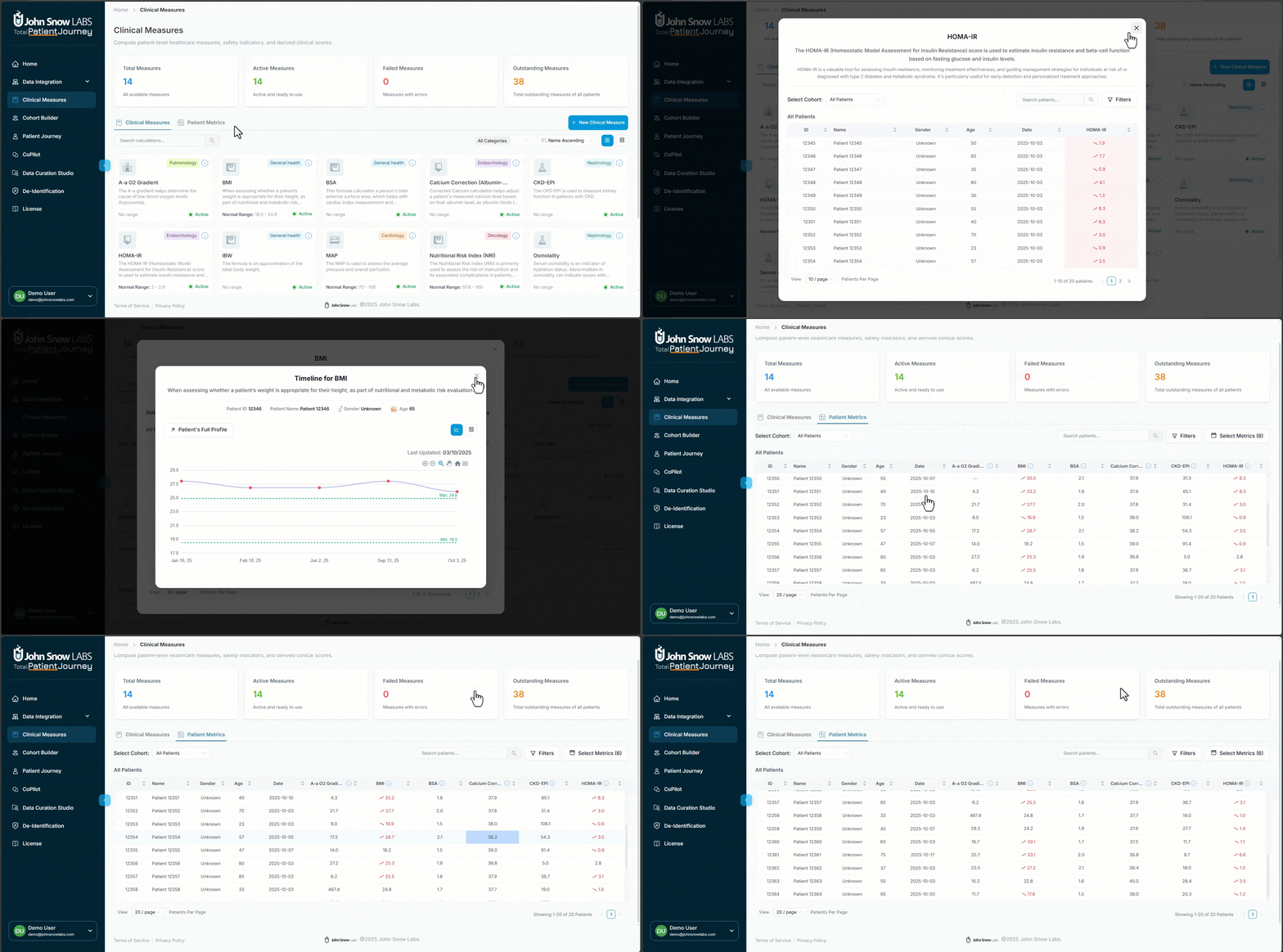
Clinical Measures

  • Built-in validated calculations – BMI, BSA, CKD-EPI, HOMA-IR, MAP, osmolality and dozens more.
  • HEDIS, CMS quality measures and research endpoints computed from unified OMOP data.
  • Custom measures defined once, computed across the whole population.

Learn more

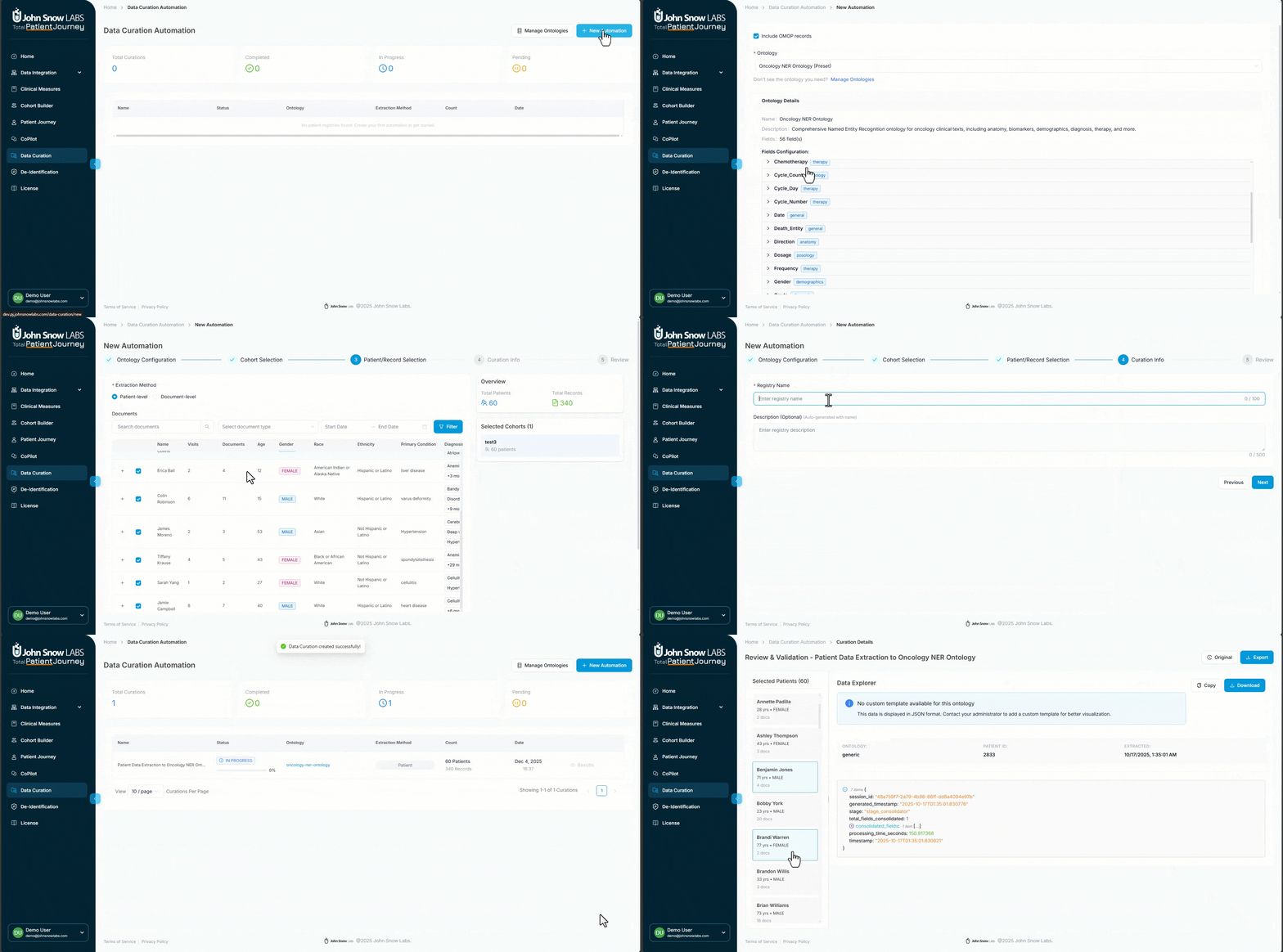
Automated Patient Registries

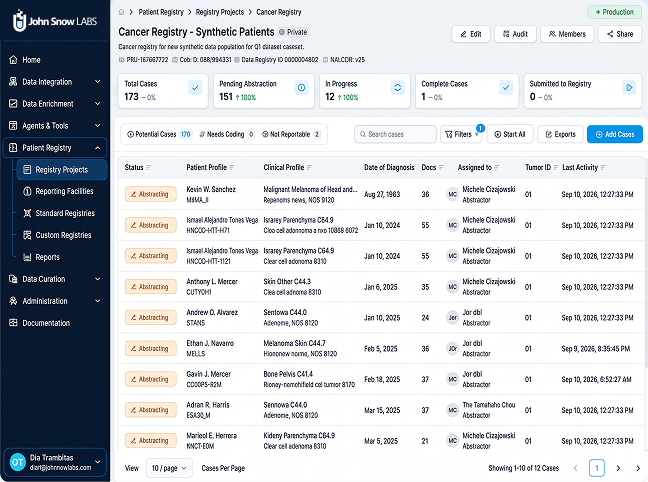
  • 700+ NAACCR data items extracted automatically, cutting per-case abstraction time 10x.
  • Continuous case finding across EHR, notes, pathology, imaging and treatment orders.
  • Registrars validate by exception; value, confidence and source evidence side by side.
  • Edits checks built in.
  • Export NAACCR ready XML or JSON.
  • NAACCR v25
  • AJCC TNM
  • ICD-O-3
  • SEER
  • CoC
  • HITL Validation
  • Custom Registries

Learn more

Extend the platform

Build your own AI agents

The same standardized data foundation that powers John Snow Labs’ agents
is available to you; build specialized clinical applications on top of it.
Build like
we do

The same curated, standardized foundation behind our own agents; no data engineering pass of your own.

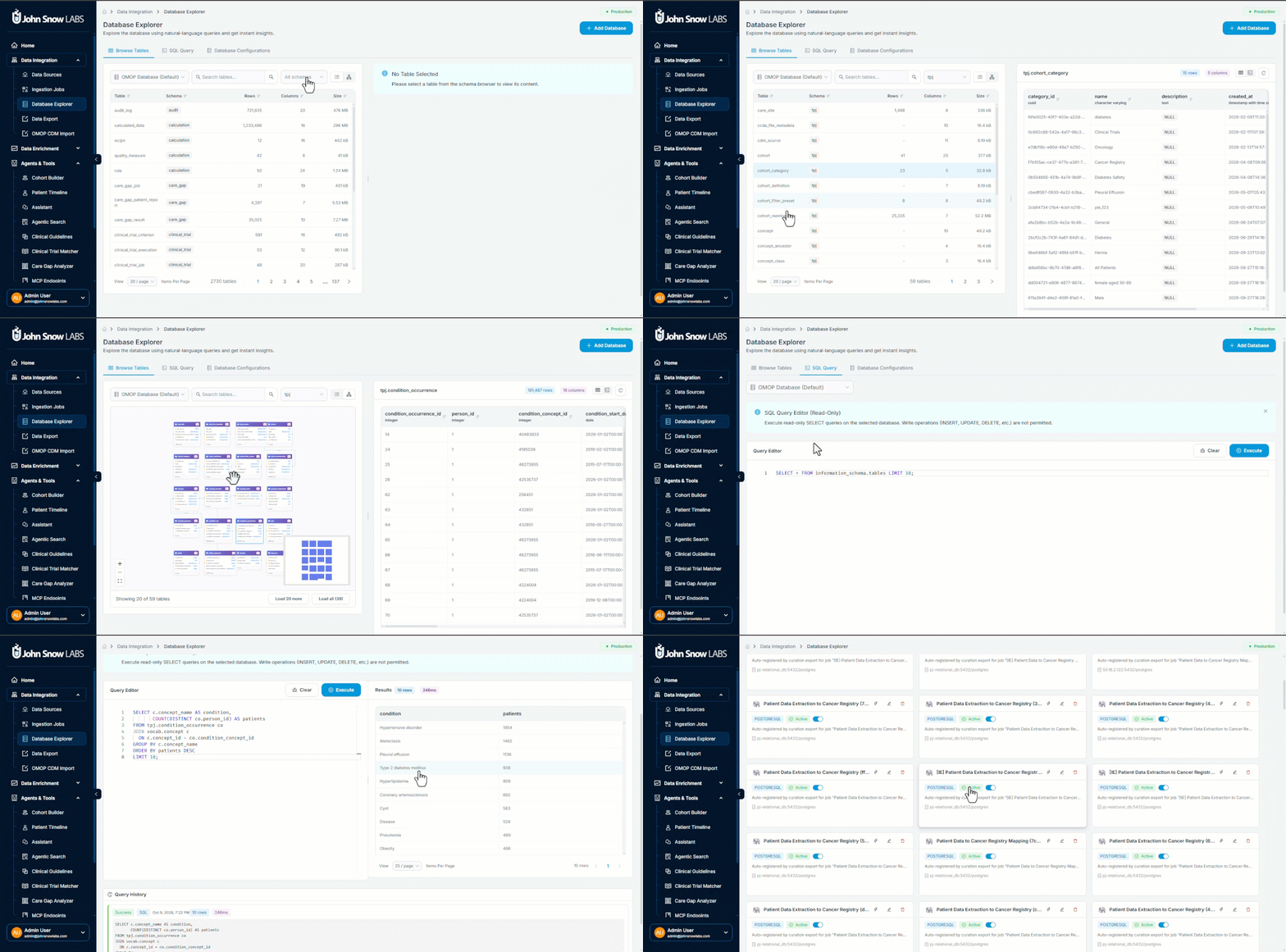
Direct access to curated data

Standard SQL against OMOP CDM tables: de-identified, conflict-resolved, scored.

Your infrastructure, your control

Data and agents stay inside your security perimeter, with access controls and audit logs intact.

Enterprise-ready by default

Open standards, major cloud providers and the agentic framework of your choice.

Build the unified foundation for secondary use

Cohorts in plain language, longitudinal timelines, and synchronized identified / de-identified OMOP
twins – with provenance behind every answer.
Ingest any source & modality
Extract from notes
Harmonize & code
Reason & score
De-identify
Serve to agents

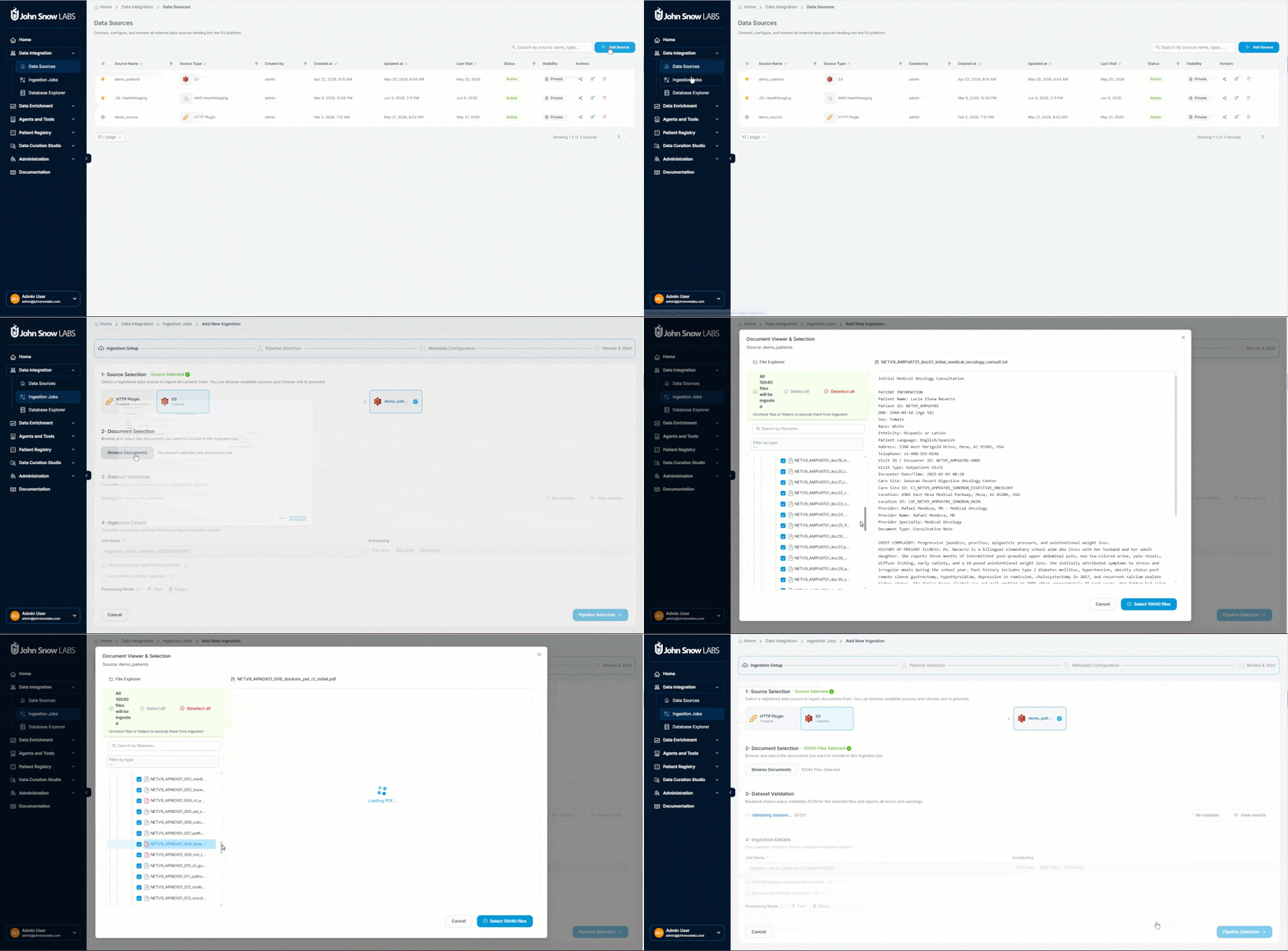
Ingest Any Source & Modality

  • Multi-modal data ingestion – clinical notes, lab reports, imaging studies, claims data, HL7 messages, FHIR, JSON, CSV and structured EHR exports through a single pipeline.
  • Data handled as-is – no extensive preprocessing, regardless of format or structure.
  • Eliminate integration complexity – fragmented systems unified into one coherent clinical data warehouse inside your infrastructure.

Data Integration docs →

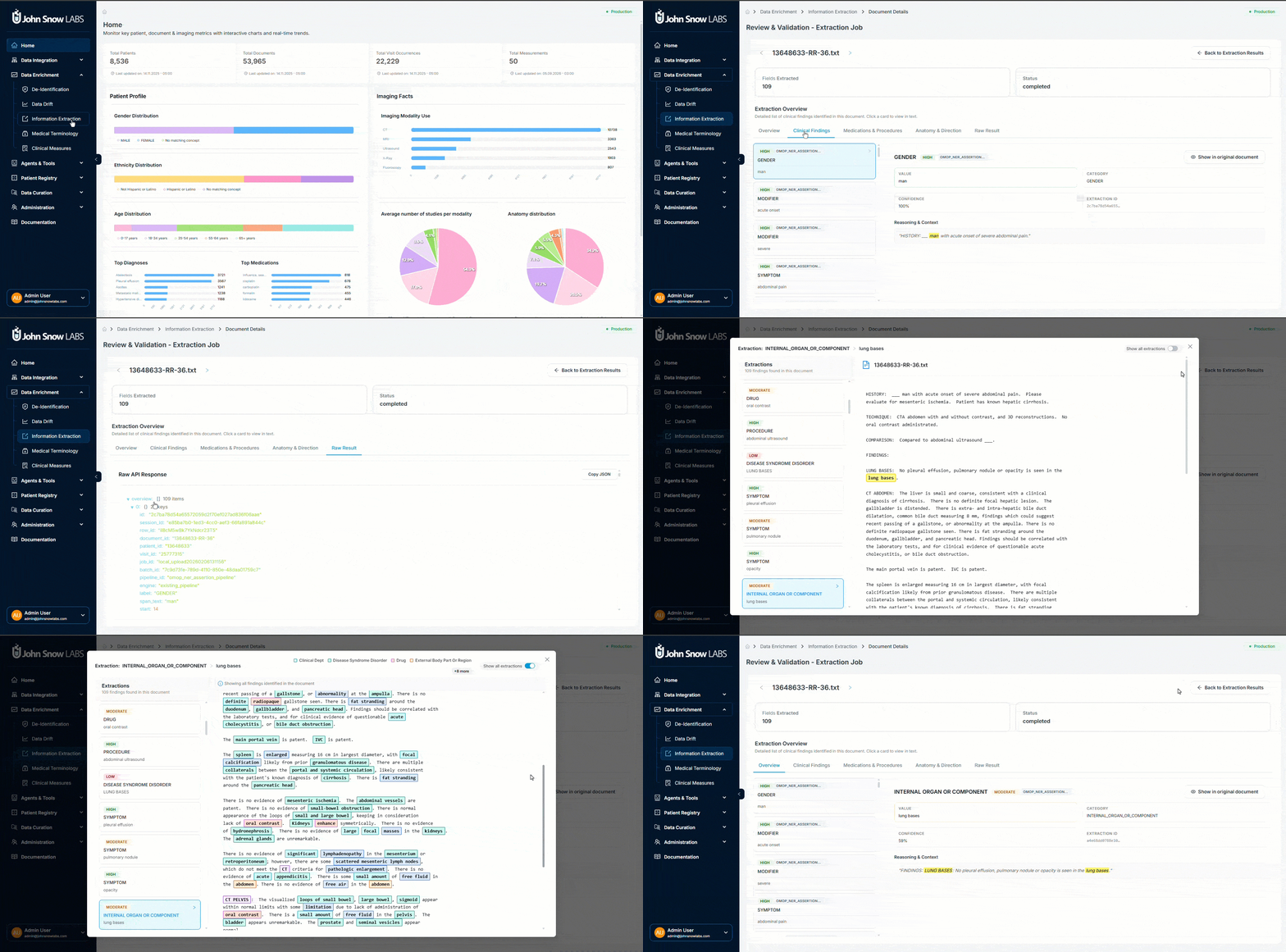
Extract From Notes

  • Clinical NLP extraction – 400+ medical entities identified in unstructured text: diagnoses, medications, procedures, lab results and clinical measurements.
  • Capture clinical context – temporal relationships, severity indicators, negations and patient-specific context that structured fields never capture.
  • Reach the hidden 40% – the clinical context that exists only in free text becomes queryable data.

Data Curation Studio docs →

Harmonize & Code

  • Standardize to OMOP – disparate sources become OMOP CDM v5.4, ready for OHDSI analytics, BI tools and AI frameworks.
  • Map to standard terminologies: automatic mapping to SNOMED CT, ICD-10, RxNorm and LOINC.
  • Continuously updated – patient journeys extend as new clinical documents arrive, not at export time.

Data Integration docs →

Reason & Score

  • Automatic conflict resolution – contradictory information across EHR systems, notes and external sources reconciled with clinical reasoning, keeping both supporting and contradictory evidence.
  • Confidence scoring – every extracted fact carries a confidence level, so you know what is reliable.
  • Complete provenance – every clinical fact traced to source document, line number and extraction timestamp – a full audit trail.

Governance docs →

De-Identify

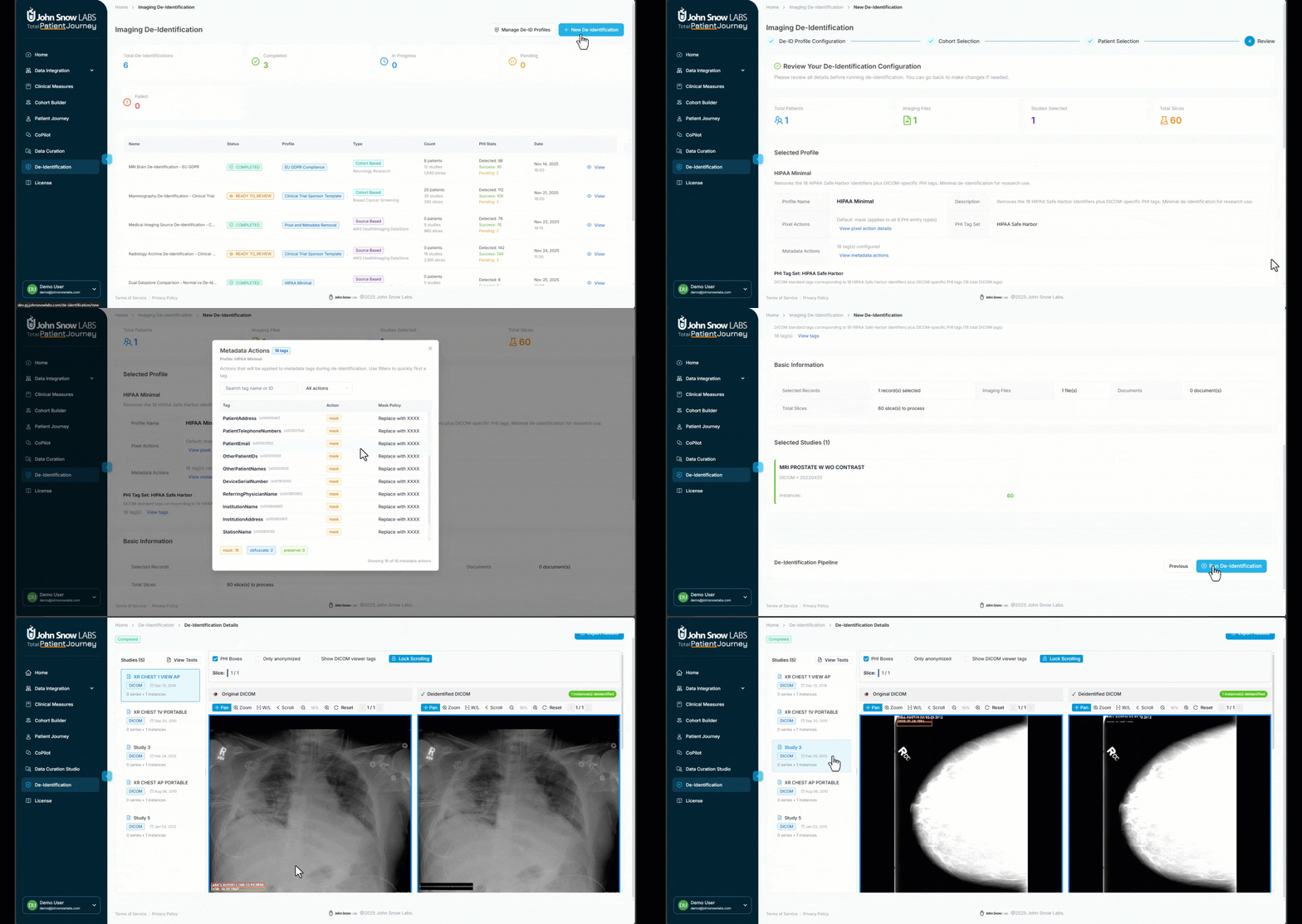
  • Multi-format de-identification – PHI removed from clinical notes, pathology reports, claims data and structured EHR fields, at patient or document level.
  • DICOM de-identification – burned-in PHI stripped from medical images while diagnostic quality and DICOM metadata integrity are preserved.
  • Validated 99%+ accuracy – independently tested by Providence Health against human expert reviewers for HIPAA-compliant de-identification.

De-identification docs →

Serve To Agents

  • Model Context Protocol – extraction, cohort queries, timelines and registry abstraction exposed as MCP tools that agents discover automatically.
  • REST and SQL access – query the curated OMOP CDM tables directly, under the same governance.
  • Your perimeter – agents run inside your security boundary with your access controls, audit logs and compliance policies intact.

Agents & Tools docs →

Recognized for innovation & impact

John Snow Labs is trusted and recognized by industry leaders and independent organizations.
2026
ACQ5 Global Awards
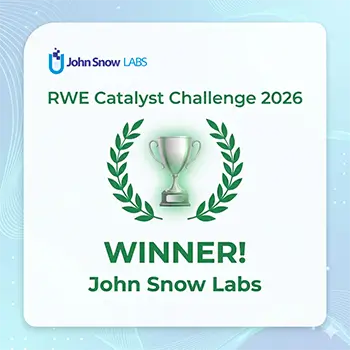
RWE Catalyst Challenge
2025
ACQ5 Global Awards 2025
2025
Best Healthcare AI Application
Global 100 Award
2025
Best Use of AI for Healthcare
AI Awards 2025

Customers and deep dives

Multimodal data for
secondary use on Patient Journey Intelligence
200M+ clinical notes
transformed into research-ready data
From raw data to agentic workflows: a deep dive into Patient Journey Intelligence
Every answer carries its evidence — that is what makes the output usable in a regulated setting
Powered by

The same products your teams already license

Available on the AWS, Azure, Snowflake and Databricks marketplaces, so the pipeline runs next to data you cannot move.

Start with one solution

One foundation deployment inside your infrastructure. Every solution after that is configuration, not a new project.

Frequently asked questions

A secondary-use data platform deployed in your environment that turns multimodal clinical data into identified and de-identified OMOP CDM datasets, with provenance and confidence on every extracted fact.

No. Each solution runs on the same cluster and can be adopted on its own; later solutions start from work already done.

Your cloud, data warehouse, or on-premises Kubernetes. No PHI leaves your perimeter; all models run locally.

Warehouses store what you load. This platform also reads documents, resolves conflicts, keeps both OMOP twins current, and preserves lineage.

preloader