

















Join the Applied AI Summit | Free online conference | October 13-15, 2026
was successfully added to your cart.

Regulatory-grade
Clinical Data Curation

Notes become registries, cohorts and endpoints —
with an evidence span, a confidence score and full
lineage on every value.

Trusted by Leading Healthcare Organizations
Leveraging Healthcare NLP Models in Regulatory Grade Oncology Data Curation
Advancing drug safety research by extracting real-world data from EHR clinical notes using NLP and machine learning
Identifying mental health concerns, subtypes, temporal patterns, and differential risks among children with Cerebral Palsy using NLP on EHR data
Using Generative AI for Data Extraction Clinical Support
Identifying Housing Insecurity and Other Social Determinants of Health from Free-Text Notes
Transforming 200M+ clinical notes into research-ready data with de-identification, extraction, and coding at enterprise scale
Regulatory-grade healthcare AI

State-of-the-art accuracy on real-world data

Peer-reviewed, deterministic and reproducible — the difference between a general-purpose LLM demo and data you can put in a regulatory submission.
>99%

De-identification
Accuracy

>95%

Oncology NER F1 Score

>92%

SDOH Extraction
Accuracy

3,000+

Pre-trained Models

Benchmarked against public datasets (n2c2, i2b2) and validated in production deployments at:

Built for the domains where general models fail

Unlike general-purpose LLMs, our models are trained on clinical data for healthcare-specific accuracy and compliance.
Fewer Errors, Higher Accuracy

Healthcare-specific training from the ground up means our models understand medical context, abbreviations and clinical patterns that general LLMs miss. No hallucinations on critical medical data.

Deterministic & Reproducible

Unlike probabilistic general-purpose LLMs, our models deliver consistent, reproducible results every time — essential for compliance and downstream analytics.

Runs in Your Private Environment

Deploy on-premise, in your VPC, or in air-gapped environments. No data leaves your infrastructure. Full HIPAA and GDPR compliance with complete data sovereignty.

Cheaper Inference, No GPU Required

Our efficient models run on commodity hardware with no GPU required for inference. Process millions of documents at a fraction of the cost of API-based LLMs.

Patient-Level Reasoning & Longitudinal Analysis

Build comprehensive patient timelines across multiple encounters. Track disease progression, treatment responses and outcomes over time — essential for cancer registries, clinical trials and longitudinal research.

Specialty-Specific Models, Out of the Box

Each medical specialty gets dedicated models trained on domain-specific data. Deploy production-ready oncology, cardiology or mental health models immediately without custom training.

Oncology

Complete cancer journey from diagnosis to outcome: 40+ specialized oncology entities,
from tumor classifications to treatment regimens.

Regulatory Grade Accuracy

  • Histological types and tumor classifications
  • Cancer staging (TNM, pathological, clinical)
  • Biomarkers and genetic mutations
  • Treatment regimens and chemotherapy cycles
  • Diagnostic tests and procedures
  • Metastasis sites and progression events

Proven in real-world oncology data curation

Registries, research teams and pharma apply these models to abstract complete cancer journeys at scale — with published accuracy.
Leveraging healthcare NLP models in regulatory-grade oncology data curation to enhance abstraction efficiency and data quality.
Unlocking insights from 1.4M+ physician notes with NLP and LLMs, achieving 93% F1 score for entity extraction and enabling clinical trial matching.
Causality-aware clinical reasoning for personalized cancer treatment, with transparent patient-specific outputs.
Building oncology patient timelines and matching patients with NCCN clinical guidelines using healthcare-specific LLMs.

Behavioral and mental health

Extract events that never get coded: 50+ specialized entities from psychiatric notes,
therapy sessions and behavioral health records.

Covering the 81% at-risk patients missed by ICD codes:

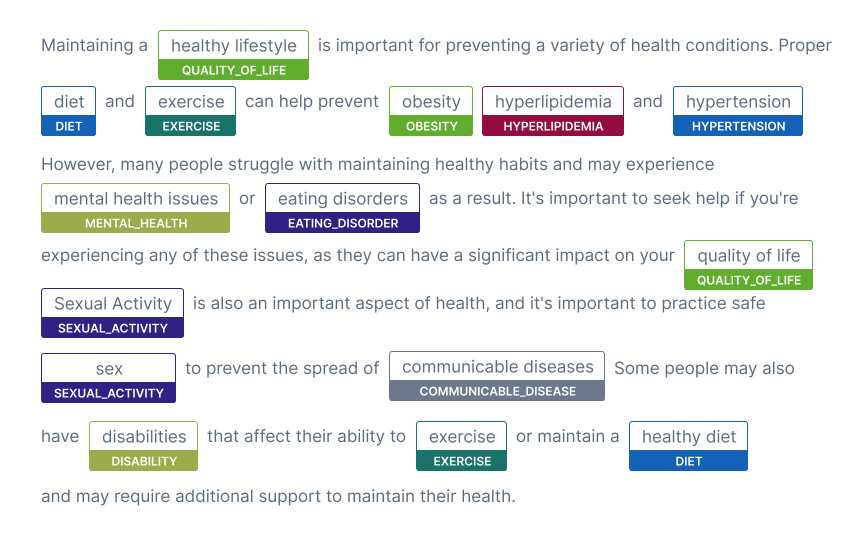
  • Diagnoses & Conditions: Depression, anxiety, PTSD, bipolar disorder, schizophrenia, OCD, eating disorders
  • Risk Indicators: Suicide ideation, self-harm behaviors, violence risk, substance abuse patterns
  • Symptoms & Behaviors: Mood changes, sleep disturbances, hallucinations, delusions, panic attacks
  • Treatment & Response: Medications, therapy types, treatment adherence, clinical outcomes
  • Social Factors: Family history, trauma exposure, social support, housing stability

Deployed in behavioral health research

Regulatory agencies and pediatric health systems use these models to surface mental health signals that structured data never records.
Identifying opioid-related adverse events from unstructured text in electronic health records using rule-based algorithms and deep learning methods.
Advancing drug safety research for the FDA (MOSAIC-NLP project) by extracting real-world data from EHR clinical notes using NLP and machine learning.
Identifying emotional states and stressors of patients at different stages of disease journeys by analyzing social media conversations using NLP.
Identifying mental health phenotypes and risk factors in children with cerebral palsy by extracting 80+ clinical entities from 50 million EHR notes.

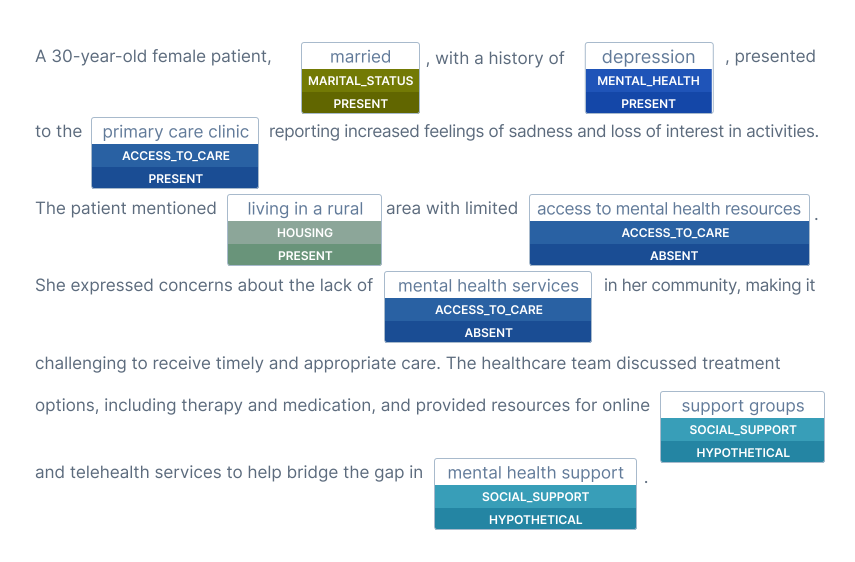
Social determinants of health (SDOH)

Identify social factors impacting health outcomes, readmissions and care equity.

Covering 40+ social determinant categories:

  • Housing stability and homelessness
  • Food insecurity and nutrition access
  • Transportation barriers
  • Financial hardship and employment status
  • Education level and health literacy
  • Social support networks and isolation
  • Violence, abuse and trauma exposure
  • Access to care and insurance status

Published research & validation

John Snow Labs SDOH models have been validated in peer-reviewed research
and deployed in production healthcare systems.
Extracted 60,717 SDOH factors from 13,258 oncology documents with 0.88 F1 score accuracy, outperforming benchmark models by 5% across 13 SDOH categories.
Population health analytics for veterans using SDOH extraction to reduce emergency visits and improve care coordination.
Identifying housing insecurity and social determinants from free-text clinical notes with >90% F1 score.
TERMINOLOGY SERVER

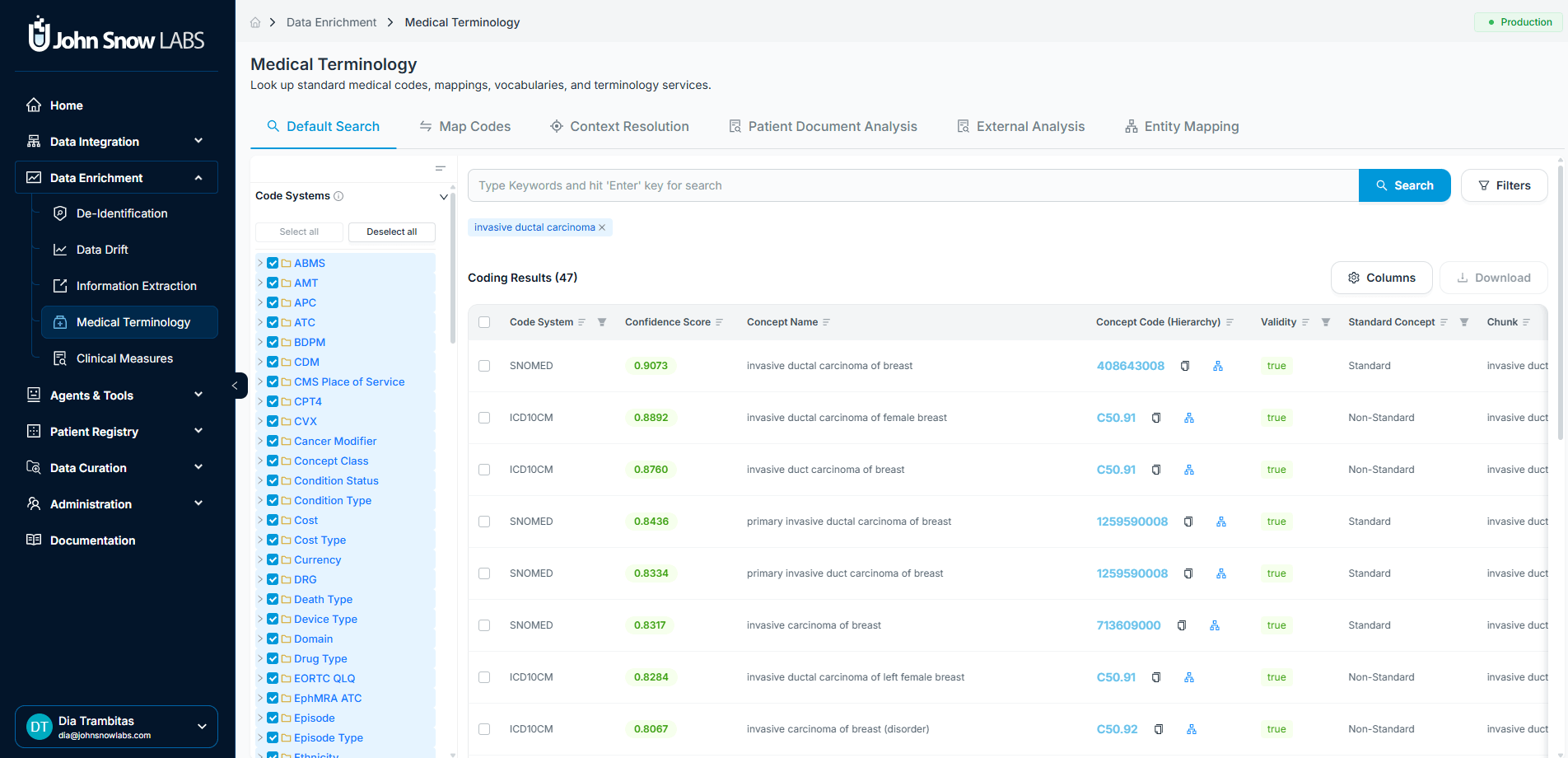
Advanced medical terminology coding

100+ pre-trained entity resolution models that map clinical concepts to standard
terminologies accurately and consistently.
Map every clinical concept to standard terminologies — consistently and reproducibly. Read the paper →
GENERATIVE AI LAB

Annotate, tune and ship your own models

From narrative to defensible data — no code human in the loop environment your own team works in.
Define a schema, annotate in the browser, train a custom model on your annotations, measure agreement, then deploy it into your workflow. No code, no data leaving your network.
Define schema
Annotate
Train your model
Deploy
WATCH THE WALKTHROUGH: Annotate, train and deploy a custom clinical model
Why us

Regulatory-grade accuracy on real-world data

Benchmarked on expert-annotated clinical corpora, published, and validated in production at billion-note scale.
80%+

lower cost than API-based alternatives

Fixed

licensing - no per-token pricing

CPU inference

no GPU required

Private

runs where your data lives

Information extraction
>96%
Oncology NER (F1)
>95%
Social determinants (F1)
>92%
Clinical assertion (F1)
>96%

From narrative to defensible data

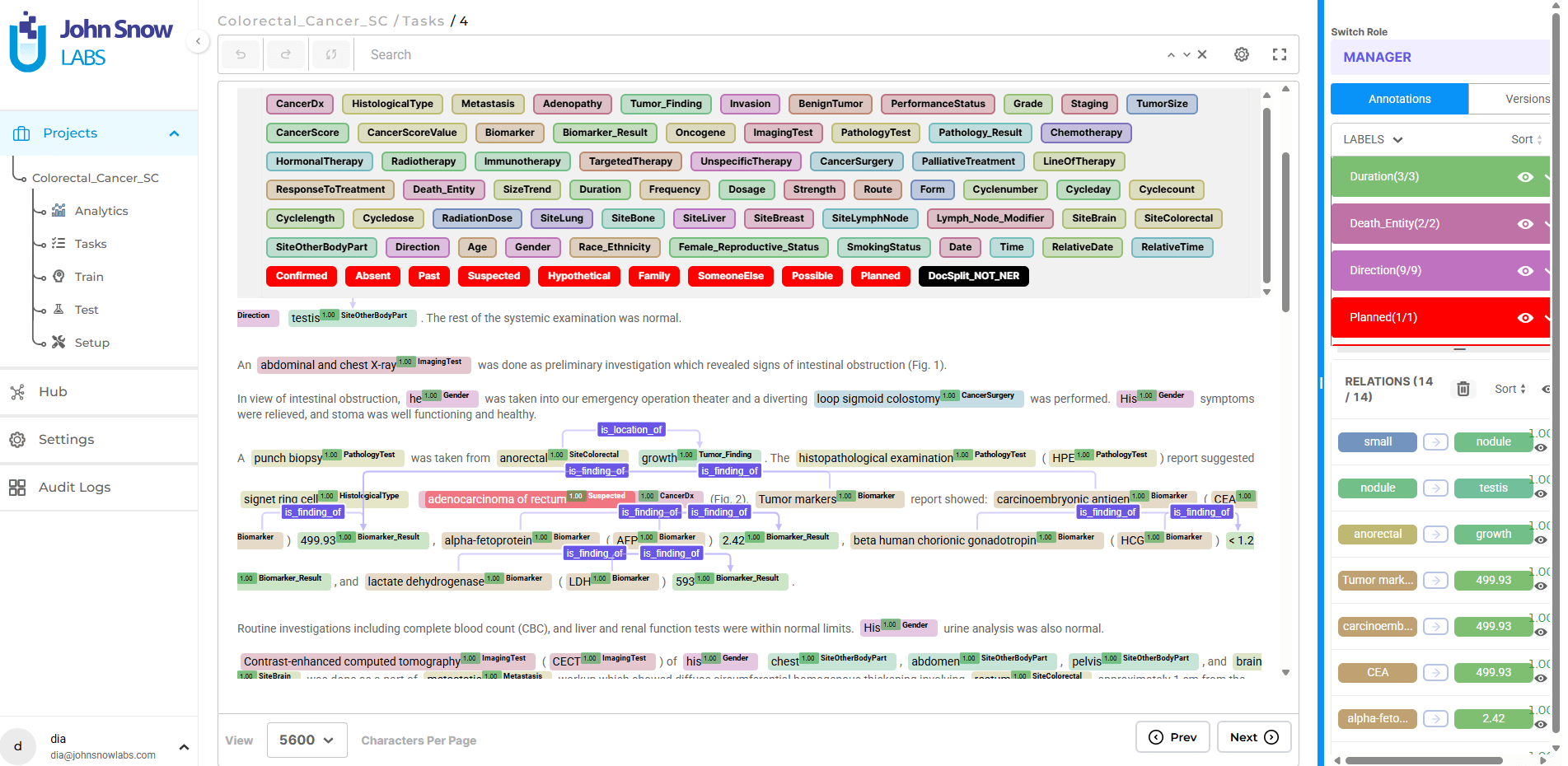
Every value links to its supporting sentence, reviewers work by exception, and field definitions are versioned so any run can be reproduced — “not documented” is never silently read as “didn’t happen”.
Define fields
Extract with evidence
Review by exception
Export analysis-ready
Evidence on every value

Click a field and land on the sentence, the document and the date it came from.

Human review by exception

Abstractors see low-confidence and conflicting values, not all million notes.

Versioned and reproducible

Definitions, models and thresholds are pinned per run, so a result can be re-derived.

Go deeper

Watch it in practice

Teams walking through their own curation programs — oncology, social determinants,
behavioral health and note-scale infrastructure.
Healthcare NLP models in regulatory-grade oncology data curation
Identifying housing insecurity and other social determinants in free-text notes
Healthcare-specific LLMs for oncology patient timelines and guideline matching
Powered by

The same products your teams already license

Available on the AWS, Azure, Snowflake and Databricks marketplaces, so the pipeline runs next to data you cannot move.

Documentation and hands-on

Patient Journey Intelligence docs

Curation pipelines, schemas and the evidence model, end to end.

Project setup, annotation guidelines, active learning and model training.

Paste a note in the browser and watch the models extract and code it.

Every accuracy claim on this page, with its publication.

Start with one endpoint

Pick the field your team abstracts by hand today. We will curate it on your own notes and show you the evidence behind every value.

Frequently asked questions

Clinical data curation transforms unstructured clinical documents into accurate, structured, and analysis-ready data. It uses healthcare-specific AI, terminology normalization, validation, and human review to produce traceable data for registries, cohorts, quality measures, and research.

Three things: accuracy on clinical text, determinism, and evidence. Our medical models score 0.962 on assertion status against GPT-4o's 0.901, return the same output on every run, and attach the source sentence to each value — none of which a prompt guarantees.

Yes, Generative AI Lab supports annotation of sensitive and proprietary data in air-gapped or on-premise deployments, ensuring zero data sharing with John Snow Labs or third parties.

The platform ensures accuracy and reliability through Human-in-the-Loop (HITL) workflows with expert oversight, pre-trained models, quality checks, and full audit trails, delivering consistent outcomes for healthcare and research tasks.

Generative AI Lab eliminates the need for data science expertise to deploy, test, train, and tune AI models through its no-code interface. The platform provides immediate access through subscription-based configuration without requiring custom development or IT infrastructure setup.

Cost optimization is achieved through two pricing models: pay-as-you-go billing that charges only for active feature usage and duration, and on-premise deployment options designed for enterprise teams requiring continuous annotation workflows.

The platform's Kubernetes-based auto-scaling architecture automatically adjusts computational resources based on demand, supporting concurrent multi-user access and processing high numbers of documents per day while maintaining consistent performance metrics across varying workloads.

The platform provides a high-productivity UI with keyboard shortcuts, pre-annotations, and AI-assisted labelling, plus a QuickStart guide and video tutorials for immediate use.

preloader