

 Demos
Demos





























Why agentic AI marks a new era for healthcare data operations
Healthcare organizations generate extraordinary volumes of data every day. Electronic health records, laboratory systems, imaging platforms, registries, clinical trial systems, and administrative datasets continuously produce information about patients, treatments, and outcomes. Yet despite this abundance of data, turning it into operational knowledge remains surprisingly difficult.
Clinical research teams spend enormous effort extracting variables from clinical notes, harmonizing heterogeneous datasets, reviewing eligibility criteria, preparing regulatory documentation, and building curated research datasets. Similarly, healthcare organizations attempting to improve patient safety or operational performance often face the same obstacle: the data exists, but the workflows required to process it remain highly manual.
This is where agentic AI begins to transform the landscape.
Instead of focusing solely on predicting clinical outcomes or making patient‑care decisions, agentic systems can operate as autonomous workflow orchestrators. These systems continuously analyze healthcare data, coordinate analytical tasks, trigger processing pipelines, and ensure that complex research and operational workflows progress automatically.
In this model, AI agents do not decide how patients should be treated. Rather, they help organizations manage the enormous complexity of healthcare data processing, ensuring that information flows reliably from raw data sources into research datasets, safety monitoring systems, quality‑improvement dashboards, and regulatory reporting pipelines.
Platforms such as those developed by John Snow Labs provide the infrastructure required to deploy these agents safely in healthcare environments. By combining healthcare‑specific natural language processing, large language models, data engineering pipelines, and governed orchestration frameworks, organizations can automate many of the most labor‑intensive processes in clinical research and healthcare operations.
What is an autonomous agent in healthcare data workflows?
In the context of clinical research and healthcare analytics, an autonomous agent can be understood as a persistent software system that coordinates complex data workflows across multiple systems.
Rather than simply producing predictions, these agents monitor data sources, trigger processing tasks, extract structured information from clinical text, validate datasets, and coordinate analytical steps that previously required extensive manual supervision.
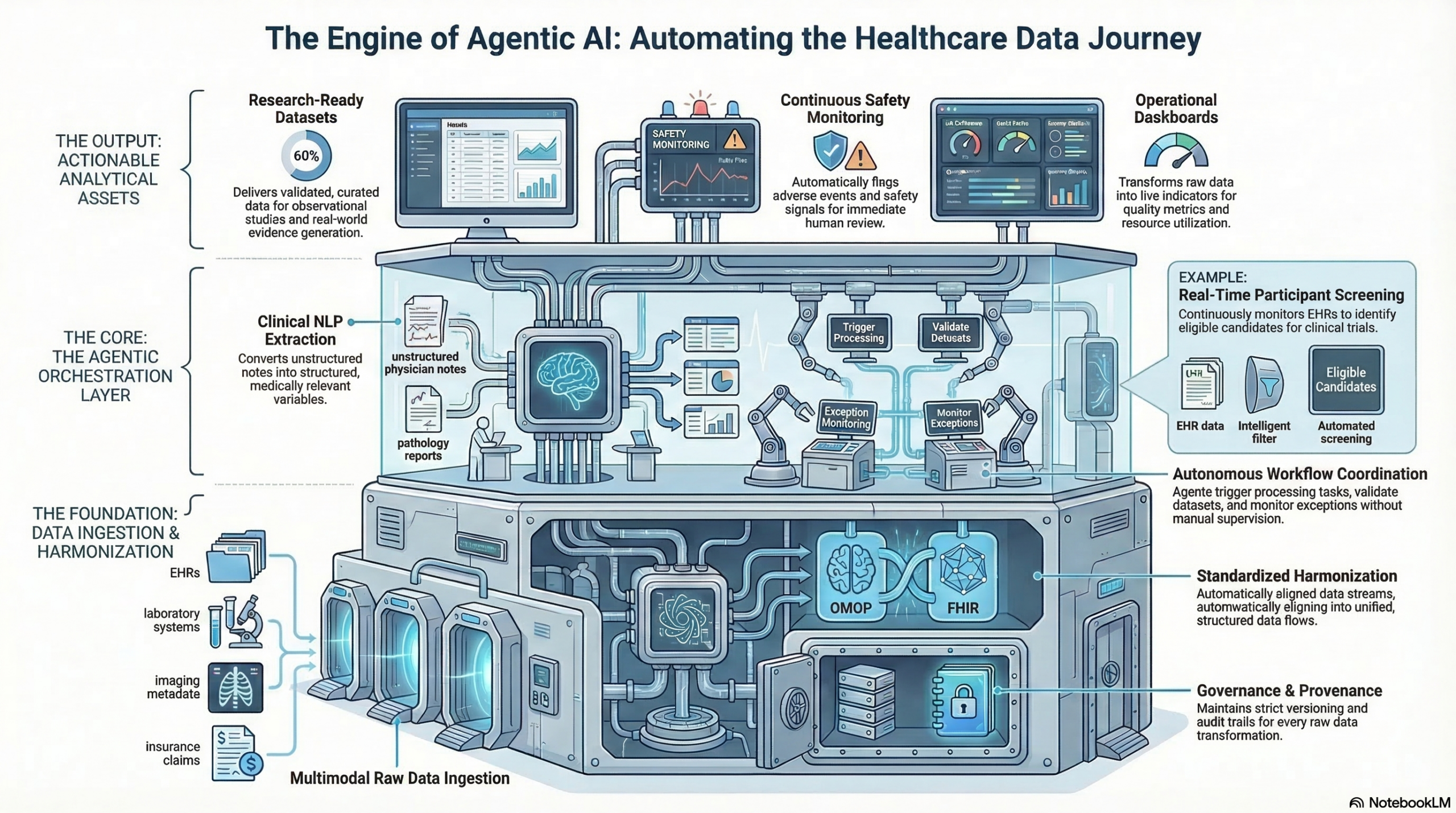
A typical workflow, as is the case of Total Patient Journey tool might involve several stages. Raw clinical data arrives from electronic health records, laboratory systems, and registries. An agent detects the arrival of new data and initiates processing pipelines that harmonize the data into standardized models such as OMOP. Natural‑language‑processing models extract clinical concepts from physician notes, pathology reports, and discharge summaries. The resulting structured information is then validated, aggregated, and delivered into research datasets or operational dashboards.
Throughout this process, the agent maintains audit trails, tracks data provenance, and monitors exceptions that may require human review. In other words, the system acts as an intelligent workflow coordinator for healthcare data pipelines.
Why now is the moment for agentic AI in clinical research and healthcare data
Several technological developments have converged to make this approach viable.
First, modern large language models and domain‑specific clinical NLP systems can reliably interpret unstructured medical text. Physician notes, pathology reports, imaging interpretations, and adverse‑event narratives can now be converted into structured data at scale.
Second, healthcare data engineering platforms have matured significantly. Interoperability standards such as HL7 and FHIR enable near‑real‑time access to clinical data streams, while modern data platforms allow organizations to manage multimodal datasets that combine clinical, genomic, imaging, and operational data.
Third, the demand for real‑world evidence and healthcare analytics has grown dramatically. Regulators, pharmaceutical companies, and health systems increasingly rely on observational data to evaluate treatment effectiveness, monitor safety signals, and guide policy decisions.
Finally, organizations are recognizing that the bottleneck is no longer the availability of data, but the manual effort required to transform raw data into trustworthy analytical assets.
Agentic AI directly addresses this challenge by orchestrating the complex workflows required to process, validate, and analyze healthcare data.
How John Snow Labs enables agentic data workflows
Automating clinical research and healthcare analytics requires a specialized technological foundation. John Snow Labs provides an ecosystem designed specifically for healthcare data environments.
At the data layer, scalable pipelines ingest and harmonize information from electronic health records, laboratory systems, imaging metadata, registries, and claims datasets. These pipelines support dataset versioning, provenance tracking, and full auditability, capabilities that are essential in regulated research environments.
On top of this data infrastructure, healthcare‑specific NLP models extract structured information from unstructured clinical text. Named‑entity recognition, clinical assertion detection, relationship extraction, and temporal reasoning allow systems to identify diagnoses, treatments, laboratory values, adverse events, and other medically relevant variables directly from clinical narratives.
These extracted signals can then be integrated into downstream workflows such as cohort building, clinical trial screening, pharmacovigilance monitoring, and real‑world evidence generation.
The orchestration layer, supported by tools such as Generative AI Lab and Total Patient Journey, enables organizations to define multi‑step pipelines that coordinate complex analytical tasks. Agents can trigger dataset refreshes, validate extracted variables, update registries, generate reports, and alert analysts when anomalies or safety signals are detected.
Equally important is governance. In clinical research environments, every transformation of the data must be traceable. John Snow Labs technologies support detailed logging, reproducible pipelines, and controlled model deployment processes, ensuring that automated workflows remain transparent and compliant with regulatory expectations.
Key domains where agentic AI can transform healthcare data workflows
One of the most immediate applications is clinical research data curation. Preparing datasets for observational studies or clinical trials often requires extensive manual chart review and variable extraction. Autonomous agents can continuously extract structured variables from clinical narratives, maintain curated research datasets, and update them as new patient data becomes available.
Another important domain is clinical trial recruitment and feasibility analysis. Agents can monitor electronic health records, evaluate eligibility criteria expressed in natural language, and identify potential participants for ongoing trials. Instead of manually screening large patient populations, research teams receive continuously updated candidate lists based on real‑time data.
Agentic systems are also highly valuable in pharmacovigilance and patient safety monitoring. Adverse‑event narratives found in clinical notes, discharge summaries, or safety reports can be automatically processed, classified, and aggregated into monitoring systems. Agents can detect emerging safety signals, trigger reviews, and ensure that reporting workflows remain compliant with regulatory requirements.
Healthcare organizations can also deploy these technologies for health services research and operational analytics. By continuously transforming raw clinical data into structured indicators, agents can maintain dashboards that track quality metrics, resource utilization, and patient safety events across the health system.
Engineering agentic healthcare data systems: roadmap and considerations
Organizations typically begin by identifying a workflow where data processing currently requires substantial manual effort. Examples include chart abstraction for registries, adverse‑event detection, cohort construction for research studies, or periodic generation of quality‑of‑care reports.
The first step involves establishing a robust data foundation. Data pipelines must ingest information from multiple clinical systems, harmonize formats, and apply privacy and de‑identification safeguards where required.
Next, organizations deploy domain‑specific NLP and machine‑learning models capable of extracting medically meaningful variables from clinical narratives. These models provide the structured signals that drive downstream workflows.
Agentic orchestration layers then coordinate the different stages of the pipeline. Agents monitor data updates, trigger processing jobs, validate outputs, and escalate anomalies when human review is required.
Finally, governance mechanisms ensure that every transformation remains transparent and reproducible. Versioned datasets, detailed logs, and human‑review checkpoints allow organizations to maintain confidence in automated workflows.
Challenges and mitigation strategies
Despite their potential, agentic healthcare data systems must address several challenges.
Healthcare data remains fragmented across many systems, and inconsistencies between sources can complicate automated processing. Robust harmonization pipelines and standardized data models are therefore essential.
Trust is also critical. Analysts and researchers must be able to understand how automated pipelines extract and transform variables. Transparent models, validation workflows, and detailed audit logs help ensure that automated processes remain interpretable and trustworthy.
Another challenge involves maintaining model performance over time. As clinical documentation practices evolve, NLP models may require periodic retraining. Continuous monitoring and controlled model updates help mitigate this risk.
Finally, regulatory compliance must remain central to system design. Automated workflows should operate within governance frameworks that preserve data privacy, maintain traceability, and ensure accountability for analytical outputs.
Conclusion: the rise of autonomous data operations in healthcare
Healthcare systems are entering a new phase in which the primary challenge is no longer generating data, but managing and transforming it effectively.
Agentic AI provides a powerful solution by coordinating the complex workflows required to transform raw healthcare data into research datasets, safety monitoring systems, and operational analytics.
With domain‑specific infrastructure such as the technologies developed by John Snow Labs, organizations can deploy governed, production‑grade automation that dramatically reduces manual effort while improving data quality and transparency.
In the coming years, the most advanced healthcare organizations will not only collect data, they will operate autonomous data workflows that continuously transform clinical information into actionable knowledge as it the case of Total Patient Journey.
FAQs
Does agentic AI make clinical decisions about patient care?
Not necessarily. In many healthcare deployments the primary role of agentic systems is to coordinate data workflows rather than clinical decisions. Agents automate tasks such as data extraction, cohort identification, safety monitoring, and research dataset preparation, while clinicians and researchers remain responsible for interpretation and decision making.
How does agentic AI improve clinical research workflows?
Clinical research often requires extracting variables from thousands of clinical documents, harmonizing heterogeneous datasets, and validating research cohorts. Agentic systems can automate these tasks by continuously processing incoming data, updating curated datasets, and coordinating analytical pipelines that previously required extensive manual effort.
What types of healthcare data can these systems process?
Agentic workflows can integrate many forms of healthcare data, including structured electronic health record fields, laboratory results, imaging metadata, pathology reports, physician notes, wearable device streams, and insurance claims datasets. Modern NLP models allow unstructured clinical text to be converted into structured research variables.
How do these systems support real‑world evidence generation?
Real‑world evidence studies depend on high‑quality observational datasets derived from routine healthcare data. Agentic AI systems automate the extraction, validation, and harmonization of these datasets, making it possible to generate research‑ready data continuously rather than through periodic manual curation.
Can agentic AI help with pharmacovigilance and patient safety monitoring?
A: Yes. By continuously analyzing clinical narratives and safety reports, agents can identify potential adverse events, classify them using standardized vocabularies, and aggregate signals for further review. This automation improves the timeliness and completeness of safety monitoring workflows.
How do John Snow Labs technologies support these workflows?
John Snow Labs provides healthcare‑specific NLP models, data engineering pipelines, and orchestration tools designed for regulated healthcare environments. Together, these components enable organizations to build automated workflows that extract structured information from clinical text, harmonize datasets, and maintain fully auditable analytical pipelines.
What is the main benefit of agentic AI for healthcare organizations?
The primary benefit is the ability to transform large volumes of heterogeneous healthcare data into reliable analytical assets with far less manual effort. Automated workflows improve data quality, accelerate research timelines, and enable continuous monitoring of healthcare operations and patient safety.