


















Join the Applied Healthcare AI Summit | Free online conference | April 14-15, 2026
was successfully added to your cart.

State-of-the-Art Medical Language Models

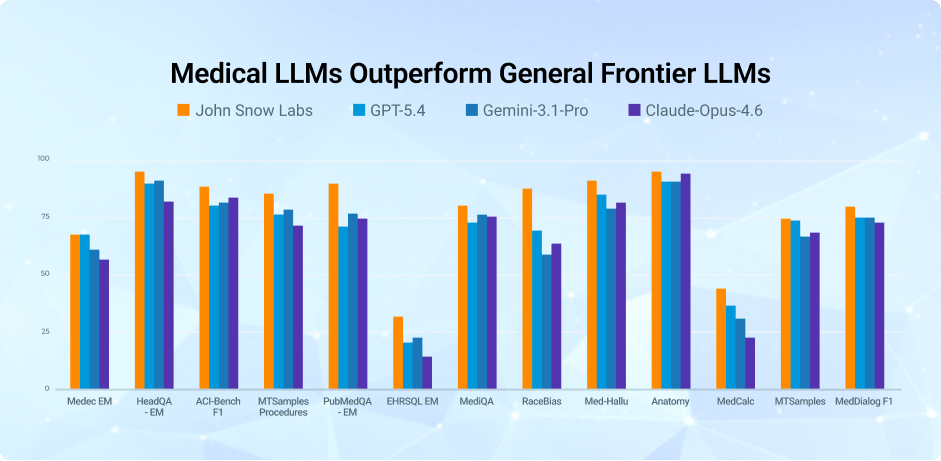
  • Delivers up to 8.6 point higher accuracy than leading frontier models – GPT-5.4, Gemini-3.1-Pro, and Claude-Opus-4.6 – across key medical benchmarks
  • Purpose-built for medical language, not general text
  • Runs privately inside your environment, with no external API dependency
  • Single-GPU deployment, enabling predictable performance, and cost control
Learn more

John Snow Labs is the De-facto Industry Leader for Medical Large Language Models.
CIO Views, 2024

State of the Art Medical Language Models

John Snow Labs’ Medical LLMs are healthcare-specific large language models (LLMs) trained on clinical notes, biomedical literature, and Electronic Health Record (EHR) data, purpose-built for the accuracy and safety standards clinical environments demand.

The table below benchmarks John Snow Labs against GPT-5.4, Gemini-3.1-Pro, and Claude-Opus-4.6 across 13 medical AI benchmarks spanning clinical NLP, named entity recognition, medical reasoning, and hallucination detection. John Snow Labs ranks #1 on 12 benchmarks and ties #1 on Medec EM, with an average score of 76.8 vs. 70.9 (GPT-5.4), 70.0 (Gemini-3.1-Pro), and 68.3 (Claude-Opus-4.6).

Benchmark Score Comparison — 13 Clinical & Biomedical Tasks
Green badge marks the highest score per benchmark
Benchmark / Task John Snow Labs GPT-5.4 Gemini-3.1-Pro Claude-Opus-4.6
Medec EM Medical entity extraction, identifying symptoms, drugs, and procedures within clinical text. NER 69tie 69tie 63 60
HeadQA - EM Medical knowledge assessed via multiple-choice questions from professional healthcare education exams.Knowledge 94best 91.8 92 82.4
ACI-Bench F1 Structured clinical note and code generation from ambient doctor-patient conversation recordings.Documentation 87.7best 81.1 81.9 82
MTSamples Procedures Procedural understanding - identifying and extracting surgical or medical procedures from clinical reports.Procedures 85best 75.4 76.5 73.2
PubMedQA - EM Reading comprehension - answering biomedical research questions from PubMed abstract context.Comprehension 86best 73 76 75
EHRSQL EM Translating natural language questions into SQL queries for Electronic Health Record databases.SQL / EHR 30best 23 24 19
MediQA General medical reasoning and question answering across complex, varied clinical scenarios.Reasoning 78.7best 74.6 75.5 75.1
RaceBias Racial bias evaluation - ensuring equitable medical decision-making and clinical logic across demographics.Fairness 89best 70 65.5 68
Med-Hallu Hallucination control - detecting and avoiding plausible but factually incorrect medical information.Hallucination 92best 90 87 89
Anatomy Anatomical knowledge - structural relationships and physiological systems mastery.Knowledge 93.3best 92.6 92.6 93.1
MedCalc Clinical calculations and medical formulas (dosage, risk scores) applied from patient vignettes.Calculations 42best 32 28 24
MTSamples Clinical documentation understanding - summarizing or classifying transcribed medical reports.Documentation 74.9best 74.6 72.4 72.6
MedDialog F1 Clinical dialogue comprehension - quality of understanding and response in patient-provider conversations.Dialogue 76.5best 75.2 75.1 74.3
Summary
76.8
avg score
13 benchmarks won
70.9
avg score
1 benchmarks won
70.9
avg score
0 benchmarks won
78.3
avg score
0 benchmarks won

Preferred in a Blind Evaluation by Medical Practitioners

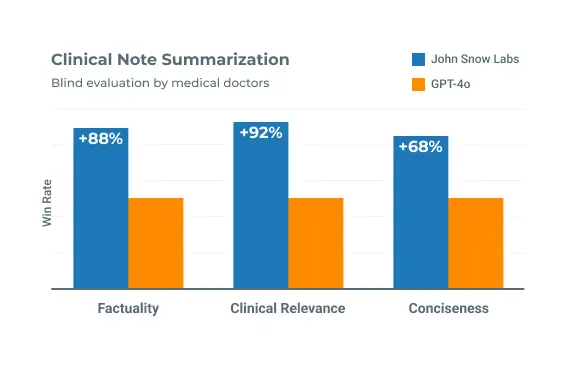
Clinical Note Summarization

Preferred 88% more often on factuality, 92% more often on relevance, 68% more often on conciseness compared to GPT-4o.
Sample Questions:

  • Summarize the final pathological diagnosis of the lesion and the patient’s follow-up and recovery after surgery.
  • Summarize the patient’s medical history and initial presentation.
  • Summarize the background and objectives of the study from the given text.

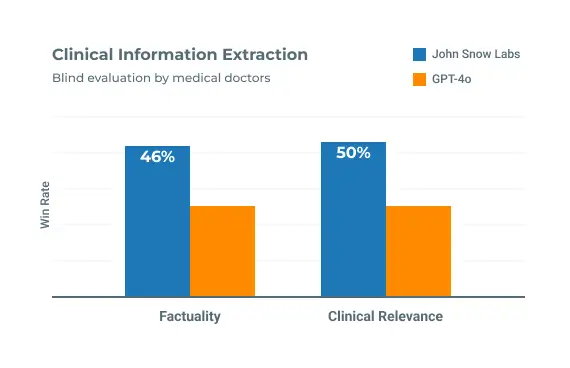
Clinical Information Extraction

Preferred 46% more often on factuality, 50% more often on relevance and 45% more often on conciseness compared to GPT-4o.
Sample Questions:

  • Can the TyG index be used to predict gestational diabetes mellitus (GDM) according to the following text?
  • Given the note, what procedures did the patient undergo?
  • Given the medical text, did Anlotinib benefit the patient?
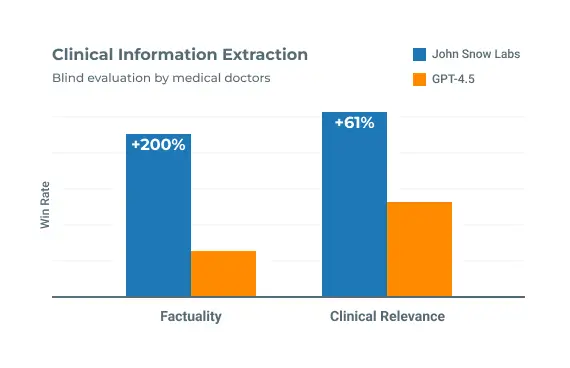
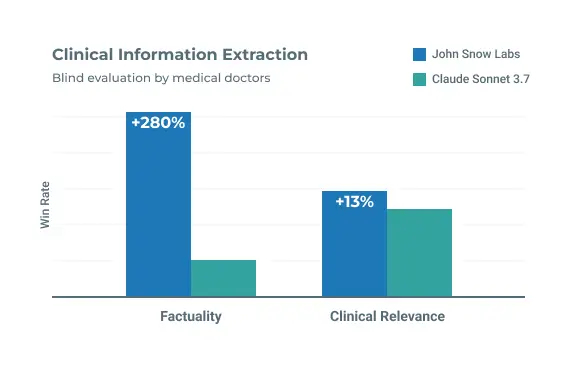
Clinical Information Extraction

Biomedical Question Answering

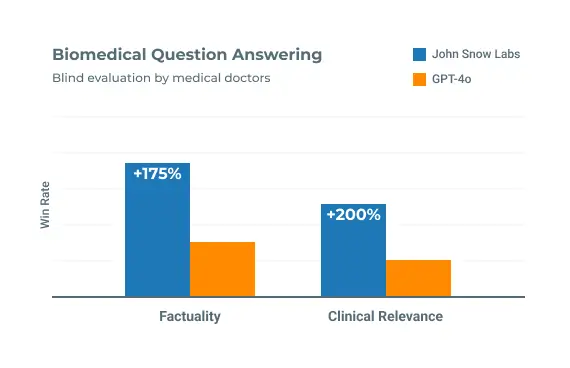
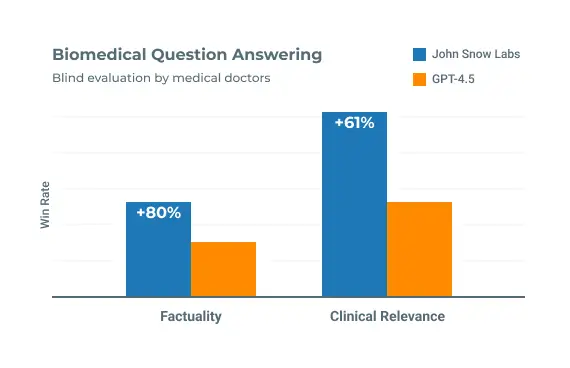
Preferred 175% more often on factuality, 200% more often on relevance, 256% more often on conciseness compared to GPT-4o.
Sample Questions:

  • Given the report, what biomarkers are commonly negative in APL cases?
  • Given the note, why is the chemotherapy the mainly used treatment in TNBC patients?
  • Given the article, what is sNFL used for?
Biomedical Question Answering

Private and Compliant Deployment

Runs Privately
Deploy the Medical LLMs within your secure infrastructure, ensuring data sovereignty and full control over sensitive information.
No Data Sharing
Medical LLMs process data locally. No need for external data sharing or internet dependencies.
Built for Compliance
In line with privacy standards like HIPAA or GDPR, ensuring seamless integration into highly regulated environments.

Putting Healthcare LLMs to Production Use

Using Healthcare-Specific LLM’s for Data Discovery from Patient Notes & Stories

The US Department of Veterans Affairs, a health system which serves over 9 million veterans and their families. This collaboration with VA National Artificial Intelligence Institute (NAII), VA Innovations Unit (VAIU) and Office of Information Technology (OI&T) show that while out-of-the-box accuracy of current LLM’s on clinical notes is unacceptable, it can be significantly improved with pre-processing, for example by using John Snow Labs’ clinical text summarization models prior to feeding that as content to the LLM generative AI output.

Text-Prompted Patient Cohort Retrieval: Leveraging Healthcare LLM Models for Precision Population Health Management

Using John Snow Lab’s Healthcare LLM models, the ClosedLoop platform enables users to retrieve cohorts using free-text prompts. Examples include: “Which patients are in the top 5% of risk for an unplanned admission and have chronic kidney disease of stage 3 or higher?” or “Which patients are in the top 5% risk for an admission, older than 72, and have not undergone an annual wellness checkup?”

Applying Healthcare-Specific LLMs to Build Oncology Patient Timelines and Recommend Clinical Guidelines

This talk covers how applying healthcare-specific Large Language Models (LLMs) to Electronic Health Records (EHRs) presents a promising approach to constructing detailed oncology patient timelines. It explores how John Snow Labs’ healthcare-specific Large Language Model (LLM) offers a transformative approach to matching patients with the National Comprehensive Cancer Network (NCCN) clinical guidelines. By analyzing comprehensive patient data, including genetic, epigenetic, and phenotypic information, the LLM accurately aligns individual patient profiles with the most relevant clinical guidelines. This innovation enhances precision in oncology care by ensuring that each patient receives tailored treatment recommendations based on the latest NCCN guidelines.

Lots of companies make claims about healthcare-specific LLM’s. John Snow Labs are the only ones who publish reproducible accuracy benchmarks and have Medical LLM systems in production.
CIO Views, 2023
preloader