


 Demos
Demos






























What is a medical reasoning engine and how does it differ from search?
Medical reasoning engines, powered by advanced large language models (LLMs), represent a new generation of clinical decision support systems. Unlike traditional search engines that retrieve documents based on keywords, reasoning engines synthesize patient-specific information, medical guidelines, and clinical literature to generate contextual, personalized, and explainable outputs.
John Snow Labs’ Medical Reasoning LLM, commercially available and built specifically for healthcare, exemplifies this shift by delivering explainable, patient-centric recommendations from structured and unstructured data.
Why is traditional medical search no longer sufficient?
Search engines excel at indexing and retrieving documents, but they falter in high-stakes medical environments where:
- Queries are often imprecise or context-rich
- Information must be synthesized across disparate sources
- Decisions require reasoning, not just retrieval
LLMs now offer mechanisms such as Chain-of-Thought prompting, Med-PaLM-style QA alignment, and reinforcement learning that enable multi-step clinical reasoning.
What types of reasoning can LLMs perform in clinical settings?
Medical LLMs are now capable of:
- Deductive reasoning: Applying general medical principles to specific cases
- Inductive reasoning: Recognizing patterns across patient cohorts
- Abductive reasoning: Proposing the most likely explanation for symptoms
John Snow Labs supports these forms of reasoning through Medical Reasoning LLM, which provides multimodal ready-to-use diagnostic reasoning capabilities across different specialties.
Why will clinicians prefer LLMs over traditional tools?
LLMs are poised to outperform search in key clinical workflows:
- More relevant information: By integrating clinical guidelines, lab results, and histories
- Personalized care: Aligning treatments with patient-specific context
- Reduced burnout: Automating administrative tasks and summarizations
- Collaborative intelligence: Supporting, not replacing, clinical judgment
The Medical Reasoning LLM complements clinicians by delivering precise, explainable outputs, while Generative AI Lab offers built-in HITL (human-in-the-loop) validation tools for model assurance, transparency, and customization across medical use cases.
How are medical reasoning engines used in practice?
Real-world deployments already show impact:
- Differential Diagnostics: Recommending likely causes for ambiguous symptoms
- Treatment planning: Mapping options based on comorbidities and genomics
- Patient engagement: Translating complex information into accessible language
With multimodal capabilities (text, imaging, genomics), John Snow Labs’ Medical VLM-30B vision-language model enhances the precision of diagnostic reasoning across radiology and pathology inputs.
What’s next for LLMs in healthcare?
The future points to agentic LLMs models that:
- Proactively surface risks and opportunities
- Synthesize cross-patient trends in real time
- Automate evidence alerts and documentation
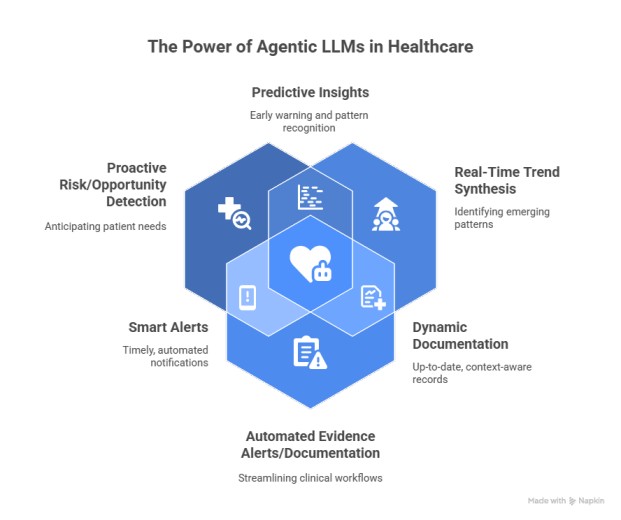
John Snow Labs is actively evolving its ecosystem to support these capabilities, including tools for real-time reasoning, multimodal fusion, and dynamic workflow automation.
What does this mean for clinical practice?
The rise of medical reasoning engines signals a move toward:
- Proactive care over reactive treatment
- Personalized recommendations over one-size-fits-all guidelines
- Real-time decision support embedded into EHRs and clinical workflows
As trust builds and capabilities grow, clinicians will increasingly treat LLMs as useful support tools, amplifying, not replacing, the human side of medicine.
Conclusion: Why this evolution matters now
Medical LLMs aren’t just better search engines; they are foundational tools for the future of medicine. By transforming search into reasoning, they offer clinicians a dynamic, context-aware companion for every patient interaction.
Healthcare organizations that integrate systems like the Medical Reasoning LLM, and Generative AI Lab early will be better equipped to improve outcomes, reduce costs, and lead in a new era of AI-powered care.