


 Demos
Demos































Why bigger isn’t always better: The paradigm shift in AI model development
For years, the benchmark of AI innovation was model size, parameter counts defined power. But in healthcare, this arms race has hit a wall. Today, domain specificity, not scale, determines real-world performance.
Large, general-purpose LLMs struggle with clinical nuance, factuality, and regulatory alignment. Even with billions of parameters, models like GPT-5, Gemini-3 or Claude-4.5 can hallucinate diagnoses, misread context, or fail to align with medical guidelines.
What’s changing? We are entering the era where smaller, medically specialized models trained on curated clinical data and well-integrated in real workflows consistently outperform larger, general-purpose LLMs in safety-critical settings.
Why domain data matters more than parameter count
Model size is only one axis of capability. In healthcare, more impactful dimensions include:
- Training data quality: Domain-relevant, well-labeled, guideline-aligned datasets improve factuality and robustness.
- Contextual depth: Clinical decisions hinge on nuanced temporal, longitudinal, and multi-modal data, not surface-level associations.
- Reasoning complexity: Clinical tasks demand deductive, inductive, and abductive reasoning, not just pattern matching.
- Real-world integration: Models must interoperate with EHRs, workflows, imaging, and ontologies, not just generate coherent text.
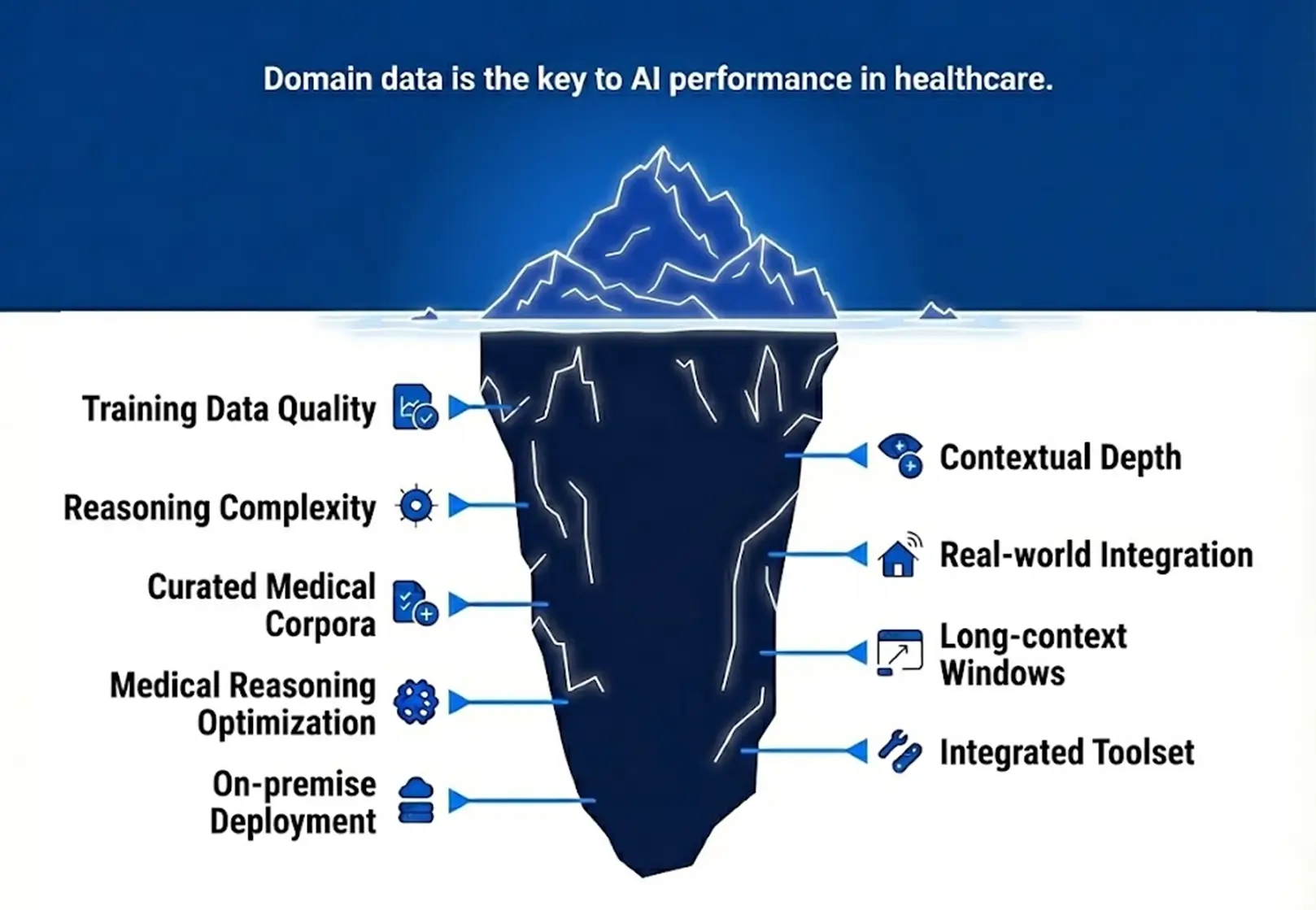
This is why John Snow Labs’ Medical Reasoning LLM though smaller in scale, delivers superior performance on benchmarked healthcare tasks. Its edge lies not in parameter volume, but in being purpose-built: trained on curated clinical narratives, mapped to medical ontologies, and optimized for context length of clinical scenarios.
How John Snow Labs leverages domain-specific data to outperform larger models
John Snow Labs has redefined performance through a stack that prioritizes quality over scale:
- Curated medical corpora: Trained on peer-reviewed, real-world, and guideline-aligned clinical content, not web-scale general text.
- Medical reasoning optimization: Supports stepwise reasoning (e.g., Chain-of-Thought), explanation generation, uncertainty quantification.
- Integrated toolset: Seamlessly connects with Healthcare NLP, Generative AI Lab, and domain-specific information extraction pipelines.
- On-premise deployment: HIPAA-ready, auditable, and customizable to institutional data, enabling real-world use, not just demos.
Even with fewer parameters than flagship general models, the Medical Reasoning LLM matches or exceeds performance on clinical Q&A, guideline retrieval, differential diagnosis, and de-identification tasks.
Real-world implications: Why your next AI project should focus on data, not model size
- Clinical accuracy beats syntactic fluency
Bigger models may sound convincing, but smaller, domain-tuned models are right more often a critical distinction in care settings.
- Compute efficiency enables real deployment
Hospitals can’t run 70B+ models in production. Models like John Snow Labs’ LLM are optimized for on-premise deployment, without sacrificing capability.
- Customization becomes practical
Smaller, domain-specific models can be fine-tuned to local guidelines, patient populations, and hospital data pipelines, something impractical at massive scale.
- Regulatory alignment is mandatory
Explainability, safety validation, and traceability are easier in smaller, purpose-built models. This is essential for EU AI Act, HIPAA, and FDA alignment.
Conclusion: It’s time to rethink what power means in medical AI
Size still matters, but only when paired with domain relevance, clinical safety, and operational feasibility. In healthcare, precision is critical. The future doesn’t belong to the largest model; it belongs to the best-informed one.
With John Snow Labs’ medically grounded LLMs, curated data pipelines, and production-ready orchestration tools, organizations can shift from AI experimentation to reliable, safe, and scalable deployment.
FAQs
Can a small medical LLM outperform a general 70B+ model?
Yes, especially on clinical tasks. Purpose-built medical models trained on curated domain data offer better factual accuracy, reasoning, and trustworthiness.
Why isn’t model size a reliable indicator of healthcare performance?
Because healthcare demands contextual reasoning, not just linguistic fluency. Smaller models trained on relevant data outperform larger ones trained on generic web-scale corpora.
How can I evaluate if my current AI stack is domain-optimized?
Assess your training data, performance on clinical benchmarks, integration with workflows, and auditability, especially under real-world constraints.