

 Demos
Demos
































The AI-Ready Hospital: Architecture, Culture, Workflows, and Staffing for the Next Decade
An AI-ready hospital is a health system whose data infrastructure, governance, clinical workflows, and staffing are built to run AI safely and repeatably at scale, not as a collection of disconnected pilots. Providence has validated PHI detection at 2 billion patient notes with zero re-identifications; Intermountain Health cut clinical document review time from 10 minutes to 3 minutes, a 70% efficiency gain. Both results rest on infrastructure built years before either AI model shipped. This article lays out the four dimensions that separate AI-ready hospitals from hospitals running isolated pilots.
Why AI-readiness is the new strategic imperative for hospitals
Rising patient volumes, chronic disease burden, workforce shortages, and regulatory complexity are pushing hospitals toward AI, from automating administrative work to supporting clinical decisions and optimizing operations. But isolated pilots rarely produce sustained impact. A 2025 systematic review of hospital AI platform architectures, synthesizing evidence from 29 studies, converged on a five-layer model spanning infrastructure, data, algorithm, application, and security [Maimaitiaili et al., 2025] rather than one-off point tools. The next horizon for healthcare AI is modular, connected architecture and clinical-data pipelines, not standalone solutions bolted together after the fact.
To realize AI’s potential at scale, hospitals need to evolve into AI-ready institutions across architecture, culture, workflows, and staffing. This article covers what that transformation requires, and why it matters over the next decade.
What does an AI-ready hospital look like? A four-dimensional blueprint
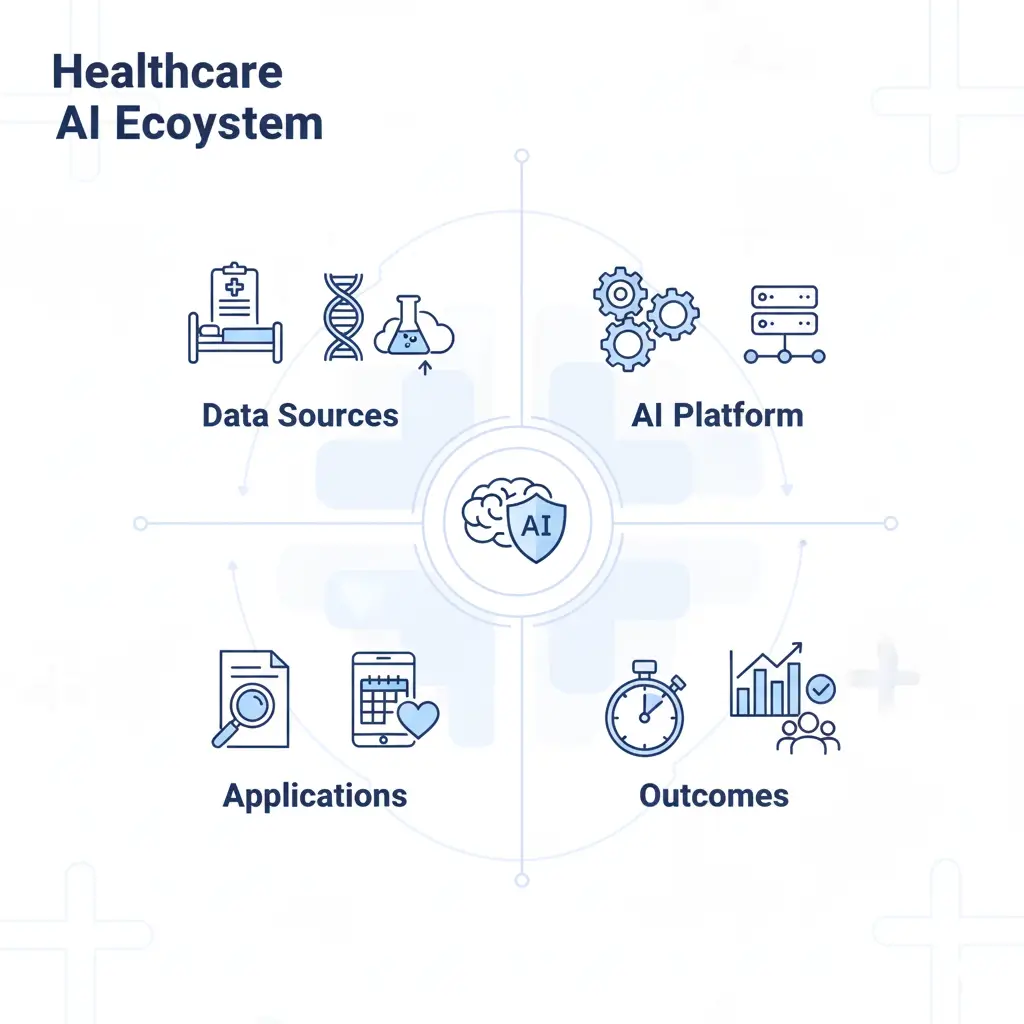
Becoming AI-ready means advancing across four interconnected dimensions: technology architecture and data infrastructure, organizational culture and governance, clinical and operational workflows, and staffing and skills.
- Technology architecture and data infrastructure
- Modular, interoperable architecture: move from siloed, point-tool approaches to a modular architecture where AI systems, data warehouses, EHR systems, imaging, lab systems, scheduling, and billing connect through standards (OMOP, FHIR, HL7, APIs) enabling standardized data exchange.
- A clinical-data pipeline layer: dedicated infrastructure that ingests, harmonizes, de-identifies when necessary, and normalizes data from clinical notes, labs, imaging metadata, and structured EHR entries into a consistent, queryable, AI-ready dataset. This foundation avoids redundant integration work for every new AI pilot and supports reuse across projects.
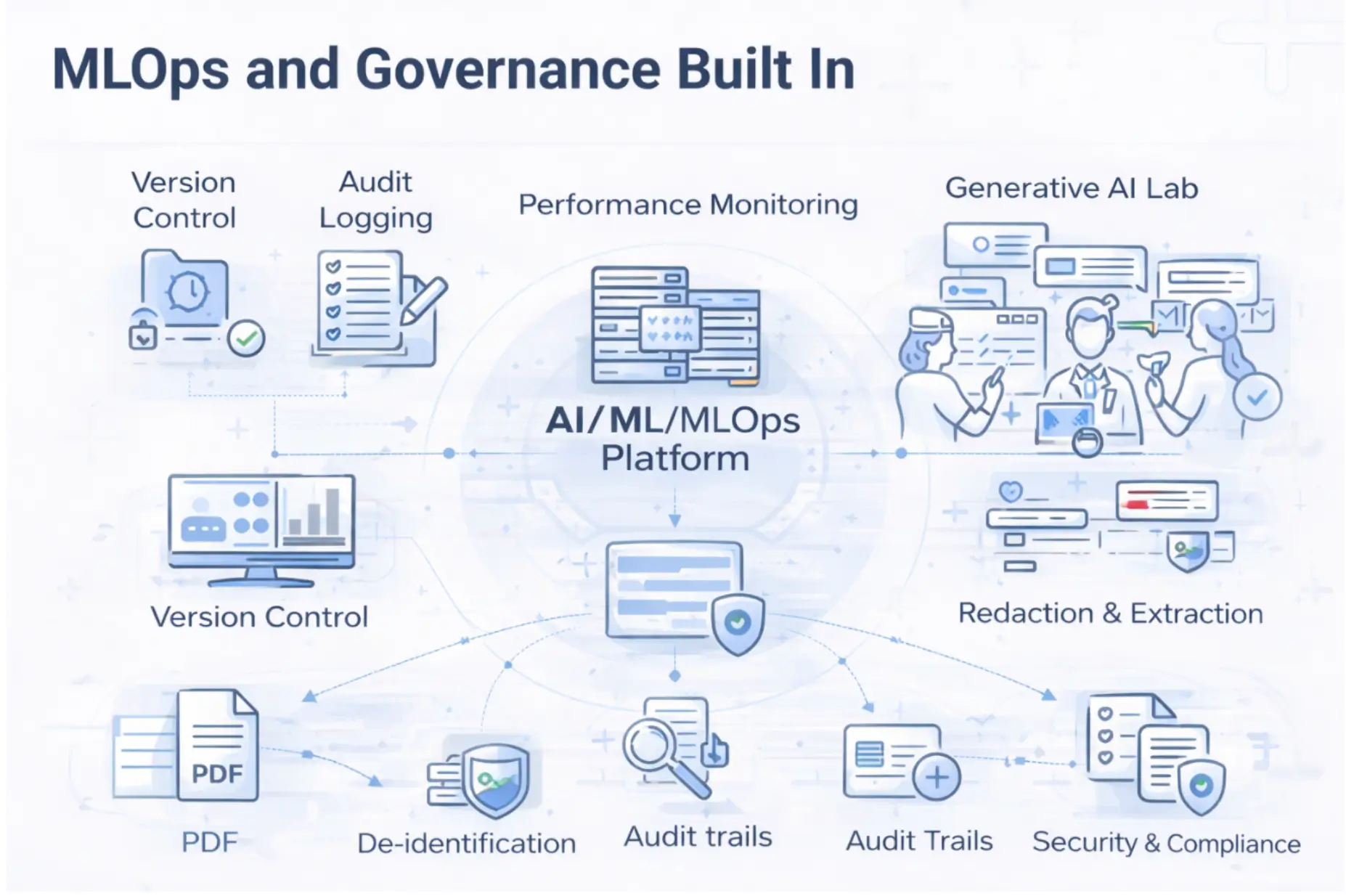
- A scalable AI/ML/MLOps platform: version control, audit logging, performance metrics, retraining pipelines, and compliance controls for building, validating, deploying, and monitoring models, the difference between a research demo and a production system.
- Security, privacy, compliance, and governance built in: architecture needs access control, encryption, audit trails, and compliance mechanisms designed in from the first pipeline. A systematic review of AI implementation barriers in healthcare found data governance and security gaps among the most cited obstacles to moving past pilot stage [Ahmed et al., 2023].
- Support for multimodal and longitudinal data: imaging, clinical notes, labs, and longitudinal history require systems built to handle image archives, metadata, and structured plus unstructured data together [Hao et al., 2025].
Why it matters: Without a data and IT backbone, AI initiatives stay brittle, siloed, and hard to scale. A modular, interoperable architecture creates the foundation for AI adoption across every department.
- Culture, governance, and strategic leadership
- Leadership commitment and strategic vision: leadership needs to treat AI as a strategic transformation aligned with institutional goals, quality, patient safety, efficiency, and equity, not an experimental add-on. A 2025 qualitative interview study with hospital physicians found adoption stalls where leadership commitment to long-term digital transformation, budget, and change-management capacity are lacking [Zhou et al., 2025].
- Governance frameworks and ethical oversight: governance needs to address patient safety, data privacy, bias, accountability, and regulatory compliance, including human-in-the-loop policies, audit trails, and clearly assigned responsibility [Singh & Keche, 2025]. The strongest architectures treat data provenance and audit trails as native properties of every clinical fact rather than something added after a pipeline ships, a gap that typically surfaces during a regulatory audit, not during development.
- Education and workforce development: staff need training beyond tool operation to cover AI’s limitations, error modes, and workflow integration. A 2026 review of AI adoption from healthcare providers’ perspectives groups insufficient training and limited AI literacy among the leading human-level barriers [Abdelwanis et al., 2026].
- Change management and cultural alignment: moving to AI-enabled workflows means revisiting established roles and responsibilities. This calls for structured change management: stakeholder engagement, communication, phased rollout, and evaluation loops [Adnan et al., 2025].
Why it matters: Technology alone doesn’t guarantee success. Institutional culture, strategic vision, and governance decide whether AI becomes a trusted, sustained part of hospital operations.
- Workflows and clinical or operational integration
For AI to deliver value, it needs to be embedded into daily workflows, not run as a separate side project. Key components:
- Embedding AI into core clinical and administrative workflows: ambient clinical documentation, resource allocation, staffing, scheduling, triage, care coordination, and operational logistics such as beds and supply chains are gaining traction. In a Fall 2024 survey of 43 US health systems, ambient documentation was the one use case where every respondent reported adoption activity, and 53% reported a high degree of success with AI for clinical documentation [Poon et al., 2025].
- Hybrid human-AI workflows with human oversight: for high-risk tasks such as diagnosis, treatment recommendations, and triage, AI supports rather than replaces clinical judgment. Human-in-the-loop review, override options, and audit trails are required. A 2025 systematic review of real-world LLM deployments in clinical workflows concluded that safe, scalable use depends on human oversight, multi-site validation, and standardized evaluation rather than on model performance alone [Artsi et al., 2025].
- Performance monitoring and continuous feedback loops: after deployment, models need ongoing monitoring for accuracy, safety, bias, and drift. A June 2025 review in the Journal of the American College of Radiology found AI models degrade over time as patient populations, input parameters, and technology shift, and called for structured post-deployment surveillance rather than one-time validation [Quinn et al., 2025].
- Modularity and interoperability across departments: build AI capabilities as reusable components, a data pipeline, a reasoning engine, a documentation assistant, rather than one-off tools, cutting fragmentation and integration overhead. The same systematic review of hospital AI platform architectures found that implementations targeting isolated tasks fail to support enterprise-wide AI, because they do not address the need for integrated, scalable components [Maimaitiaili et al., 2025].
Why it matters: Integrated workflows raise return on investment, reduce friction, and make AI part of everyday care instead of an experimental add-on.
- Staffing, skills, and workforce evolution
AI reshapes hospital staffing without necessarily reducing the need for people. Roles evolve instead:
- New AI-ops, data, and informatics roles: data engineers, ML engineers, AI governance officers, MLOps specialists, AI-aware clinical informaticists, and compliance officers to build and maintain AI pipelines.
- Clinician and staff training for AI collaboration: interpreting AI outputs, understanding limitations, overseeing AI-assisted workflows, and knowing when to override or verify results.
- Human-in-the-loop oversight and quality-assurance staff: to validate AI outputs, review edge cases, manage audit logs, and handle exceptions.
- Change in administrative and support-staff functions: roles shift from manual, repetitive tasks toward oversight, patient coordination, AI-augmented decision support, compliance, and patient-facing care.
Staffing challenges persist: provider-perspective evidence consistently reports insufficient training, clinician resistance, added workload, and uncertainty about professional roles and de-skilling [Abdelwanis et al., 2026].
Why it matters: Without investment in people, even the most advanced AI architecture falls short. Adoption, trust, and sustainability depend on people as much as on technology.
What the evidence shows, and where best practice is heading
Across the 29 studies in the 2025 systematic review cited above, hospital AI platforms converged on the same five architectural layers — infrastructure, data, algorithm, application, and security — rather than on loose collections of point tools [Maimaitiaili et al., 2025].
Real-world deployments show measurable benefits, though unevenly: ambient clinical documentation is where results are strongest, with scheduling and staffing optimization, reduced clinician burden, and workflow efficiency following behind, and diagnostic use cases still producing more modest gains.
However, barriers remain. A 2026 review of AI adoption from healthcare providers’ perspectives sorts the most cited obstacles into three clusters: human factors such as inadequate training and clinician resistance; organizational factors such as infrastructure limits, financial constraints, and weak leadership support; and technology factors such as accuracy, explainability, and workflow fit [Abdelwanis et al., 2026]. How health systems themselves rank those barriers looks different: in a Fall 2024 survey of 43 US health systems, immature AI tooling was named a top-two barrier by 77% of respondents, financial concerns by 47%, and regulatory or compliance uncertainty by 40%, while insufficient in-house expertise (14%) and lack of leadership support (7%) were rarely named among the top two [Poon et al., 2025].
These findings show real progress, but they also show AI-readiness is a multi-year strategic effort that requires sustained commitment, coordination, and investment across the institution.
How John Snow Labs supports the AI-ready hospital architecture
Building the clinical-data pipeline and modular architecture described above requires purpose-built healthcare AI infrastructure. John Snow Labs provides production-grade platforms that address the requirements of AI-ready hospitals across all four dimensions.
Addressing the data infrastructure challenge
The clinical-data pipeline concept, a centralized layer that ingests, harmonizes, de-identifies, and normalizes data from multiple sources, is what Healthcare NLP delivers at production scale. Built on that same layer, the Patient Journey Intelligence platform turns unstructured clinical notes, radiology reports, pathology findings, and discharge summaries, alongside structured EHR data, into a queryable, AI-ready longitudinal record for each patient.
Intermountain Health demonstrates this in practice. Its Databricks Lakehouse implementation processes hundreds of millions of clinical documents, applying medical text summarization that cut document review time from 10 minutes to 3 minutes, a 70% efficiency gain that directly supports its research-acceleration goals.
For hospitals focused on data privacy, Providence St. Joseph Health’s production deployment shows what regulatory-grade de-identification looks like at scale: PHI detection validated at 2 billion patient notes with zero re-identifications, running at 100K-500K patient notes processed daily against an independently validated 0.81% PHI leak rate.
Modular, interoperable architecture by design
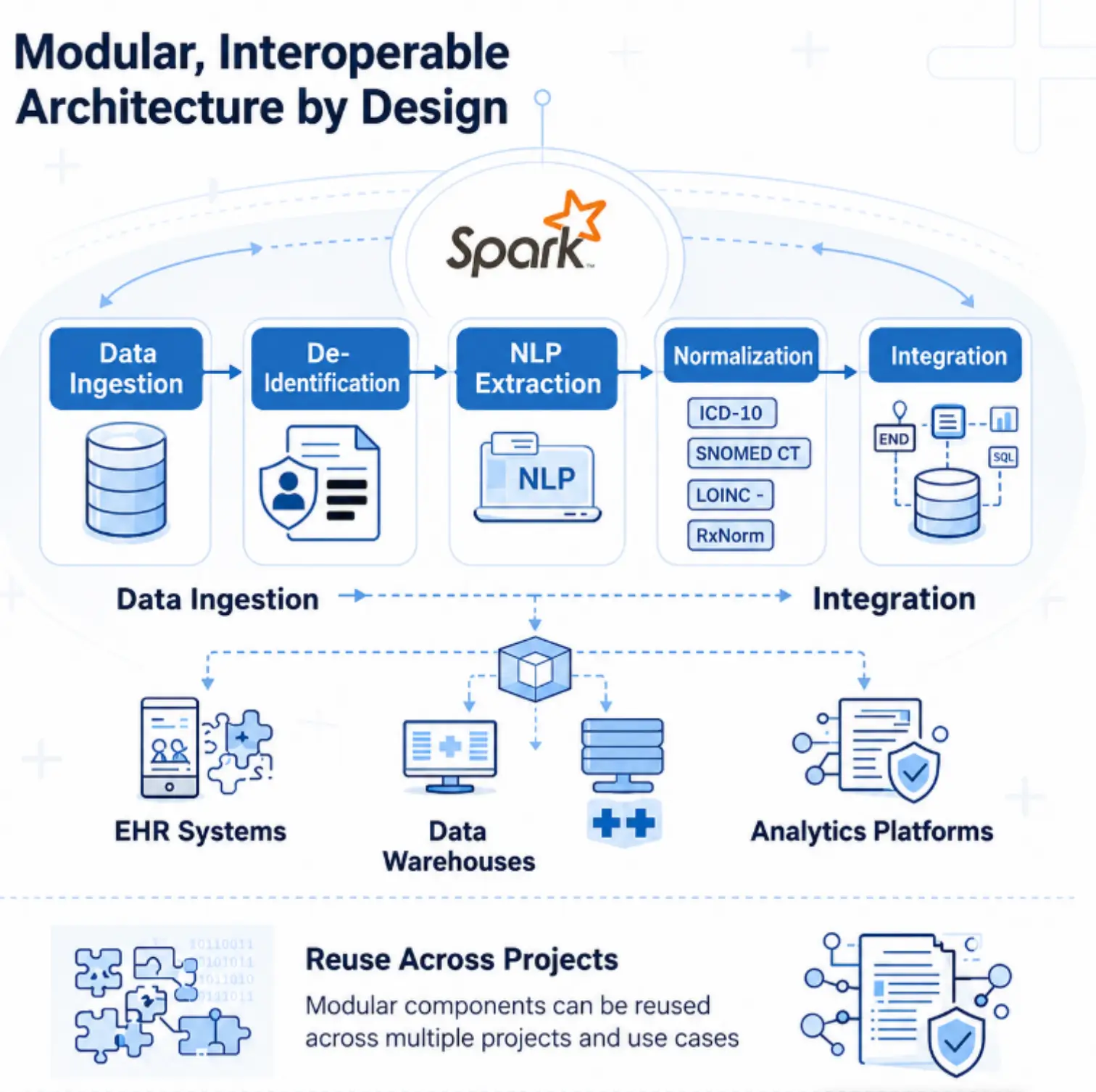
Rather than a proprietary black box, John Snow Labs’ pipelines run on Apache Spark and are built for integration into existing hospital IT ecosystems. Data moves from ingestion, to de-identification if data is reused for research, to NLP extraction, to normalization against standard terminologies, then to EHR systems, data warehouses, and analytics platforms.
This modularity supports reuse across projects. Novartis applied this approach in its Trial Master File automation, building a pipeline of 40+ specialized NER models adaptable across document types without rebuilding from scratch. The same extraction and normalization components served multiple downstream use cases.
Supporting multimodal and longitudinal data
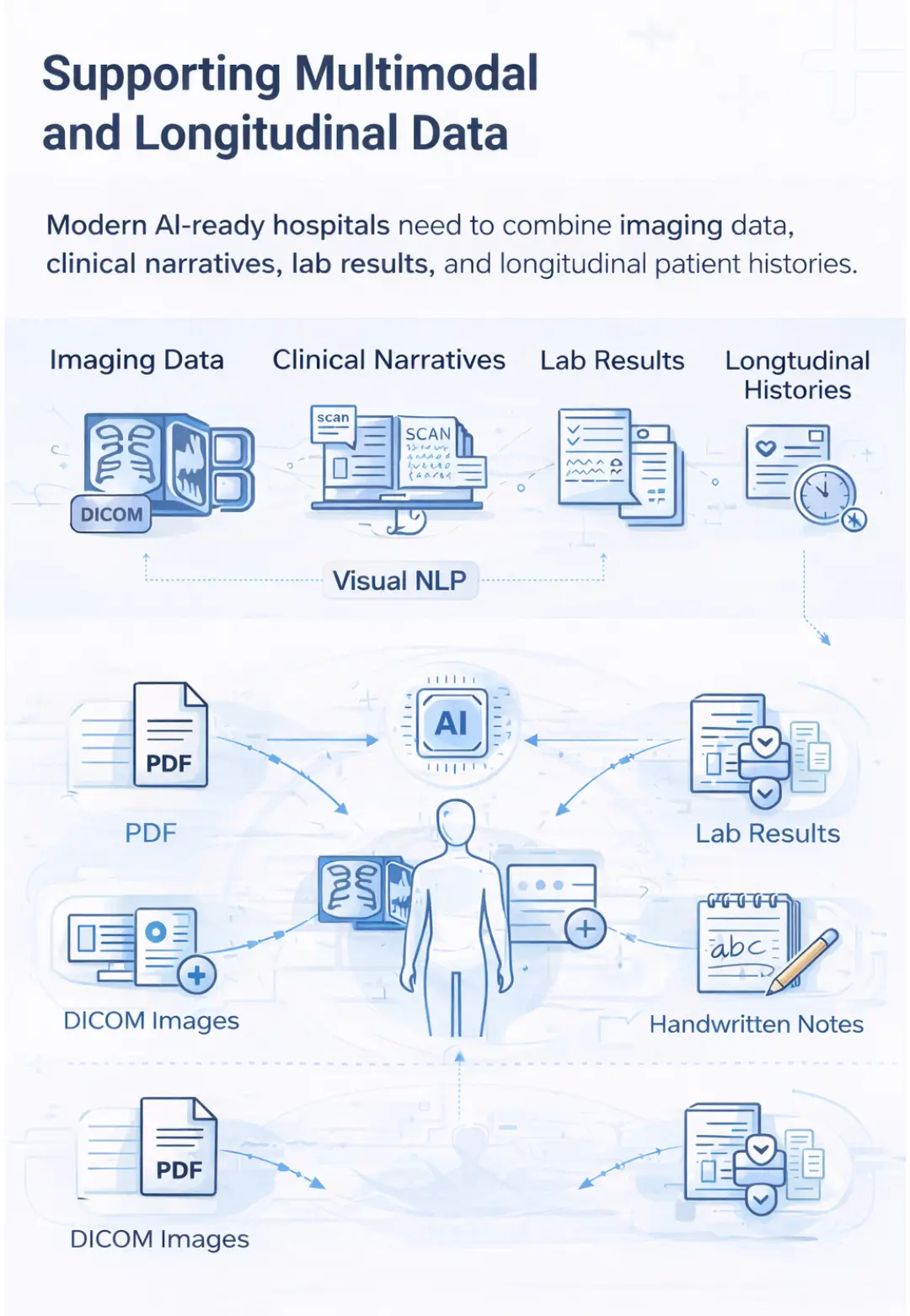
AI-ready hospitals need to combine imaging data, clinical narratives, lab results, and longitudinal patient histories [Hao et al., 2025]. Visual NLP processes scanned documents, PDFs, DICOM images, and handwritten notes, a requirement for institutions with legacy paper records or mixed-format documentation. Paired with clinical text processing, this supports the complete patient view that advanced AI applications need.
MLOps and governance built in
Closing the data governance gap
Most healthcare data platforms govern access at the level of the file or table: a permission on a dataset, a versioned snapshot. That granularity answers questions about a study population. It cannot answer a per-value audit question: where did this specific fact come from, which model extracted it, how confident was the extraction, and how was a conflict with another source resolved. The FDA’s December 2025 final guidance on real-world evidence for medical devices sharpens this expectation: sponsors must submit a relevance and reliability assessment of the underlying real-world data, and where multiple data sources contribute, address how each one affects the reliability of the final dataset, with data provenance and audit trails documented rather than assumed. That guidance also relaxed the requirement to submit identifiable participant-level data, which shifts the burden onto the documentation itself: if a regulator cannot inspect the underlying records, the dataset has to carry its own evidence of where each value came from [FDA, 2025].
John Snow Labs’ Patient Journey Intelligence platform is built around fact-level provenance from first ingestion: every extracted clinical fact carries its source document, extraction model version, and confidence score as a native attribute, not a metadata table added later. Identified and de-identified datasets are maintained in parallel from first ingestion rather than de-identified only at export, a design consistent with GDPR Article 25 and the HIPAA Minimum Necessary standard. Every access event is recorded in a tamper-evident, hash-chained audit log, which is what the audit-trail provisions of 21 CFR Part 11 are designed to establish.
Provenance at ingestion only covers half the problem. A 2025 report to the FDA on AI healthcare product approvals identified gaps in post-market surveillance and safety evaluation across approved AI products [Abulibdeh et al., 2025], precisely what fact-level provenance and continuous audit logging are built to address.
Real-world integration into clinical workflows
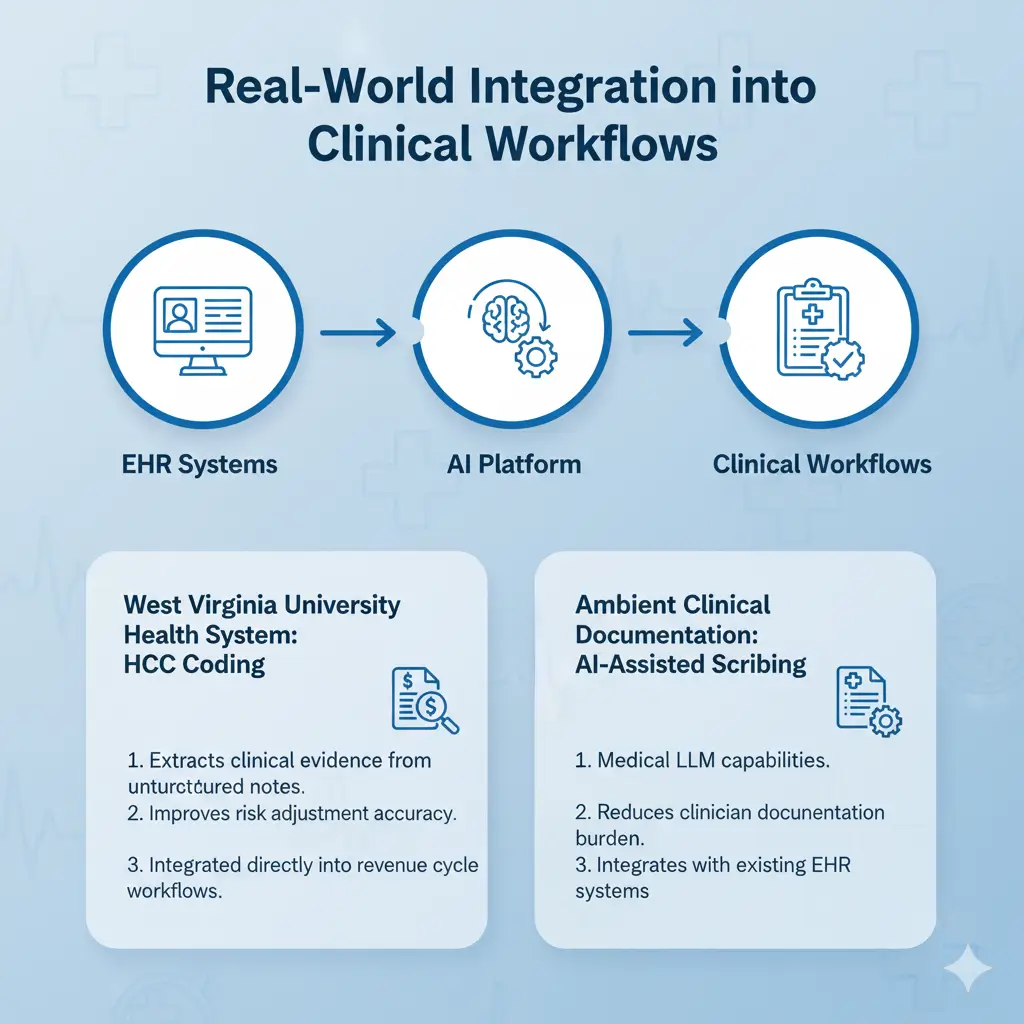
Workflow integration means embedding AI into daily operations, not leaving it as a separate pilot. West Virginia University Health System demonstrates this with HCC coding, extracting clinical evidence from unstructured notes to improve risk-adjustment accuracy directly within revenue-cycle workflows.
For ambient clinical documentation, Medical LLM supports generative AI applications that reduce documentation burden while maintaining clinical accuracy, integrating with existing EHR systems for natural-language queries and automated summarization without disrupting established workflows.
Addressing the staffing and skills gap
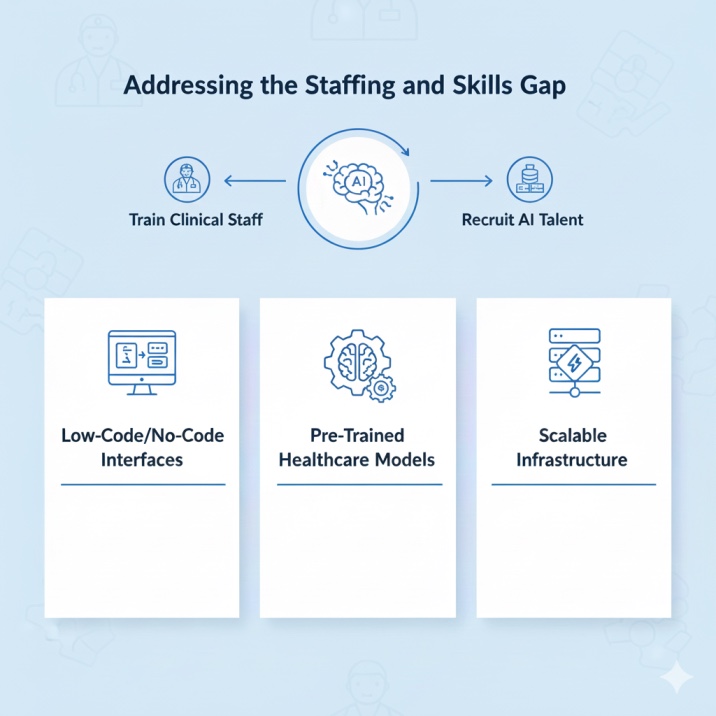
The workforce challenge is real: hospitals need data engineers, ML specialists, and AI-aware informaticists, and they need to train existing clinical staff. John Snow Labs addresses both:
- Low-code and no-code interfaces: Generative AI Lab lets clinical domain experts build and validate NLP models through visual interfaces, reducing dependency on scarce data-science talent.
- Pre-trained healthcare models: rather than training from scratch, teams start from 3,000+ pre-trained models for clinical entity extraction, relation extraction, and assertion detection, cutting deployment time and required ML expertise.
- Runs on infrastructure hospitals already have: where a health system has already standardized on a Spark-based lakehouse, as Intermountain Health did with Databricks, the pipelines deploy onto platform and skills the organization has already invested in, rather than requiring a parallel stack.
De-identification as a foundation for multiple use cases
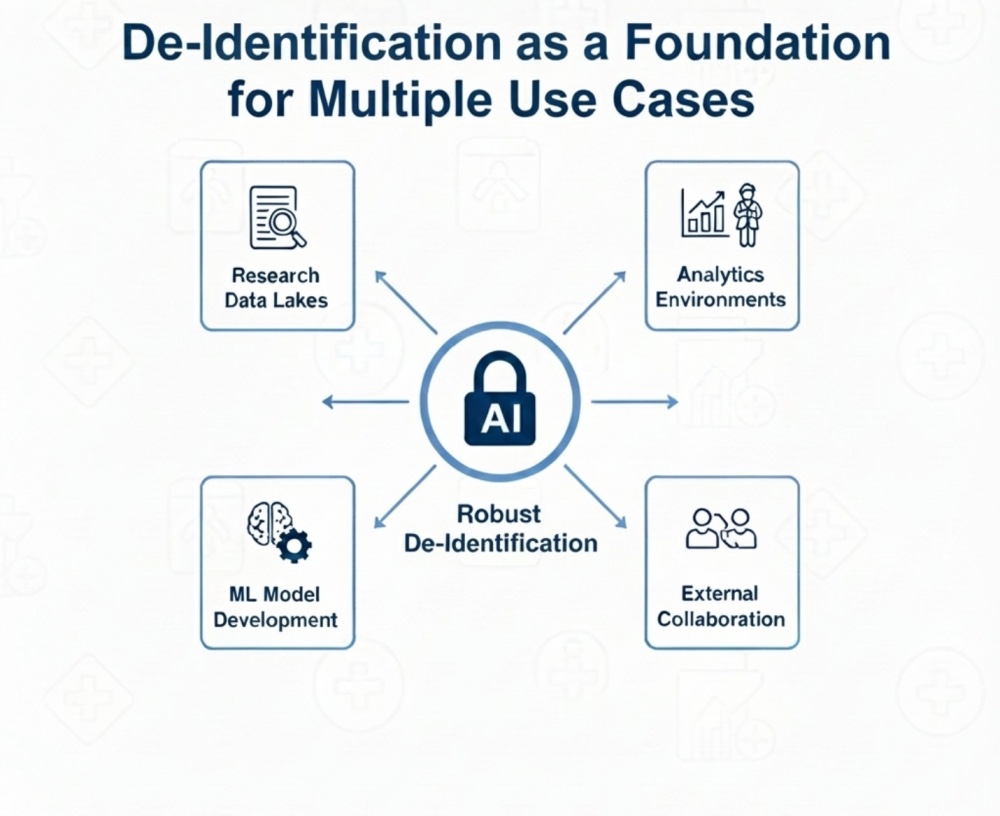
De-identification isn’t only useful for data sharing. Validated de-identification infrastructure also enables:
- Research data lakes that satisfy IRB requirements
- Analytics environments where data scientists work without PHI access restrictions
- Model development on real clinical data
- Collaboration with external research partners and health information exchanges
Providence’s experience illustrates this: its initial focus on de-identification opened the door to research collaborations, quality-improvement initiatives, and population-health analytics that would not have been possible without that foundational capability.
A practical path to the clinical-data pipeline
Building the clinical-data pipeline does not require replacing existing systems outright. Organizations typically start with one high-value use case, research acceleration, de-identification for data sharing, or clinical trial recruitment, and build the foundational pipeline to support it. That same infrastructure then supports additional AI applications without redundant integration work.
This phased approach matches the roadmap below: assess infrastructure, build core data pipelines, pilot key use cases, then scale across departments. The modular design means investments in normalization, de-identification, and extraction compound across AI initiatives instead of requiring a separate build for each project.
A roadmap to become AI-ready: 7 strategic steps
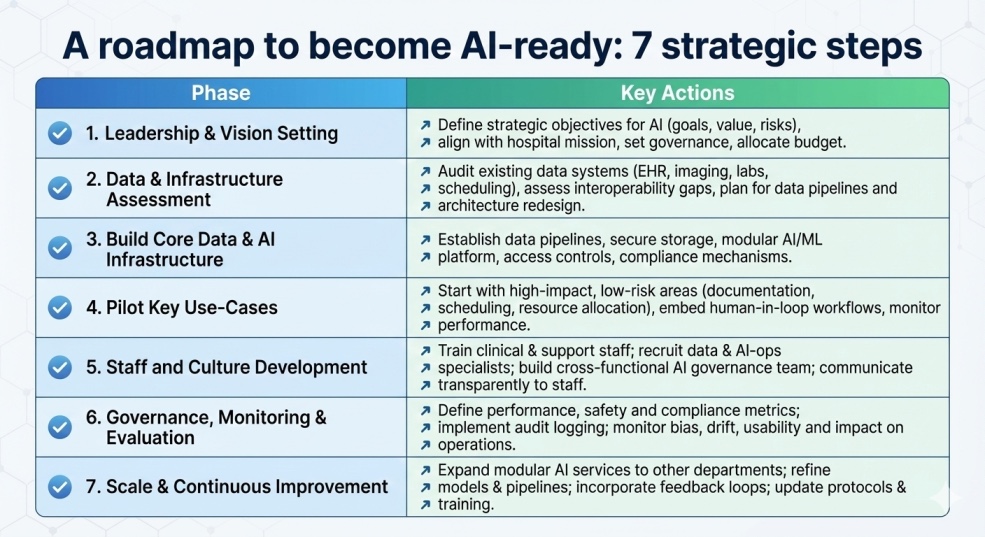
This roadmap, while ambitious, lays out a structured, phased path from pilot AI tools to a fully AI-ready hospital.
Risks and challenges: what could go wrong, and how to mitigate it
No transformation is risk-free. Common risks and mitigations:
- Data privacy and security breaches: mitigate by design, encryption, access control, audit logs, and compliance oversight [Ahmed et al., 2023].
- Bias, inequity, and unfair outcomes: mitigate with representative data, bias audits, fairness testing, and transparent governance. A 2026 fairness-auditing study makes the practical point that audits are only defensible when bias is traceable, which means testing against recorded data provenance rather than model outputs alone [Alu et al., 2026].
- Regulatory and liability uncertainty: mitigate by aligning with evolving regulations, rigorous validation, human-in-the-loop review, and documented audit trails. Reviews of the ethical and regulatory landscape converge on accountability, transparency, and human oversight as the recurring requirements across the EU AI Act, WHO guidance, and national frameworks [Singh & Keche, 2025].
- Operational and change-management resistance: mitigate through stakeholder engagement, training, phased rollout, and directly addressing staff concerns, within a system-level approach spanning assessment, implementation, and continuous monitoring [Abdelwanis et al., 2026].
- Resource constraints, cost, skills, and time: mitigate by prioritizing high-impact pilots, using modular design, partnering with vendors or academic institutions, and building internal capacity gradually. A 2026 scoping review of medical AI deployments across low- and middle-income countries found success depends less on model sophistication and more on stable systems, trustworthy data, and trained staff [Al-Ganad et al., 2026].
Awareness of these risks, paired with proactive planning, is what keeps AI-readiness from becoming a source of failure instead of transformation.
Why now is the time for hospitals to commit to AI readiness
The tooling has matured: advances in generative AI, LLMs, modular architecture, and data governance are now paired with standardized MLOps maturity frameworks for healthcare, making scalable deployment more workable than in prior years [Li et al., 2025].
Pressure on healthcare systems is rising: staffing shortages, administrative burden, burnout, and cost pressure make AI’s potential relief harder to ignore.
Regulatory and governance frameworks are evolving: a 2025 report to the FDA on AI healthcare product approvals identified gaps in post-market surveillance and safety evaluation [Abulibdeh et al., 2025], reinforcing the shift toward continuous monitoring and audit-ready infrastructure rather than one-time validation.
Long-term value and competitive advantage: AI-ready hospitals can adopt new AI-driven capabilities, scale what works, respond to changing care demands, and deliver more efficient care, gaining a durable strategic advantage.
Conclusion: building the foundations today to deliver tomorrow’s AI-enabled care
The next decade will decide whether AI reshapes healthcare in a meaningful way, or stays an assortment of disconnected pilots. For hospitals, the choice is direct: commit early to the infrastructure, governance, culture, workflows, and skills that support AI at scale, or risk falling behind.
An AI-ready hospital is defined by a foundation that supports continuous, safe, and auditable AI-driven innovation across departments, more than by any single tool. Institutions already building these foundations, like Intermountain’s 70% efficiency gain in research or Providence’s 2-billion-note de-identification infrastructure, are building the platforms that will define competitive advantage for the next decade. The question for hospital leadership: build that foundation now, or spend the 2030s retrofitting it.
FAQ
What does it mean for a hospital to be AI-ready? An AI-ready hospital has the data architecture, governance, workflows, and staffing in place to run AI safely and repeatably at scale, rather than as a series of disconnected pilots. It spans four dimensions: technology architecture and data infrastructure, culture and governance, clinical and operational workflows, and staffing and skills.
What is a clinical-data pipeline, or clinical-data foundry? It’s a dedicated infrastructure layer that ingests, harmonizes, de-identifies, and normalizes data from clinical notes, labs, imaging, and structured EHR entries into a single, queryable, AI-ready dataset, avoiding redundant integration work for every new AI pilot.
Why do isolated AI pilots fail to scale? Isolated pilots typically lack shared data infrastructure, governance, and MLOps support. Each pilot rebuilds its own data pipeline, so investment doesn’t compound. A modular architecture reuses the same extraction, normalization, and governance layers across projects instead.
What is fact-level provenance, and why does it matter? Fact-level provenance means every extracted clinical fact carries its source document, extraction model version, and confidence score as native attributes. It matters because regulators increasingly expect a submission to show how each value was produced; when they cannot inspect the underlying records, per-fact traceability is what makes that documentation credible.
How long does it take to become AI-ready? Based on the evidence reviewed here, AI-readiness is a multi-year effort, not a single deployment. Organizations typically start with one high-value use case, build the supporting data pipeline, and scale that infrastructure across additional use cases over several years.
Does AI reduce the need for hospital staff? Not based on current evidence. Roles shift rather than disappear: hospitals need new AI-ops and governance roles, and existing clinical and administrative staff need training to interpret AI outputs, oversee AI-assisted workflows, and know when to override them.
What’s the biggest barrier to AI adoption in hospitals? It depends who you ask. Review-level evidence points to inadequate training, clinician resistance, infrastructure limits, and data governance [Abdelwanis et al., 2026]. Health systems surveyed directly rank it differently: immature AI tooling (77%), cost (47%), and regulatory uncertainty (40%) came out on top, while in-house expertise and leadership support were rarely named among the top two [Poon et al., 2025].
How does de-identification support use cases beyond compliance? Once a hospital has validated de-identification infrastructure, it also enables IRB-compliant research data lakes, PHI-restriction-free analytics environments, model development on real clinical data, and collaboration with external research partners.
How do you stop AI models from degrading after deployment? Performance drifts as patient populations, input parameters, and technology change, so validating a model at go-live is not enough. Structured post-deployment surveillance, monitoring accuracy, safety, bias, and drift on a defined cadence, is what keeps a deployed model trustworthy [Quinn et al., 2025].
What changed with the FDA’s December 2025 real-world evidence guidance? It superseded the 2017 guidance of the same name for medical devices, expanded the recommendations for assessing whether real-world data are relevant and reliable, and relaxed the expectation that identifiable participant-level data accompany every submission. The practical effect is that documentation, validation, and data provenance carry more of the burden of proof [FDA, 2025].