

 Demos
Demos















Large language models (LLMs) have captured the spotlight with their ability to generate fluent, contextual responses across a wide range of medical use cases. But beneath the hype, a quieter truth persists: natural language processing (NLP) remains the foundational layer of healthcare AI. It is the mechanism by which unstructured clinical notes are transformed into structured, standardized, and actionable data, the kind that drives decision support, quality reporting, registry submissions, and reimbursement.
At institutions deploying AI safely and at scale, NLP and LLMs are complementary: NLP enables LLMs to be clinically usable. This is why John Snow Labs has invested in building the most advanced NLP platform tailored specifically to the needs of healthcare.
Why doesn’t fluent clinical text mean usable data?
Large language models are genuinely good at producing human-readable text. They can summarize discharge notes, draft patient letters, and even suggest differential diagnoses with apparent fluency. But a health system doesn’t ship fluent text to a quality measure, a registry, or a payer. It ships structured, coded, compliant, and auditable data.
Any system deployed at production scale in a regulated clinical environment has to satisfy several requirements at once: clinical accuracy, patient privacy, processing scale, cost, and regulatory compliance. Fluency alone satisfies none of them. The difference shows up first in three everyday documentation patterns: negation, temporal status, and terminology mapping.
What do LLMs get wrong in clinical notes?
Example 1: The negation problem
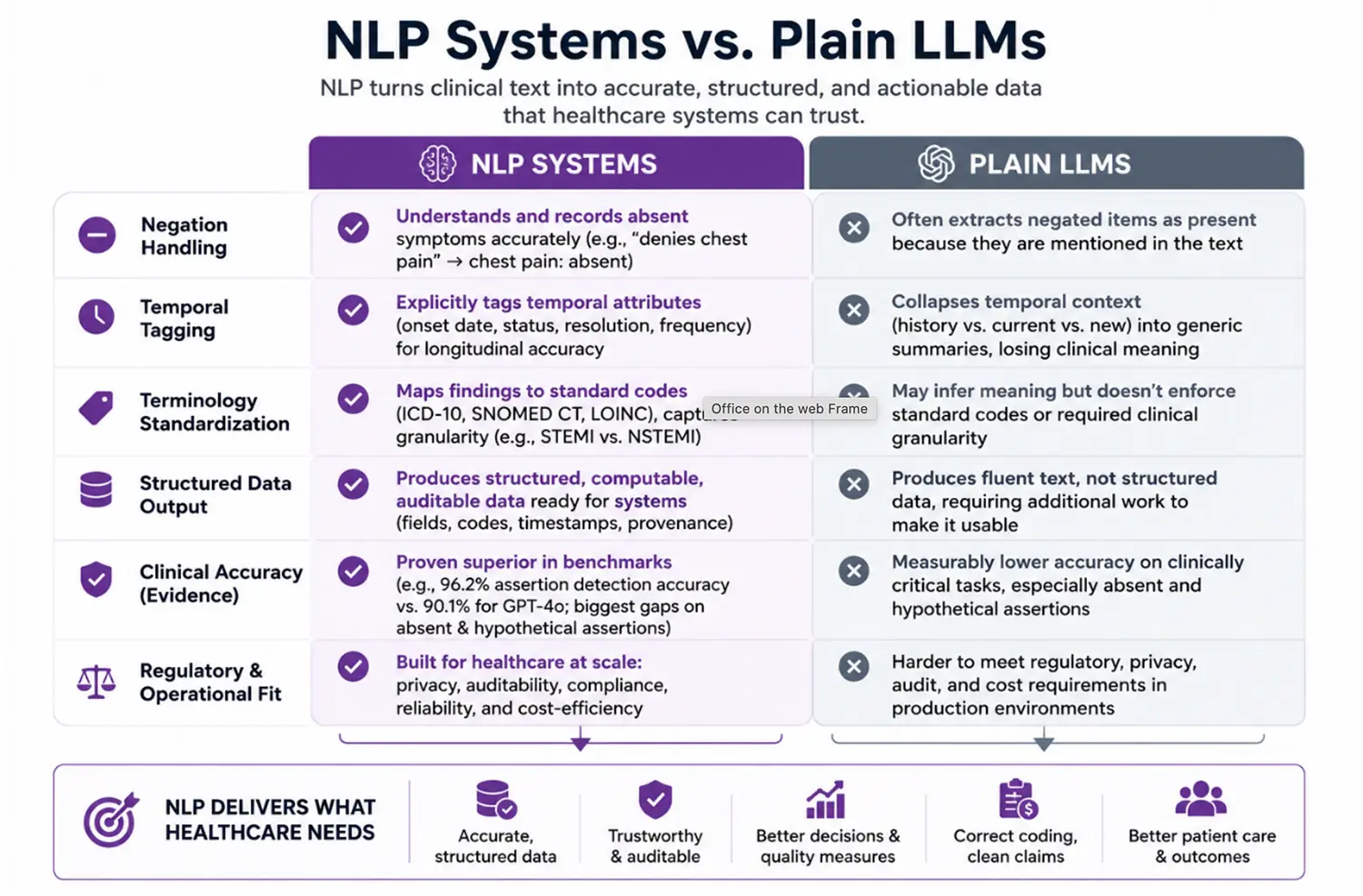
An LLM reading “Patient denies chest pain, shortness of breath, and palpitations” might extract all three symptoms as present findings. After all, they’re mentioned in the text. A properly trained clinical NLP system understands the negation structure and records:
- Chest pain: absent
- Shortness of breath: absent
- Palpitations: absent
That distinction decides whether a cardiac workup alert fires, whether a quality measure calculates correctly, and whether a claim gets paid or denied. It is also where general-purpose models measurably fall short: in a peer-reviewed benchmark, John Snow Labs’ assertion detection models reached 96.2% accuracy across present, absent, hypothetical, conditional, and family-history categories, against 90.1% for GPT-4o, with the widest gap on exactly the categories that change clinical meaning: absent assertions (+8.4 points) and hypothetical assertions (+23.4 points).
| Model | Assertion detection accuracy |
|---|---|
| Healthcare-specific NLP (John Snow Labs) | 96.2% |
| GPT-4o | 90.1% |
Example 2: Temporal context collapsed
Compare two phrases:
- “History of diabetes diagnosed 15 years ago, well-controlled on metformin” and
- “Diagnosed with diabetes today, started on metformin.”
Both mention diabetes and metformin. A model summarizing the chart might collapse them into the same sentence: “Patient has diabetes, taking metformin.” They are not the same clinical reality. One is chronic disease management; the other is a new diagnosis requiring different coding, follow-up, and documentation.
NLP systems explicitly tag temporal attributes, onset date, status (historical vs. current), resolution, frequency. This enables accurate longitudinal records. LLMs often collapse these distinctions into narrative summaries that sound correct but lose critical structured information.
Example 3: Terminology standardization without standards enforcement
An LLM might read “pt had MI last week” and correctly infer “myocardial infarction” in a summary. That is real linguistic understanding. But summarizing is not the same job as:
- Map the finding to the correct ICD-10 code (I21.9 for unspecified MI, or more specific codes if documented)
- Resolving SNOMED CT concept 22298006
- Distinguishing between STEMI and NSTEMI when that detail sits somewhere in the note
- Extracting whether it’s the principal diagnosis or a complication
- Normalizing the event date for registry submission.
These are not edge cases. They’re the daily requirements of clinical data systems. Quality reporting depends on them. Value-based care contracts require them. Billing compliance demands them.
LLMs generate plausible text. NLP systems generate computable data.
How much clinical information hides in free text?
John Snow Labs’ clinical data accuracy gap research reviewed dozens of peer-reviewed studies and found a consistent pattern: structured EHR data alone misses 40 to 87% of clinically relevant information.
- 40% of important diagnoses appear only in free-text notes and are absent from structured problem lists (Poulos et al., 2021).
- 93.8% of patients with adverse social determinants of health are identified by NLP on notes, versus 2% by ICD-10 Z-codes alone (Guevara et al., npj Digital Medicine, 2024).
- 68%+ of cancer staging data is missing from structured fields and exists only in pathology narratives (Emamekhoo et al., JCO Clinical Cancer Informatics, 2022).
- 60 to 70% of medication histories contain at least one error, and more than 90% of patients have at least one discrepancy between their structured medication list and what clinicians documented in notes and discharge summaries (Lombardi et al., Rev Lat Am Enfermagem, 2016; Ahmadi et al., Pharmacy, 2024).
A model trained or prompted only against structured data is working from a fraction of the available clinical signal before it ever generates a single word. NLP is what recovers the rest of it.
But clinical documentation is notoriously complex: physician notes, discharge summaries, imaging reports, and pathology findings contain a mix of abbreviations, shorthand, ambiguous language, and embedded context. These documents cannot be fed into decision systems directly. NLP is what reads between the lines, identifying that “no signs of pneumonia” is not a diagnosis, that “family history of diabetes” does not apply to the patient, and that “ASA” in a cardiology note likely refers to aspirin, not an organization.
John Snow Labs’ models handle these challenges through specialized components for negation detection, temporality, abbreviation resolution, and assertion classification. This creates a structured, OMOP- or FHIR-compatible data layer from which AI, analytics, and human decision-making can all operate more effectively. You can test different functionalities through the live Healthcare NLP demo
Why can’t LLMs replace healthcare-specific NLP models?
LLMs can summarize and infer, but they cannot reliably extract structured, codified data at scale. They do not enforce terminology standards like SNOMED or LOINC, nor do they consistently apply clinical logic. They may generate readable text, but without NLP systems, that output does not integrate into a hospital’s existing workflows or meet the compliance needs of regulatory frameworks like HIPAA or the EU AI Act.
For example, a generative model might produce an elegant discharge summary, but it is the NLP system that ensures all medications are identified, normalized, and matched to dosage codes. Without this, quality measures cannot be calculated and billing data cannot be validated.
How does John Snow Labs keep NLP central to healthcare AI?
John Snow Labs has built a production-grade NLP stack designed to operate in concert with LLMs but remain independently valuable. It includes:
- Over 3,000 pretrained models and pipelines for domain-specific tasks like oncology abstraction, radiology report parsing, and surgical note analysis.
- Small, task-specific models that run on commodity hardware without GPU clusters, keeping inference cost and latency low enough to process entire document archives.
- Spark-based scalability that enables processing of billions of documents across institutions, including de-identification and terminology mapping at petabyte scale.
- Deterministic output: the same note processed twice yields the same structured result, which is what makes validation, auditing, and regulatory review possible.
- Full support for FHIR, integration with Databricks, and compliance with privacy regulations globally.
These tools form the infrastructure on which trustworthy, real-world clinical AI is built.
What is next for NLP in healthcare as LLMs advance?
Far from being replaced, NLP is evolving to complement LLMs. The future lies in hybrid systems, where LLMs offer human-like reasoning and language generation, and NLP provides precision, structure, and traceability. This combination ensures that every clinical interaction, whether a note, an image, or a voice transcript becomes both machine-readable and machine-actionable.
NLP is indispensable to healthcare AI.
Frequently asked questions
What is NLP in healthcare?
NLP in healthcare is the use of language models trained on clinical text to convert unstructured documentation, physician notes, discharge summaries, pathology and radiology reports, into structured, standardized, and actionable data. It is what allows decision support, quality reporting, registry submissions, and reimbursement systems to work from clinical facts rather than free text.
How is healthcare-specific NLP different from a general-purpose LLM?
A general-purpose LLM generates fluent text and can infer meaning, but it is not built to enforce clinical terminology standards or consistently apply assertion logic at scale. In a peer-reviewed benchmark, John Snow Labs’ healthcare-specific assertion detection models reached 96.2% accuracy versus 90.1% for GPT-4o, with the largest gains on the categories, absent and hypothetical findings, that change clinical meaning.
Why does negation detection matter in clinical NLP?
Negation determines whether a symptom is present or ruled out. A note stating a patient denies chest pain contains the words “chest pain,” but the clinical fact is the opposite. Missing this distinction can trigger the wrong clinical alert, miscalculate a quality measure, or result in a denied claim.
Why is temporal context important in clinical documentation?
Two notes can mention the same diagnosis and medication, one describing a well-controlled chronic condition and the other a brand-new diagnosis, yet require entirely different coding, follow-up, and documentation. Healthcare-specific NLP tags onset date, status, and resolution explicitly, so a longitudinal patient record reflects what actually happened and when.
How much clinical information is missed by structured EHR data alone?
Peer-reviewed research reviewed by John Snow Labs found that structured EHR fields alone miss 40 to 87% of clinically relevant information, including diagnoses documented only in free-text notes, social determinants of health identified almost exclusively through NLP, and the majority of cancer staging detail, which exists mainly in pathology narratives rather than coded fields.
Can LLMs replace healthcare NLP pipelines?
No. LLMs are strong at summarization, generation, and reasoning, but they do not reliably enforce terminology standards such as SNOMED CT or LOINC, or consistently apply clinical logic such as negation and assertion detection. Production healthcare AI systems combine healthcare-specific NLP for extraction and terminology mapping with LLMs for language generation and reasoning.
What terminology standards does healthcare NLP map to?
Healthcare-specific NLP maps extracted concepts to over 40 standard clinical vocabularies including ICD-10, SNOMED CT, RxNorm, and LOINC. This is what lets a single extracted fact feed quality reporting, registries, and billing systems consistently.
Where can I test John Snow Labs’ Healthcare NLP models?
You can test negation detection, temporal tagging, and terminology mapping directly in the Healthcare NLP live demo.