

 Demos
Demos





























HEDIS isn’t being retired, but its hybrid data-collection method is. See what digital quality measures and ECDS reporting require from clinical data infrastructure through 2030.
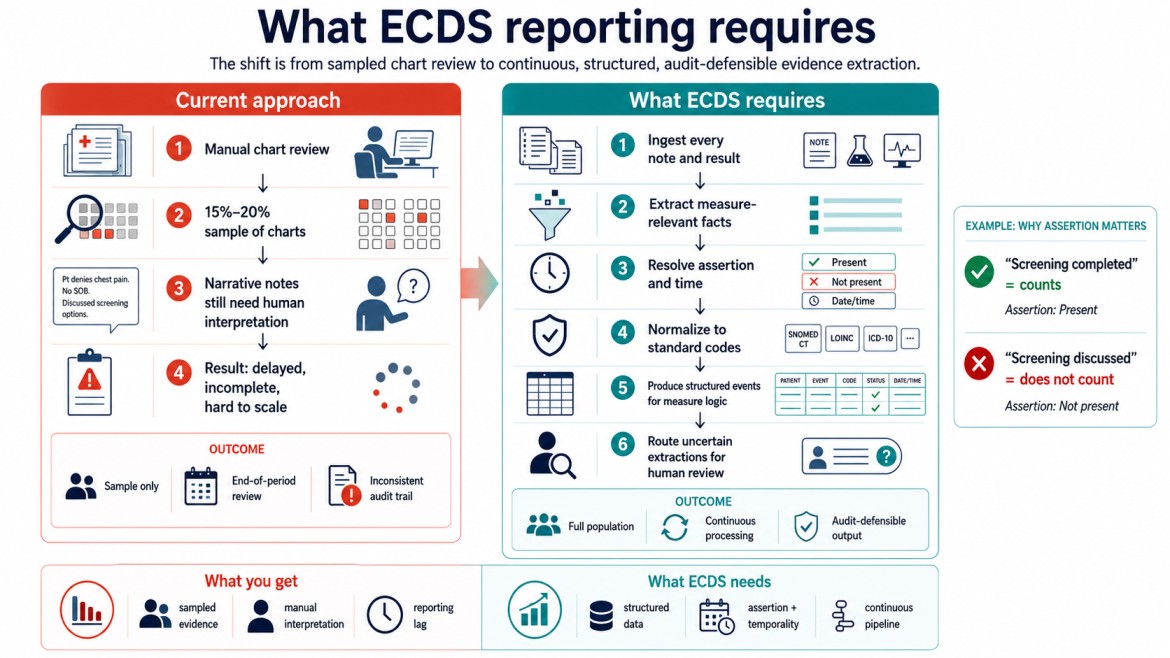
Chart abstraction reviews a 15%–20% sample after the fact. ECDS requires ingesting every note, resolving assertions and timing, and producing structured, audit-defensible output continuously.
Digital quality measures (dQMs) compute automatically from electronic clinical data instead of a sampled chart pull. HEDIS itself is not going anywhere: what NCQA is retiring is the hybrid method, one specific data-collection approach, used for a subset of measures, that pairs claims data with a manual chart-review sample. That retirement runs on a fixed schedule that reaches full digital data collection for those measures by measurement year 2030, starting with lead screening in children moving to administrative-only reporting in MY 2026 (NCQA, 2024). The deadline is fixed. What most health plans and provider organizations have not yet solved is that most of the clinical evidence those measures need still lives in free text, not structured fields.
Why is NCQA retiring hybrid measures on a fixed schedule?
Hybrid HEDIS measures pair claims data with a manual chart-review supplement, the mechanism that let a colonoscopy documented only in a gastroenterology note, or a blood pressure reading buried in a progress note, still count toward a numerator. NCQA’s published transition sequence retires that supplement measure by measure: lead screening in children moves to administrative-only reporting for MY 2026, weight assessment and counseling for children and adolescents follows in MY 2027, and prenatal and postpartum care moves to administrative-only in MY 2028 alongside controlling blood pressure and blood pressure control for patients with diabetes, both of which shift to Electronic Clinical Data Systems (ECDS) reporting that same year (NCQA, 2024). Glycemic status assessment, transitions of care, and care for older adults follow into ECDS by MY 2029.
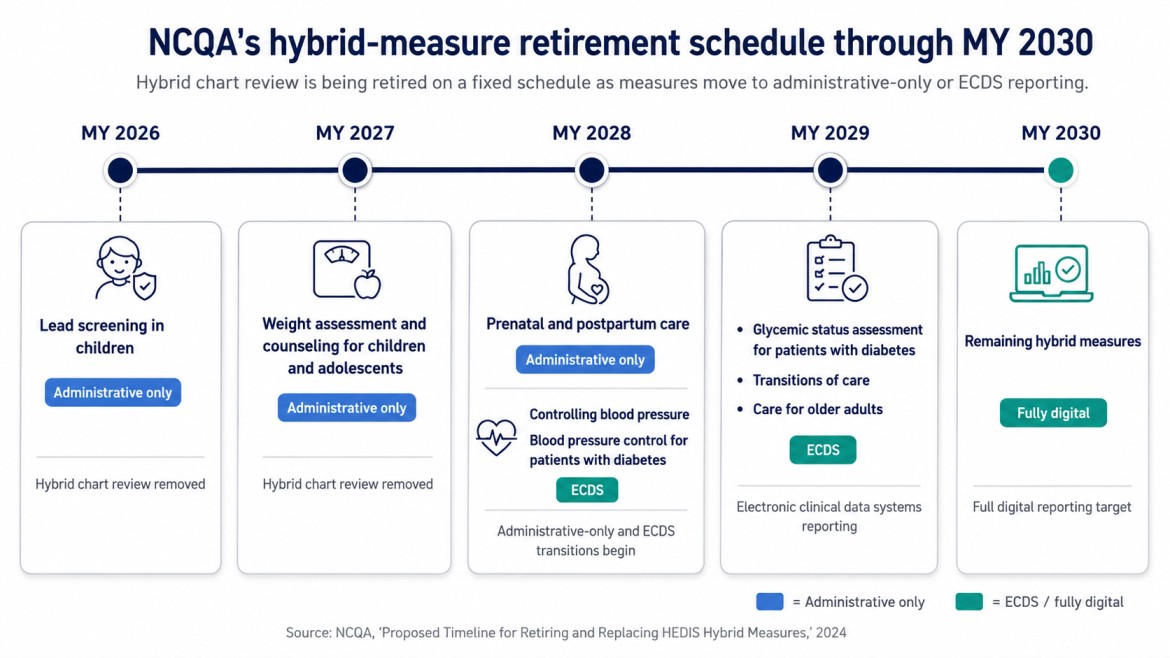
NCQA retires hybrid chart review on a fixed schedule through MY 2030 – starting with administrative-only reporting for lead screening in MY 2026 and ending with all remaining hybrid measures fully digital.
The market is already moving faster than the mandate. Among Medicare plans, the share reporting core HEDIS measures through ECDS rather than hybrid or administrative methods rose from 50.0% in measurement year 2021 to 95.1% in MY 2023, with commercial plans at 100% and Medicaid plans at 96.8% for the same period (NCQA, 2024). A plan still building its evidence pipeline around annual abstraction cycles is not just facing a future deadline. It is already an outlier against where the rest of its peer group has moved.
What does ECDS reporting require that a chart pull does not?
ECDS is a HEDIS reporting method that draws on administrative claims, clinical registries, health information exchanges, immunization registries, case-management systems, and EHRs, but it comes with a condition: NCQA requires that the data used “be stored in structured electronic formats that use standard layouts,” in contrast to the nonstandard formats hybrid and administrative reporting tolerate (NCQA, 2026). That structured-data requirement is the whole difficulty. A colonoscopy result, a smoking-cessation counseling note, or a documented follow-up visit exists in most EHRs as narrative text long before, if ever, it becomes a coded field.
CMS’s own framing of digital quality measures draws the same line. Its April 2026 fact sheet on the transition states that “dQMs use standardized, structured data drawn from one or more electronic systems,” which is what supports automated, consistent calculation, and distinguishes that from the current state where even electronic reporting specifications “still require manual review and interpretation of the measure narrative” in many states and programs (CMS, 2026). ECDS and dQMs do not remove the need to read clinical narrative. They move the reading from a human abstractor to a machine, and that machine has to produce structured output a measure logic engine can actually consume.
Why isn’t speeding up abstraction the same as building a dQM pipeline?
A hybrid measure’s chart-review supplement is designed to check a 15% to 20% sample of a population at the end of a measurement period. dQMs require continuous computation across the full population as clinical events happen. Making the sample faster does not close that gap; the sample is still a sample. What closes it is a pipeline that ingests every incoming note, discharge summary, and lab result as it arrives, extracts the entities that matter to the measure, resolves whether each one is confirmed, negated, planned, or historical, and normalizes it to a standard terminology before the measurement window it belongs to has closed.
This is where an NLP capability and a functioning dQM pipeline diverge. A model that scores well on a demonstration set can still fail in production if it has nowhere to route uncertain extractions, no versioning that lets last year’s coded output stay reproducible against this year’s model, and no mechanism for catching drift as documentation habits change across a health system’s clinical staff. Health plans and providers moving toward ECDS are effectively being asked to replace a well-understood, if slow, human process with an automated one that has to be at least as defensible under audit. That is a data-infrastructure problem before it is an NLP-accuracy problem, and organizations that treat it purely as a model-selection exercise tend to discover the gap only after their reported measures come up short.
Why do assertion and temporal accuracy decide whether a dQM is defensible?
Entity recognition alone does not satisfy a numerator. A quality measure that counts a colonoscopy or a follow-up visit has to know whether the event actually happened, when, and to whom, not merely that the words appear somewhere in a note. This is where general-purpose language models create real risk for dQM and ECDS reporting: they are not built to resolve the negation, hedging, and time-anchoring that clinical narrative is full of. In a blinded evaluation covering present, absent, hypothetical, conditional, and third-party assertion categories, a fine-tuned healthcare-specific model reached 0.962 combined accuracy against GPT-4o’s 0.901, with the largest gap, a 23.4-point advantage, on hypothetical statements, the exact category that separates “screening completed” from “screening discussed but not scheduled” (Kocaman et al., 2025). For a measure feeding a regulatory submission, that gap is not academic. It is the difference between a numerator a compliance team can defend under a RADV-style review and one that needs a second manual pass anyway, which erases the automation gain a dQM pipeline is supposed to deliver.
Why does continuous processing have to be fast, not just accurate?
ECDS and dQM pipelines are not batch jobs run once a year. They ingest documentation as it is created, which means the underlying NLP layer has to hold accuracy at production throughput, not only on a curated benchmark set. On a real-world clinical note corpus, a purpose-built healthcare NLP pipeline reached 0.95 F1 and 0.98 recall on PHI detection, against 0.55 F1 and 0.64 recall for a general-purpose privacy filter built on a frontier LLM, while running 5.8 times faster on the same CPU hardware (Gul, 2026). That combination, higher recall and lower latency in the same pass, is what a continuous pipeline needs to protect patient data before it ever reaches measure logic, without becoming the bottleneck the abstraction cycle used to be.
That kind of throughput has already been proven at population scale. Ohio State University Wexner Medical Center runs a production pipeline processing more than 200 million Epic clinical notes across seven hospitals, combining cohort selection, de-identification, extraction, and human-in-the-loop validation on both Azure Databricks and on-premises infrastructure (Huerta, 2025). At Providence St. Joseph Health, an independent red-team audit of 790 randomly selected patients found no successful re-identifications across a corpus of roughly 2 billion de-identified notes, with 99% PHI obfuscation, a validation standard run against production data’s full documentation diversity rather than a curated test set (Kocaman et al., 2025). A dQM or ECDS pipeline reporting into a regulatory audit needs that same standard of proof, not a demo-environment accuracy score.
Where should you start before the next NCQA deadline?
Organizations closest to a hybrid-to-ECDS deadline should not start by shopping for a dQM software product. Start by asking what fraction of the clinical evidence for your highest-volume measures currently sits only in free text, and whether your extraction pipeline resolves assertion and timing correctly enough to survive an audit, not just an entity-recognition benchmark. Healthcare NLP and Generative AI Lab are built for exactly this combination: continuous, on-premises extraction with assertion and temporal logic as first-class outputs, and a human-in-the-loop layer for the residual cases a model should not resolve alone.
Extraction alone does not produce a reportable measure. Patient Journey Intelligence‘s Clinical Measures module is where normalized clinical evidence becomes a defined, versioned calculation: HEDIS and CMS quality metrics ship as standard measures in its library, with the exact thresholds and logic regulatory submission requires, computed against OMOP-standardized data and updated as new evidence arrives rather than recalculated once a year. Every patient-level result stays traceable back through its SQL logic and clinical thresholds to the source data that produced it, which is what turns a pipeline’s output into something a compliance team can defend under review rather than a number it has to re-derive by hand before an audit.
For the implementation sequence, from measure scoping through evidence provenance, see our companion post, “Closing HEDIS and Stars quality gaps: a 6-step blueprint for evidence extraction,” on the John Snow Labs blog. For the audit-defensibility layer that carries risk-adjustment evidence into RADV and CMS review specifically, see how Martlet.ai’s RADV Audit Readiness Platform applies the same encounter- and signature-verification logic ahead of an audit rather than in response to one. Request an architecture consultation scoped to your own measure set and document mix to see where the gap actually sits before the next measurement year closes it for you.
Frequently asked questions
What is the difference between a digital quality measure (dQM) and ECDS reporting? A dQM is a measure designed to be computed automatically from standardized, structured electronic data rather than abstracted from a chart sample (CMS, 2026). ECDS is NCQA’s HEDIS reporting method that defines which electronic data sources and structured formats are acceptable for a specific measure (NCQA, 2026). In practice, ECDS is the HEDIS-specific path most health plans are using today to move toward the fuller dQM model.
When is NCQA retiring hybrid HEDIS measures? On a schedule running through measurement year 2030. Lead screening in children moves to administrative-only reporting for MY 2026, weight assessment and counseling follows in MY 2027, prenatal and postpartum care and controlling blood pressure move in MY 2028, and glycemic status assessment, transitions of care, and care for older adults move to ECDS by MY 2029 (NCQA, 2024).
Why can’t health plans just make chart abstraction faster instead of automating it? Hybrid abstraction is built to review a sample, typically 15% to 20% of a population, at the end of a measurement period. dQMs require continuous computation across the full population as care happens. Speeding up a sampling process does not turn it into population-wide, continuous measurement; the underlying architecture has to change, not just the pace of the existing one.
Does ECDS reporting eliminate the need to process unstructured clinical text? No. ECDS requires structured data as input to measure logic, but most of the clinical evidence that satisfies a measure, a documented screening, a confirmed diagnosis, a completed intervention, still originates as narrative text in physician notes and discharge summaries. An NLP pipeline that extracts and normalizes that text into structured form is what makes ECDS-eligible reporting possible for most measures.
Can general-purpose LLMs handle the assertion and timing logic dQMs require? Not reliably without validation against a healthcare-specific alternative. In a blinded evaluation of assertion classification, a healthcare-specific model reached 0.962 combined accuracy against GPT-4o’s 0.901, with the largest gap on hypothetical and conditional statements, exactly the distinctions that determine whether a mentioned event actually satisfies a measure’s numerator (Kocaman et al., 2025).
What scale has this kind of continuous clinical NLP pipeline been validated at? Ohio State University Wexner Medical Center’s production pipeline processes more than 200 million Epic clinical notes across seven hospitals (Huerta, 2025), and an independent audit of Providence St. Joseph Health’s roughly 2-billion-note de-identification pipeline found 99% PHI obfuscation with no successful re-identifications across 790 randomly sampled patients (Kocaman et al., 2025). Both validations ran against production documentation rather than curated test sets.
How is this different from HEDIS and Star Ratings evidence extraction in general? The evidence-extraction techniques overlap, but this is specifically about the regulatory mechanism forcing the shift: NCQA’s fixed retirement schedule for hybrid measures and the structured-data requirements ECDS and dQMs impose. For a step-by-step implementation sequence covering measure scoping, pipeline design, and provenance, see our companion post, “Closing HEDIS and Stars quality gaps: a 6-step blueprint for evidence extraction,” on the John Snow Labs blog.
Does automating dQM and ECDS evidence extraction remove the need for human reviewers? No. Production pipelines route low-confidence extractions to human reviewers rather than reporting every result automatically. A no-code human-in-the-loop layer, such as Generative AI Lab, is what Ohio State’s 200-million-note pipeline uses to keep that review governed and auditable rather than ad hoc (Huerta, 2025).