Demos





























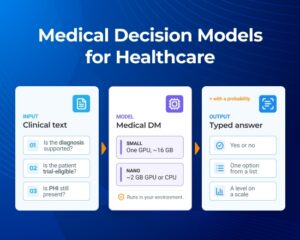
Medical DM Small and Nano turn clinical text into structured decisions, fast and affordable enough to review every note
Every team that works with clinical notes runs into the same kind of question. What grade does this pathology report state? Does this note support the diagnosis on the claim? Does this patient pass the trial’s hemoglobin threshold? Much of clinical document understanding comes down to questions like these, and at its core each one is a classification task: the answer is one of a few known options, and it is needed for every note, often for millions of them.
Most teams reach for one of two tools. They send each note to a general large language model (LLM), or they train a classifier for that one question. Both work in a demo. At scale, the LLM returns text that code has to parse, with no measure of how sure it is. The classifier has to be relabeled and retrained every time a rule changes.
Decision models are a new class of AI built for this job. A decision model answers a defined question about a document with a fixed set of answers and a probability, rather than generating text. The category took shape in September 2026, when TypeSafe AI released Jev, a general-purpose decision model. John Snow Labs Medical Decision Models (Medical DMs) are the healthcare counterpart, built and evaluated for clinical text. This post follows one pathology report through Medical DM Small, compares what teams usually assume with what we measured, and covers the nine task areas, the cost per million notes, and the cases where a generative model is still the better tool.
One pathology report from question to registry field
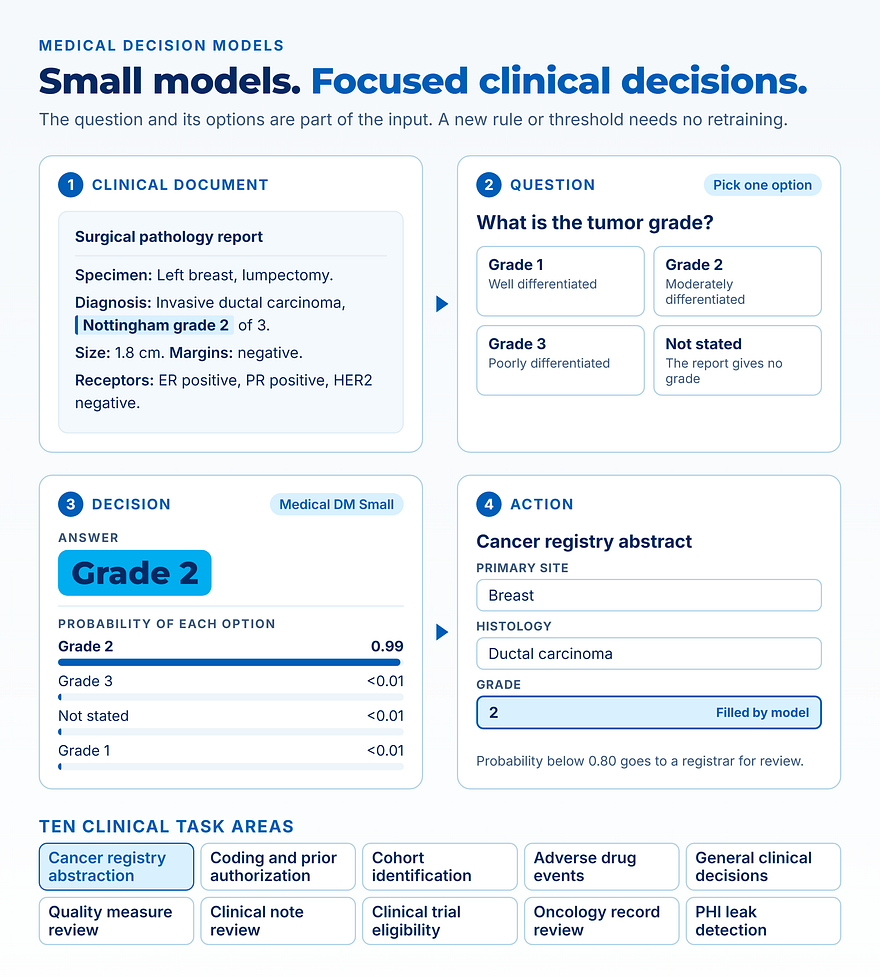
A cancer registry needs the tumor grade from every breast pathology report. Today an abstractor reads each report and types the grade into the abstract. With a Medical DM, the same work takes four steps.
Step 1: the document. The model reads the report as it is. Nothing is extracted or reformatted first.
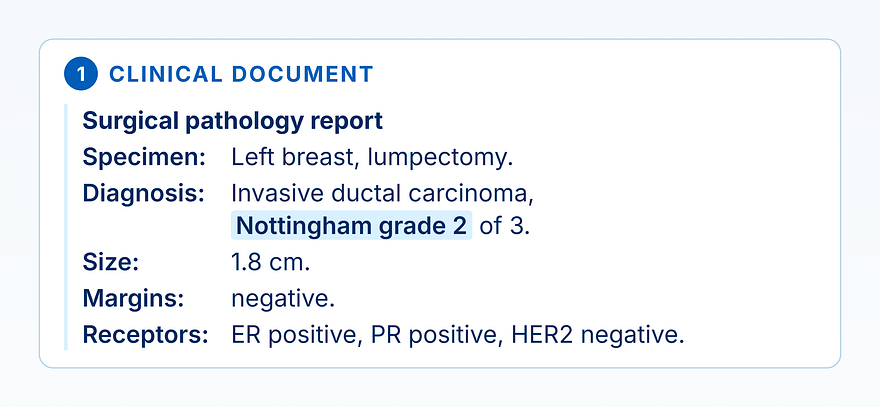
Step 1: a synthetic surgical pathology report.
Step 2: the question. You write the question and the answers you accept, each with a short description. “Not stated” is one of the answers, so a report without a grade is never forced into one.
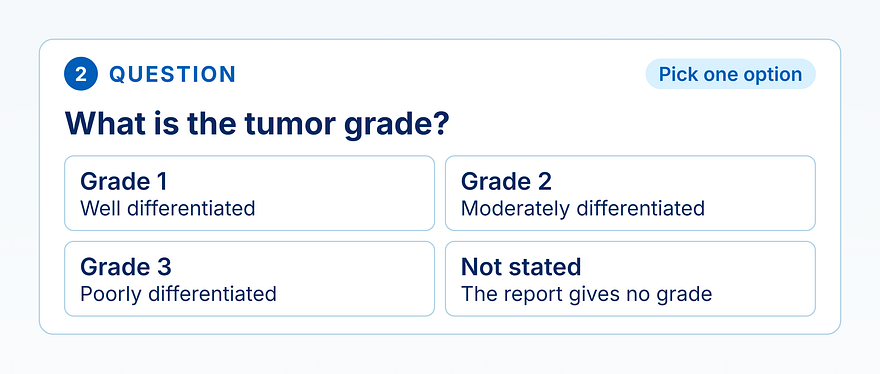
Step 2: the question and the four answers it accepts.
Step 3: the decision. Medical DM Small returns grade 2 with a probability of 0.99. The other three answers share the rest. The model writes no text, so the answer is always one of your four options.
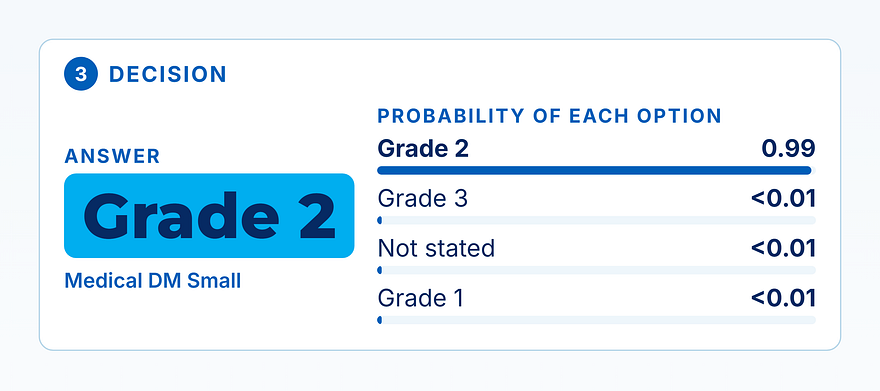
Step 3: Medical DM Small’s answer and the probability of each option.
Step 4: the action. The grade field in the registry abstract is filled. Any answer below 0.80 goes to a registrar instead.
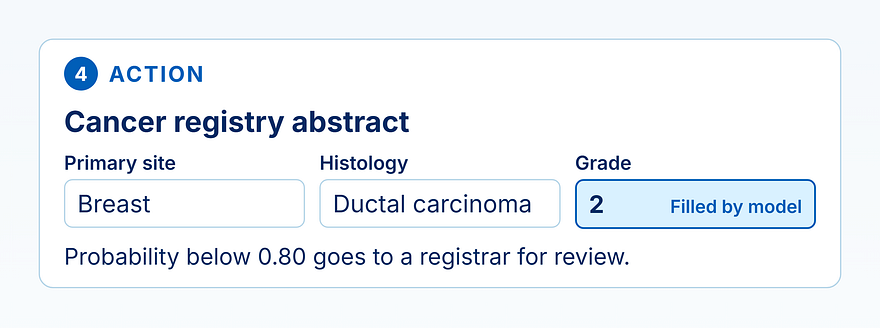
Step 4: the registry field is filled. Answers below 0.80 go to a registrar.
The 0.80 threshold is what keeps a person in the loop for every uncertain report. A clear report gets a confident answer and passes. A report that is harder to read gets a lower probability and goes to a person. We changed one line of the same report three times:
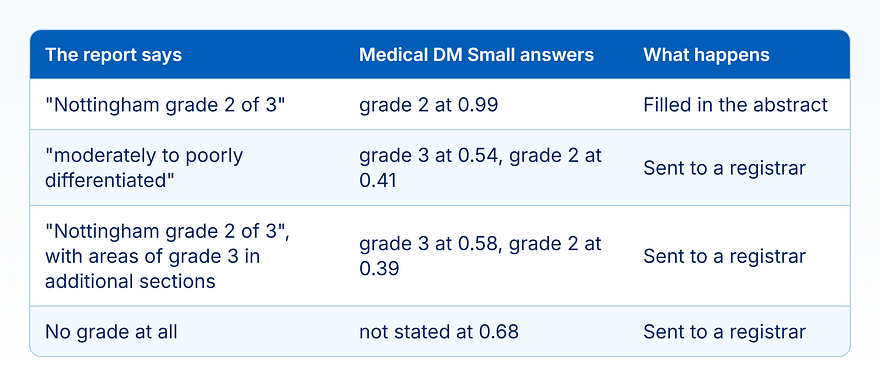
One line of the synthetic report, changed three times. Medical DM Small, review threshold 0.80.
In the third row the report states grade 2 and the model leans to grade 3, but only at 0.58, so the threshold sends it to a registrar. In the last row the answer is right, but the model is not sure enough, and a person checks it. That is the trade a threshold sets. A higher threshold sends more reports to people. A lower one fills more fields without review. Choose it on notes you have labeled yourself, and keep it fixed once it is set.
What teams assume and what we measured
We ran the same kinds of questions through a Medical DM and through the alternatives teams use today. Several common assumptions did not hold.
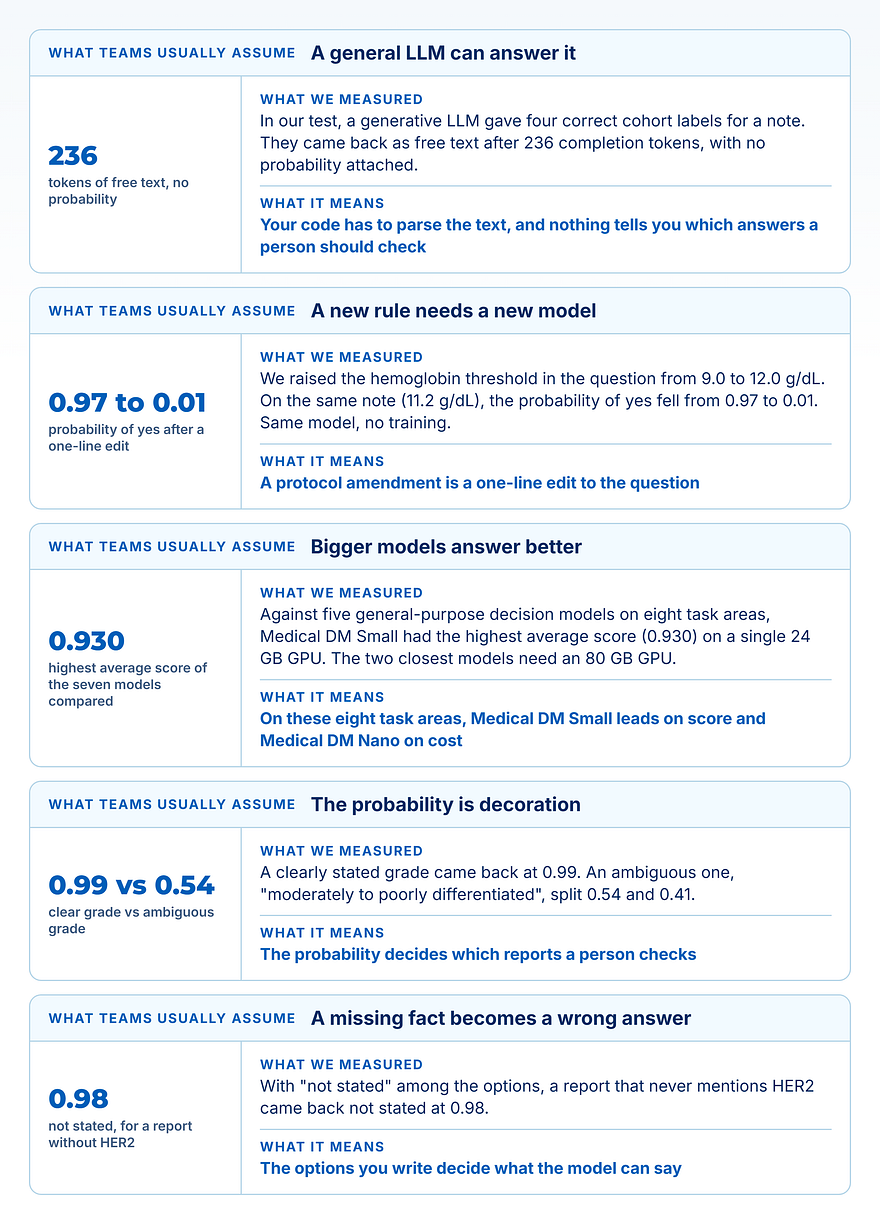
What teams usually assume, and what we measured.
How a decision model answers
A Medical DM reads three things: the note, your question, and the options you accept, each with a short description of what it means. It returns one probability per option, and the probabilities add up to one.
Every question has one of three types. A yes-or-no question returns the probability of yes. A choice returns the chosen option with a probability for every option. An ordered level returns a step on a scale you write from lowest to highest. One discharge note, asked one question of each type:
Discharge summary. A 68-year-old man was admitted with chest pain. Troponin was negative. He was discharged home on aspirin 81 mg daily. He walks the ward and does light housework. He cannot do heavy labour.
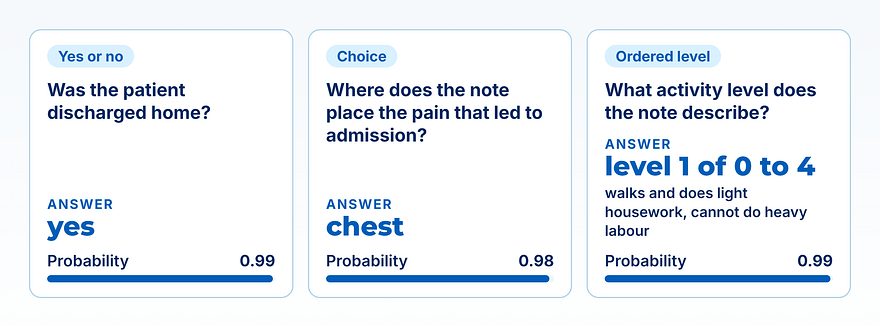
One question of each type on a synthetic discharge note, answered by Medical DM Small.
The three answers come back from one call, and one request can carry up to 64 questions. The model reports what the note supports. A clinician makes the care decision.
Nine task areas with one request format
Medical DMs cover ten clinical task areas. Medical DM Small and Medical DM Nano are scored on the first nine. PHI leak detection is served by the PHI Guard models, which ship in Healthcare NLP and run on CPU.
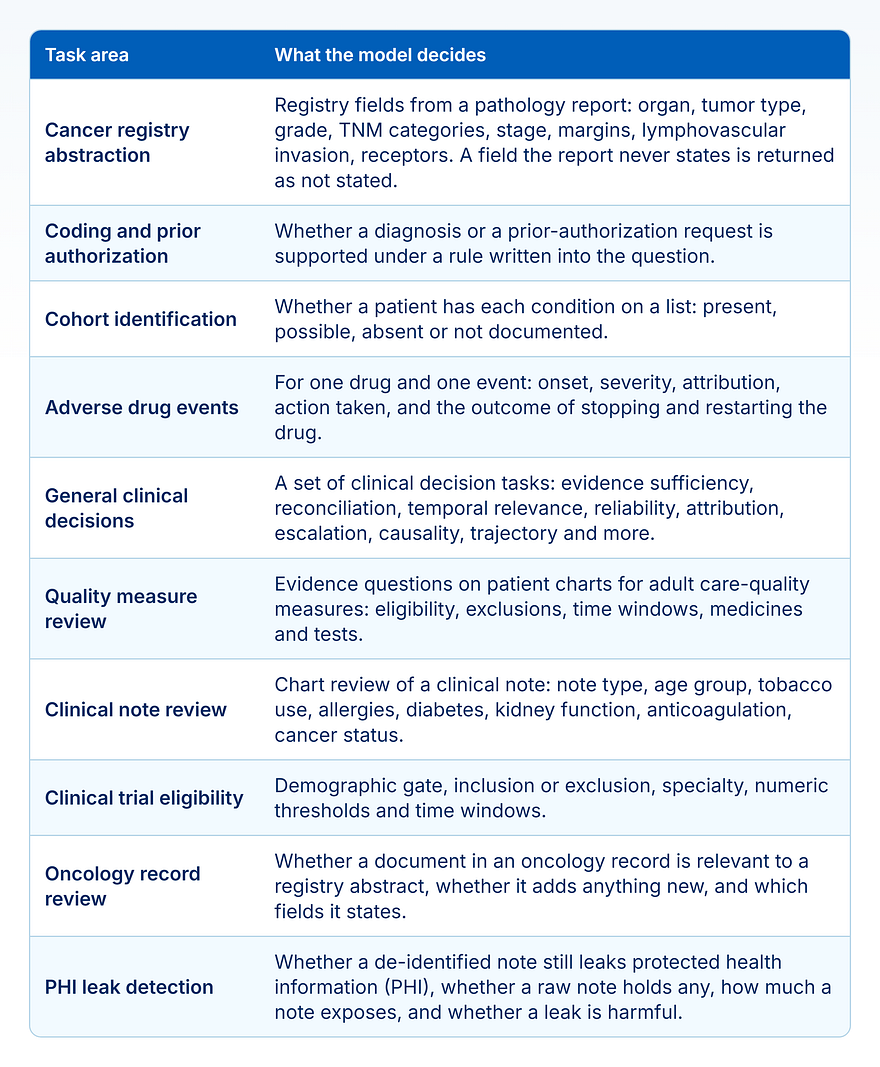
The ten task areas Medical DMs cover. Medical DM Small and Medical DM Nano are scored on the first nine. Source: Decision Models page, John Snow Labs.
Each of the nine areas, with one line of a synthetic note, one question, and Medical DM Small’s answer:
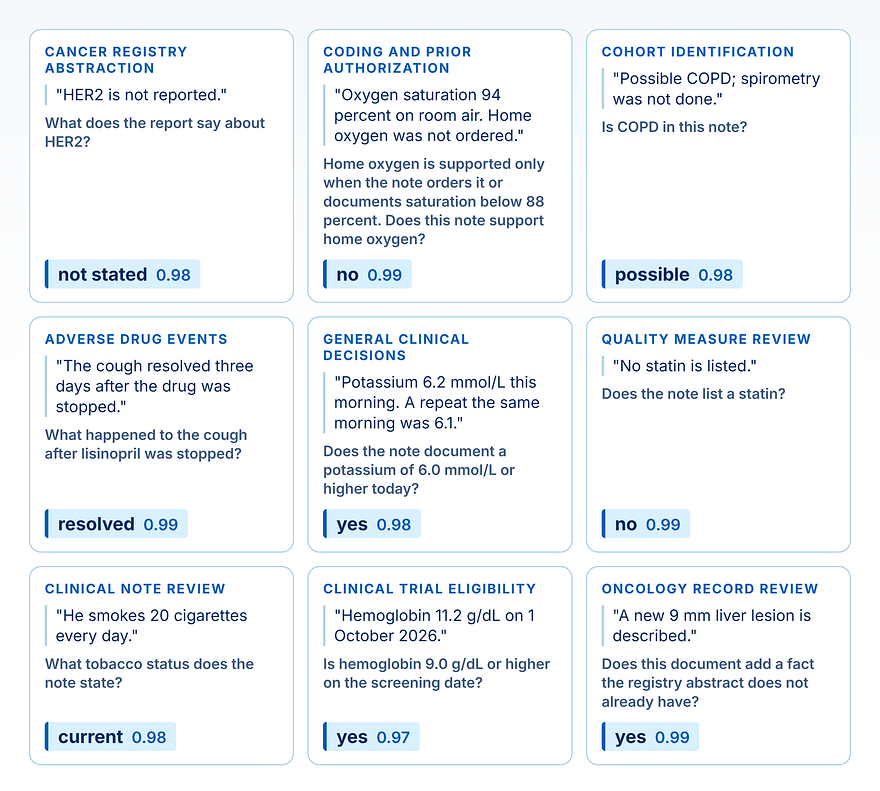
One synthetic note line, one question and Medical DM Small’s answer for each of the nine task areas.
Every row uses the same request: a note, a question, and its options. Only the words change.
Change the rule and keep the model
Rules change all the time. A payer updates a coverage policy, a trial amends a threshold, a registry adds a field. With a classifier, each change means new labels and a new training run. With a Medical DM, the rule lives in the question.
The same HER2 question on two versions of the pathology report:
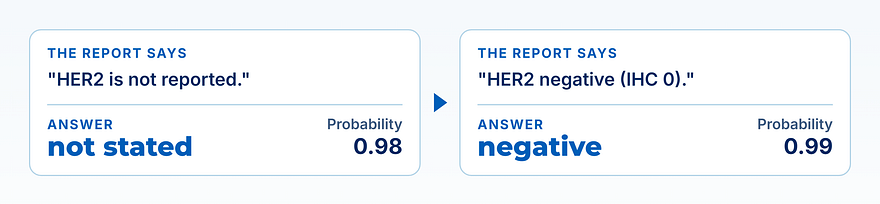
The same HER2 question on two versions of the report.
The same trial note, with hemoglobin 11.2 g/dL on the screening date. Only the threshold in the question changes:
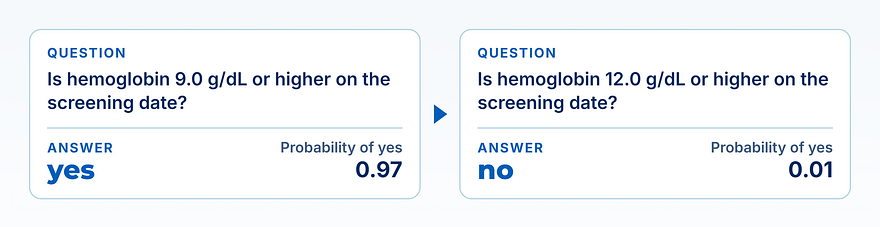
The same trial note with two hemoglobin thresholds in the question.
A protocol amendment that raises the threshold is a one-line edit, reviewed like any other change to the question.
Medical DM Small or Nano
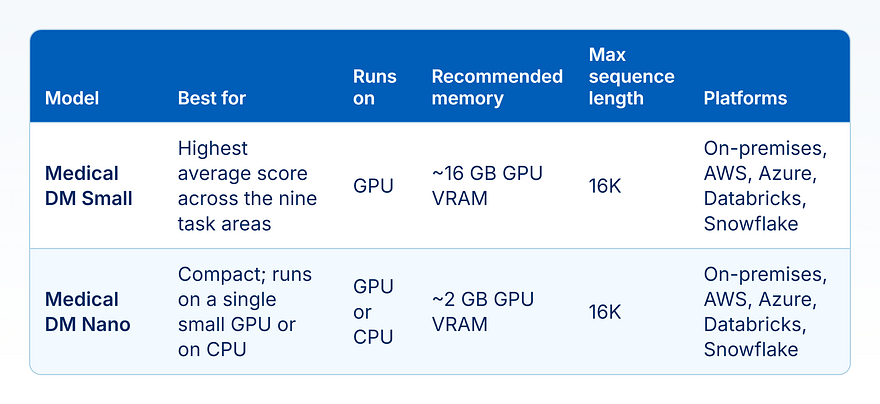
Medical DM Small and Medical DM Nano. Source: Decision Models page, John Snow Labs.
Medical DM Small is the model to use when the work spans many task areas and a GPU with about 16 GB of memory is available. It leads on six of the nine areas.
Medical DM Nano needs about 2 GB of GPU memory or runs on CPU. It scores higher than Small on cancer registry abstraction, adverse drug events, and oncology record review. On five of our example notes, Nano gave the same answers as Small to all 25 questions, including grade 2 for the pathology report. Its probabilities sit closer to 0 and 1 than Small’s, so set a Nano review threshold on your own labeled notes rather than reusing Small’s.
Medical DM Small averages 0.917 on internal hard cases
Each score is the mean of accuracy and macro precision, recall, and F1, measured on internal hard cases.
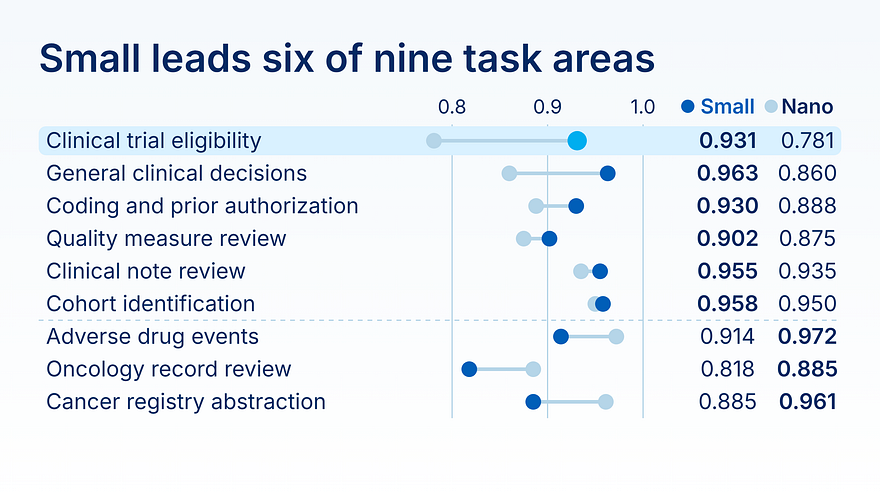
Score by task area: the mean of accuracy and macro precision, recall and F1 on internal hard cases. Source: Decision Models page, John Snow Labs.
Medical DM Small’s widest lead is clinical trial eligibility, 0.931 against 0.781, and it reaches 0.963 on general clinical decisions. Medical DM Nano leads on adverse drug events (0.972), cancer registry abstraction (0.961), and oncology record review (0.885).
One million notes in hours on one GPU
Consider a cancer registry with one million breast pathology reports. The registry asks many questions of each report, such as grade, HER2 status, margins, and stage, and one request can carry up to 64 of them. To keep the example easy to follow, it tracks one question, the tumor grade, so the times and costs below are for one question per report. On a single GPU with 24 GB of memory:
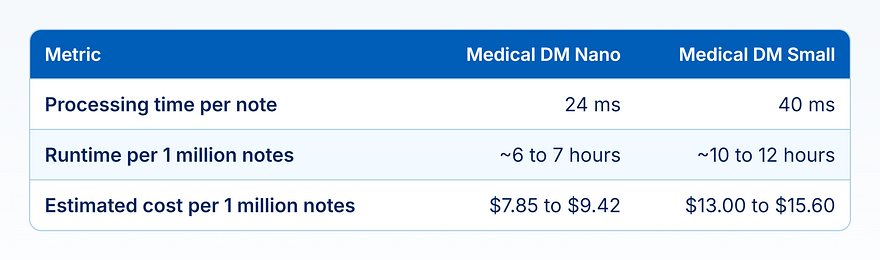
Estimated GPU cost at an illustrative $1.30 per hour. Source: Decision Models page, John Snow Labs.
The cost assumes an illustrative $1.30 per GPU hour and covers GPU compute only, not storage, networking, or orchestration. These are illustrative cloud GPU rates, not John Snow Labs prices. The work splits by note, so it scales across GPUs.
Medical DM Nano also runs without a GPU. With notes processed in parallel, it takes about 0.29 seconds per note on an 8-core CPU and 0.20 seconds on a 16-core CPU, roughly 3.4 and 2.3 days for one million notes on a single server.
We also measured other decision models on the same notes, each on the smallest GPU it fits on. The score is the average over eight task areas:
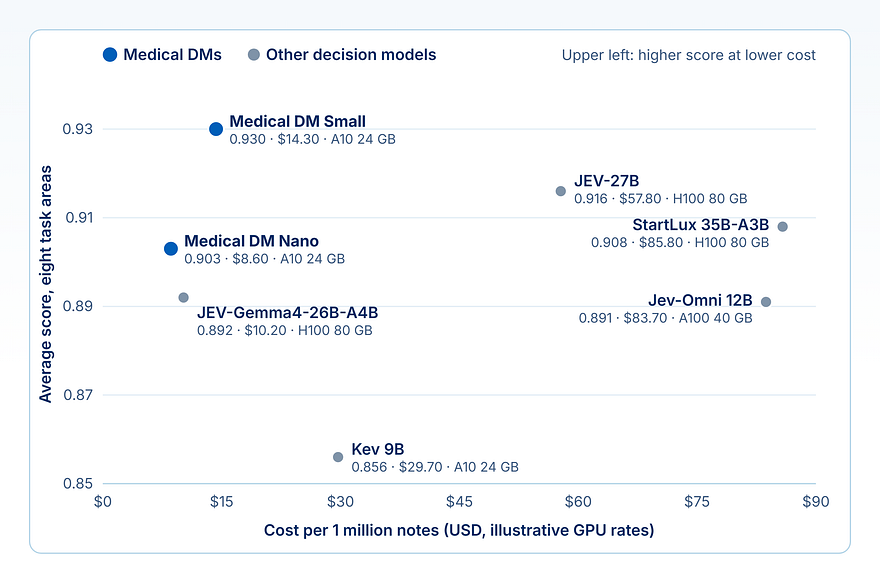
Average score against cost per million notes. Each model ran on the same notes, on the smallest GPU it fits on; score averaged over eight task areas; GPU rates are illustrative. Source: Decision Models page, John Snow Labs.
The models closest to Medical DM Small in score, JEV-27B and StartLux 35B-A3B, need an 80 GB GPU and cost about 4 and 6 times as much per million notes ($57.80 and $85.80 against $14.30). No model in the comparison beats Medical DM Small on score or Medical DM Nano on cost. The $1.99 and $4.20 hourly rates are illustrative as well.
The threshold then sets the human share of the work. Reports at or above 0.80 fill the grade field, and the rest go to a registrar. If, for example, 5 percent of reports fall below the threshold, registrars review 50,000 reports instead of one million. Measure that share on your own labeled reports before you plan the review team.
At these costs, a team can afford to ask every note, not a sample. The human review budget then goes to the answers the threshold sends back, not to reading every chart.
When a generative model is the better tool
No single large model should be expected to do every task. Generative models are strong at writing and reasoning. Decision models bring the speed, accuracy, and low cost that clinical work at scale depends on.
A decision model picks among answers you define. It is the wrong tool when the output is text or the answer set is open:
- Summarizing a hospital stay or drafting a letter.
- Answering an open question such as “what explains this patient’s anemia?”
- Reasoning across many documents to build an argument.
- Any question where you cannot list the acceptable answers in advance.
For these, a generative Medical LLM is the better choice. Many workflows use both: the LLM for the narrative, the decision model for the repetitive judgments that must be made the same way across millions of notes.
Both models run inside your environment
Medical DM Small and Medical DM Nano are offered on-premises and on AWS, Azure, Databricks, and Snowflake, so notes are processed without sending patient data to external AI APIs. On-premises, Medical DM Small is served from the johnsnowlabs/jsl-llms Docker image:
docker pull johnsnowlabs/jsl-llms:0.33.0
docker run -d --gpus all \
    --env "SPARK_NLP_LICENSE=$SPARK_NLP_LICENSE" \
    -p 8080:8080 --ipc=host \
    johnsnowlabs/jsl-llms:0.33.0 \
    --model Medical-DM-Small
The tumor grade question is one request to POST /v1/decisions:
{
  "model": "Medical-DM-Small",
  "state": "Surgical pathology report. Specimen: Left breast, lumpectomy. Diagnosis: Invasive ductal carcinoma, Nottingham grade 2 of 3. Size: 1.8 cm. Margins: negative. Receptors: ER positive, PR positive, HER2 negative.",
  "questions": {
    "grade": {
      "type": "choice",
      "instructions": "What is the tumor grade?",
      "criteria": {
        "grade_1": "Grade 1: Well differentiated",
        "grade_2": "Grade 2: Moderately differentiated",
        "grade_3": "Grade 3: Poorly differentiated",
        "not_stated": "Not stated: The report gives no grade"
      }
    }
  }
}
The answer carries the choice and a probability for every option:
"grade": {
  "type": "choice",
  "choice": "grade_2",
  "confidence": 0.985,
  "probabilities": {
    "grade_1": 0.0033,
    "grade_2": 0.9887,
    "grade_3": 0.0043,
    "not_stated": 0.0036
  }
}
The Medical DM Small and PHI Guards notebook walks through the container’s endpoints, the three question types, and the error codes. The model list, scores, and cost tables are on the Decision Models page.
Questions to ask about your own workflow
If any of these is hard to answer, a decision model is worth a look:
- How many of your LLM calls ask the model to choose between answers you already know?
- What happens to your classifiers the next time a payer rule or a trial protocol changes?
- Which answers does a person review today, and is that choice based on how sure the system is?
- Do you review every note, or a sample, because reviewing every note costs too much?
- Can your patient notes leave your environment to reach an AI service?
Every one of these has a practical answer. A small model built for clinical text can ask the question of every note, return one of your answers with a probability, and send only the uncertain ones to a person, inside your own infrastructure. Medical DM Small and Medical DM Nano are available now to existing customers for private deployment. To see how they would work on your notes and your questions, talk to our team.
Frequently asked questions
What is a Medical Decision Model? A Medical Decision Model reads a clinical note and answers a question you write about it. You send the note, the question, and the answers you accept, and it returns a probability for every one of them. A question can be yes or no, a choice among options, or an ordered level. A new question needs no retraining.
How do Medical DMs relate to general-purpose decision models such as Jev? They follow the same idea: a typed answer with a probability instead of generated text. Medical DMs are built and evaluated for clinical text, and they run inside your own environment.
How is a decision model different from asking an LLM? A general LLM writes its answer as text, so your code has to map the reply back to your options. A decision model returns one of your options with a probability for each, and you use that probability to decide which answers a person reviews.
Which tasks can Medical DM Small and Medical DM Nano handle? They were evaluated on nine task areas: cancer registry abstraction, coding and prior authorization, cohort identification, adverse drug events, general clinical decisions, quality measure review, clinical note review, clinical trial eligibility, and oncology record review. Medical DM Small averages 0.917 and Medical DM Nano 0.901 on internal hard cases.
Should I use Medical DM Small or Medical DM Nano? Medical DM Small has the higher average and leads on six of the nine areas. Medical DM Nano needs about 2 GB of GPU memory, runs on CPU, and scores higher on cancer registry abstraction, adverse drug events, and oncology record review.
How long does it take to process one million notes? For one question per note on a GPU with 24 GB of memory, Medical DM Nano takes about 6 to 7 hours and Medical DM Small about 10 to 12 hours. At an illustrative $1.30 per GPU hour, that is $7.85 to $9.42 for Nano and $13.00 to $15.60 for Small. Without a GPU, Medical DM Nano takes roughly 3.4 days on an 8-core CPU and 2.3 days on a 16-core CPU.
Do my notes leave my environment? No. Both models are offered on-premises and on AWS, Azure, Databricks, and Snowflake.
Does a Medical DM make clinical decisions? No. It reports what the note supports, with a probability you use to route answers to review. A clinician makes the care decision.
All patient data shown is synthetically generated for illustration.