

 Demos
Demos
































A clinical NLP pipeline that reaches 96% F1 in validation can still underperform against live hospital data, and the reason rarely traces back to the model. It traces back to everything around it: document ingestion and cleaning, output validation and storage, pipeline monitoring, and how updates roll out without breaking dependent applications. Health systems running production volumes, from hundreds of millions to billions of clinical notes, have learned this the operational way (Kocaman et al., 2025).
Why isn’t a validated model the same as a production-ready pipeline?
Clinical NLP models have reached a level of capability where the model itself is rarely the constraint on production performance. MLOps, the practice of applying software engineering and operations discipline to machine learning, is what closes the remaining gap. General-purpose MLOps frameworks cover most of it: deployment automation, monitoring, rollback. Clinical NLP adds requirements those frameworks don’t anticipate. De-identification governance, clinical terminology versioning, HIPAA-compliant audit logging, and human-in-the-loop validation aren’t optional extras layered on top of a working pipeline. They are what makes the pipeline’s output usable for research, quality measurement, or regulatory reporting in the first place, and skipping them is a common reason deployments that clear a technical bar still stall before they reach clinical use.
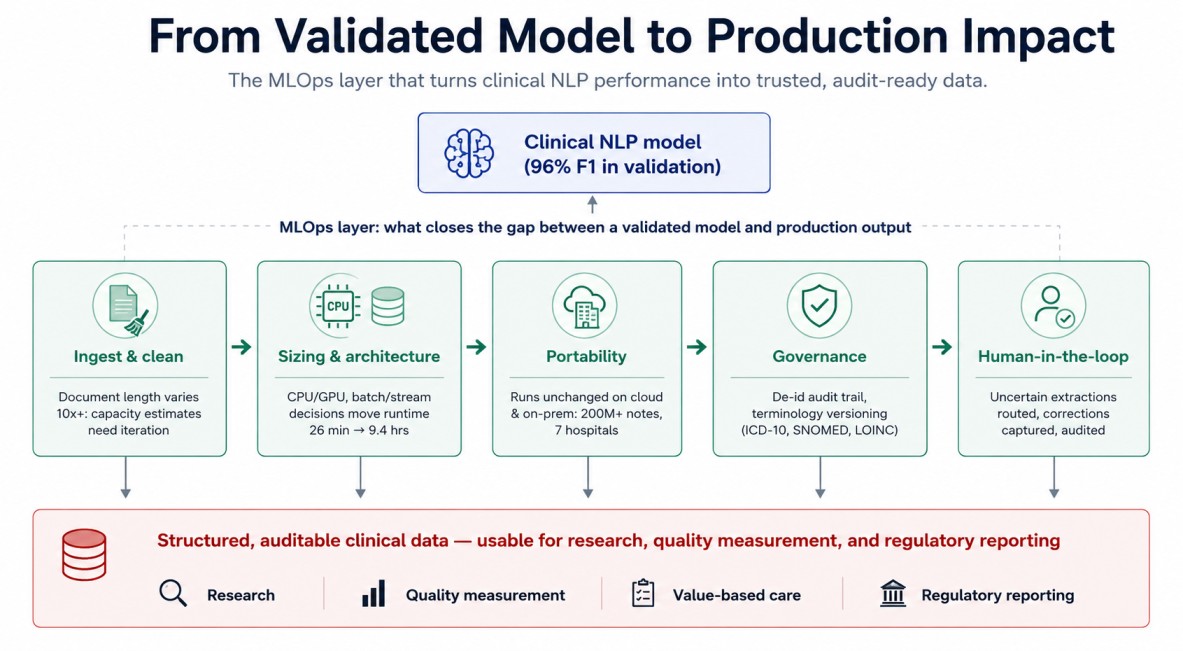
Five MLOps layers turn a 96%-F1 validation result into structured, audit-ready data — ingest and clean, size for scale, run anywhere, govern every extraction, and route uncertainty to a human reviewer.
What does infrastructure sizing for clinical NLP actually require?
Clinical documents apply multiple sequential operations, tokenization, sentence boundary detection, named entity recognition, assertion detection, normalization, and sometimes relation extraction, to every document before structured output exists. Compute demand scales with document length, and clinical document length varies more than in most NLP applications: a discharge summary can run many times longer than an outpatient note, and a longitudinal history assembled from multiple encounters longer still. That variability is why initial capacity estimates for a clinical NLP pipeline are usually wrong, and why reaching stable production throughput takes iteration against realistic data volumes rather than a single sizing exercise.
A 2026 benchmark testing de-identification pipelines across CPU and GPU infrastructure on a 478,000-document dataset found that pipeline complexity, not raw compute, was the dominant factor in runtime: an optimized configuration finished in roughly 26 minutes where a more complex variant took 9.4 hours on the same CPU cluster, and moving a medium-complexity pipeline from CPU to GPU cut execution from 3.1 hours to 1 hour (Caglayan, 2026).
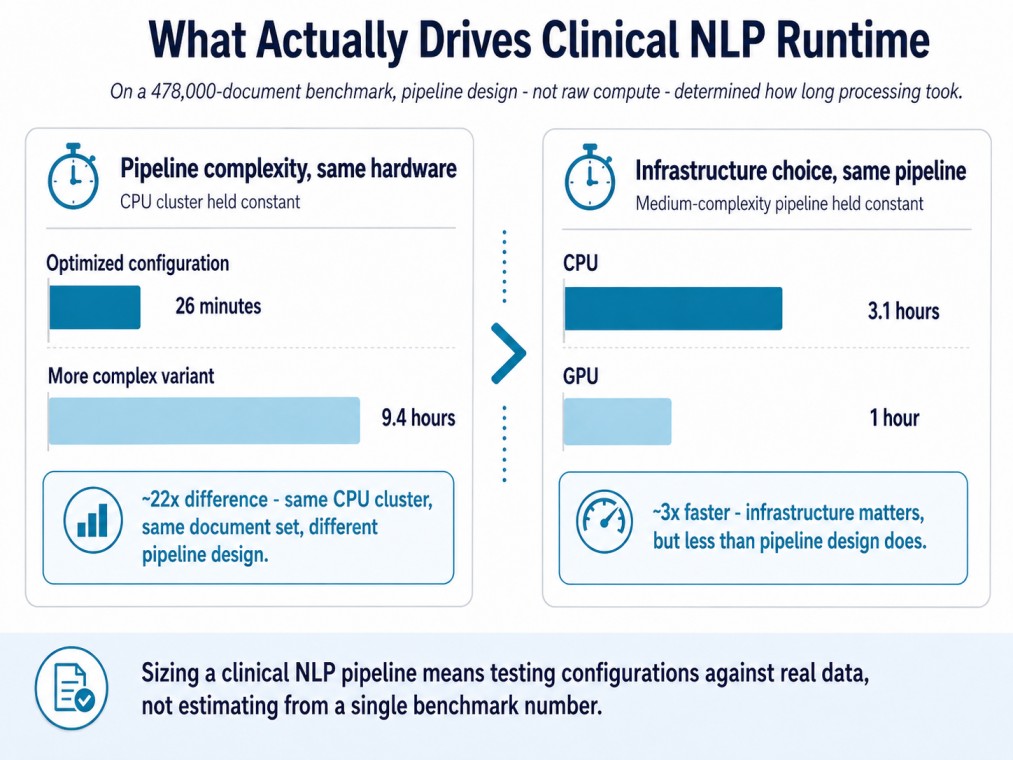
Reworking a pipeline’s configuration cut runtime from 9.4 hours to 26 minutes — a far bigger swing than switching from CPU to GPU alone (3.1 hours to 1 hour). Architecture decisions outweigh hardware choice.
Architecture decisions, sequential versus parallel processing, batch versus streaming, which pipeline stages run on GPU, determine throughput and cost as much as the model itself does. The stakes of getting this wrong compound at scale: a de-identification pipeline built on this pattern has since run in production across roughly 2 billion patient notes, with an independent audit of 790 randomly selected patients finding 99% PHI obfuscation and no successful re-identifications after a dedicated red team worked the dataset for three months (Kocaman et al., 2025).
Why does environment portability decide where a pipeline can run?
Research applications, clinical decision support pipelines, and quality-measurement workflows carry different data governance requirements, and often the same health system needs one clinical NLP pipeline to satisfy all three. That is a portability requirement, not a convenience feature. Ohio State University Wexner Medical Center runs a clinical NLP pipeline processing more than 200 million Epic notes across seven hospitals, and the pipeline executes unchanged on both Azure Databricks and Ohio State’s on-premises high-performance computing environment, with a runnable, documented notebook that reproduces results in either setting (Huerta, 2025).
Reaching that kind of portability requires every pipeline component, models, ingestion connectors, normalization mappings, quality checks, and output formatters, to be decoupled from any single cloud provider’s storage API or GPU driver version. Those coupling points are easy to miss while a pipeline is still a prototype and expensive to remove once downstream applications depend on a specific configuration. Version control has to extend past the model to the pipeline itself: the ability to reproduce a historical result by re-running the exact pipeline version that produced it, which is both a research-integrity requirement for published studies and an operational necessity once the pipeline updates on an ongoing basis.
How does shared data infrastructure compound the return on one pipeline investment?
Intermountain Health runs a Databricks Lakehouse that processes hundreds of millions of clinical documents and supports two distinct applications from the same underlying pipeline output: medical text summarization, which cut document review time from 10 minutes to 3 minutes per document, a 70% reduction, and natural-language querying of the structured clinical data the NLP pipeline produces (Bonis, 2026). The Lakehouse pattern, storage scalability paired with warehouse-grade query performance, fits clinical NLP output particularly well because a single processing run produces several output types with different schemas: extracted entities and their assertion status, normalized codes, entity relationships, and document-level classifications.
The compounding effect matters more than the pattern itself. Once a pipeline has produced structured clinical data at scale, that data supports applications that weren’t part of the original design. A researcher looking for patients with a specific diagnosis-and-treatment combination doesn’t have to write a database query; a natural-language interface translates the request into one against the structured output the NLP pipeline already produced. That capability only exists because the underlying extraction and storage infrastructure was built once and reused, not because the query layer is doing anything the raw text alone could support.
What governance infrastructure does production clinical NLP require?
Every deployment described here shares a governance baseline: audit logs documenting what was processed and when, version control tying each output to the pipeline version that produced it, quality assurance validated on production data rather than a held-out test set, and human-in-the-loop routing for uncertain or high-stakes extractions. Human review isn’t a fallback for a pipeline that isn’t accurate enough; it’s a structural requirement for any pipeline whose output supports clinical research or regulatory reporting.
De-identification governance illustrates why. A pipeline processing clinical notes has to document, per note, whether de-identification ran, which model version applied it, and what validation exists for that version’s accuracy, evidence that goes beyond confirming a de-identification step executed. Terminology versioning adds a requirement with no general-NLP equivalent: ICD-10-CM updates annually, SNOMED CT twice yearly, LOINC and RxNorm on their own cycles, and a pipeline normalizing entities to those standards has to track which terminology version applied to each extraction so that results from different points in time can be compared correctly. Normalization accuracy also varies more across general-purpose models than entity extraction accuracy does: one 2025 evaluation mapping medical terms to ontology concepts found a leading hosted LLM reaching 93.75% precision while an open-source alternative managed 19.19% precision on the same task (Mavridis et al., 2025). A governed Terminology Server that tracks version and validates accuracy per release closes a gap that model choice alone doesn’t.
Why don’t hosted general-purpose APIs hold up at clinical NLP production scale?
The operational reality of running a pipeline against GPT-4o-class hosted APIs at production volume looks different from a single accurate response in a demo. Accuracy is the first gap. In a controlled comparison of de-identification tools run under identical conditions, John Snow Labs’ purpose-built healthcare NLP model reached 96% F1, ahead of Azure Health Data Services at 91%, Amazon Comprehend Medical at 83%, and GPT-4o at 79% (Kocaman et al., 2025). On assertion detection, the task of classifying whether a clinical finding is present, absent, hypothetical, or conditional, John Snow Labs’ fine-tuned healthcare-specific model reached 0.962 combined accuracy against GPT-4o’s 0.901 on the same test set, with the largest gap on hypothetical statements (Kocaman et al., 2025). Neither gap closes with a better prompt; both papers ran the comparison zero-shot and few-shot and found the accuracy difference held.
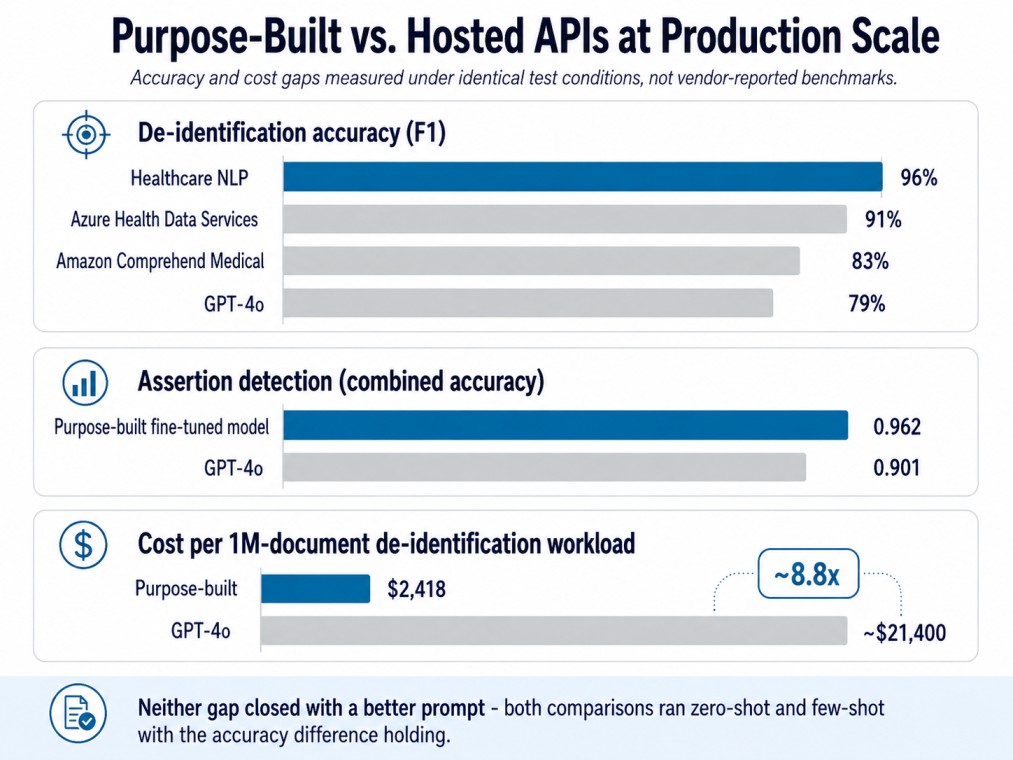
Purpose-built healthcare NLP beats hosted frontier APIs on accuracy and cost alike — and neither gap closes with a better prompt.
Cost compounds the accuracy gap at production scale rather than offsetting it. A per-document benchmark comparing de-identification tools on the same 1 million-document workload estimated $2,418 to run John Snow Labs healthcare NLP model against roughly $21,400 for GPT-4o over the same volume (Santas, 2025). A production MLOps pipeline reprocesses the same documents repeatedly, on model updates, terminology revisions, and reprocessing runs required by audit findings, so a per-call API cost that looks reasonable in a pilot compounds every time the pipeline runs again. Hosted APIs add a second, non-financial cost specific to healthcare: every call sends patient text outside the health system’s environment, which conflicts directly with the audit and data-sovereignty requirements described above and forces a separate governance review for every application built on top of the API.
What does John Snow Labs’ MLOps stack for clinical NLP deliver?
Healthcare NLP and Medical LLM run on-premises or in a customer’s private cloud, so the accuracy and cost advantages above come without patient text leaving the environment or a per-call bill that scales against production volume. Generative AI Lab supplies the human-in-the-loop layer that governed pipelines depend on: a no-code interface that routes uncertain extractions to reviewers, captures corrections, and keeps an audit trail linking every structured output back to its source note. Terminology Server handles the versioned SNOMED CT, ICD-10, LOINC, and RxNorm mapping that general models handle inconsistently, with each mapping tied to the terminology version current when it ran.
Scaling clinical NLP from prototype to production isn’t a model problem to solve once. It’s an infrastructure and governance investment that has to hold up across every model update, terminology revision, and new downstream application built on the pipeline’s output. Teams evaluating that investment should ask a vendor for production-data validation numbers, not benchmark averages, and for evidence the architecture has actually run at the note volume they operate at. Request a technical consultation scoped to your own EHR environment and document volume to see what that looks like against your own data.
Frequently asked questions
If clinical NLP models are already accurate, why do production deployments still underperform? The model is rarely the bottleneck. Production failures typically trace back to infrastructure: how documents are ingested and cleaned before the model sees them, how outputs are validated and stored, how the pipeline is monitored over time, and how updates are managed without breaking applications that depend on it. A model that performs well on a curated validation set can degrade once it meets the full variability of live clinical documentation.
Why does infrastructure sizing for clinical NLP take more iteration than typical data pipeline work? Clinical document length and complexity vary widely, a discharge summary can run many times longer than an outpatient note, and that variability makes initial capacity estimates unreliable. A 2026 benchmark found pipeline complexity, not raw compute, was the dominant factor in runtime, with an optimized configuration finishing in about 26 minutes against 9.4 hours for a more complex variant on the same hardware (Caglayan, 2026). Reaching stable production throughput requires testing configurations against realistic volumes, not a one-time sizing estimate.
What does environment portability mean for a clinical NLP pipeline, and why does it matter? A portable pipeline runs unchanged across cloud platforms, on-premises servers, and different hardware configurations because different applications inside the same health system can face different data governance requirements that dictate where processing has to occur. Ohio State’s pipeline runs identically on Azure Databricks and on-premises HPC across seven hospitals for exactly this reason (Huerta, 2025). Achieving it requires every component, models, connectors, and orchestration logic, to be decoupled from environment-specific dependencies before those coupling points become expensive to remove.
How is clinical terminology versioning different from ordinary model version control? Standard version control tracks changes to models and code. Terminology versioning tracks which release of ICD-10-CM, SNOMED CT, LOINC, or RxNorm was current when a specific extraction ran, since these standards update on regular cycles and the same clinical concept can carry different codes across versions. A pipeline’s audit log has to record the terminology version per extraction so results from different points in time can be interpreted correctly, a requirement with no equivalent in general-purpose MLOps.
Can a GPT-4o-class hosted API replace a purpose-built clinical NLP pipeline in production? The evidence says no on both accuracy and cost. In a controlled de-identification comparison, a purpose-built healthcare NLP model reached 96% F1 against GPT-4o’s 79% (Kocaman et al., 2025), and on assertion detection a fine-tuned model reached 0.962 combined accuracy against GPT-4o’s 0.901 (Kocaman et al., 2025). A benchmark on 1 million documents estimated the specialized model’s cost at roughly $2,418 against approximately $21,400 for GPT-4o over the same workload (Santas, 2025), and hosted APIs also require patient text to leave the health system’s environment on every call.
What’s the difference between entity extraction accuracy and normalization accuracy? Extraction identifies a clinical concept in text; normalization maps that concept to a standard terminology code, which is what makes it usable for aggregation, quality measures, and reimbursement. The two steps have different accuracy profiles across models: one 2025 evaluation found a leading hosted LLM reaching 93.75% precision on ontology mapping while an open-source alternative reached only 19.19% on the same task (Mavridis et al., 2025). Reporting extraction accuracy alone hides most of the remaining work a production pipeline has to do.
What does shared data infrastructure add beyond the first application built on it? Once a clinical NLP pipeline has produced structured data at scale, that data can support applications that weren’t part of the original design. Intermountain Health’s Lakehouse, built to support document summarization that cut review time from 10 to 3 minutes per document, also supports natural-language querying of the same structured data without a separate infrastructure build (Bonis, 2026). The infrastructure cost is spread across every application built on top of it rather than tied to a single use case.