

 Demos
Demos



























Twenty-six million adults in the United States have limited English proficiency, and half of them experienced a language barrier when dealing with a healthcare provider in the past three years (KFF, 2024). Most clinical NLP models are trained, tuned, and benchmarked almost entirely in English. When a health system deploys an English-only pipeline, patients whose notes are documented in English get the full benefit of that AI. Everyone else’s data runs through a model that was never built for it.
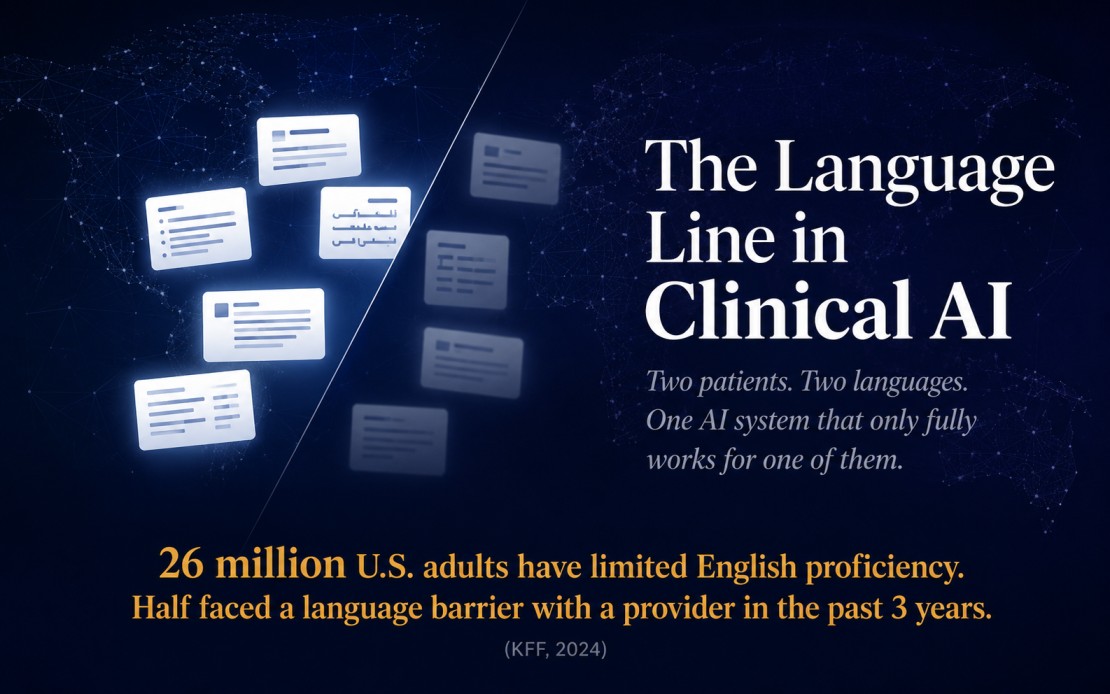
26 million U.S. adults have limited English proficiency, and half faced a language barrier with a provider in the past three years — most clinical NLP is trained, tuned, and benchmarked almost entirely in English.
Why is an English-only clinical NLP pipeline an equity problem?
Language barriers do not stop at the intake desk. The same asymmetry that makes an appointment harder to schedule shapes what happens after the encounter, when clinical notes get processed by NLP models built to extract diagnoses, medications, and social determinants for research, quality measurement, and care coordination. In a multilingual health system, patients whose care is documented in the dominant language get the full benefit of AI-assisted chart review, cohort identification, and risk scoring. Patients whose documentation exists in a minority language, or in a mix of languages within the same record, get a degraded version of the same tool, or none at all. Research built on top of that AI-processed data inherits the same skew, so the gap compounds instead of staying fixed.
This is not a hypothetical failure mode. The largest multilingual clinical-text benchmark published to date, BRIDGE, evaluated 95 large language models, including GPT-4o and Gemini, across 87 tasks drawn from 59 real-world clinical data sources in 9 languages. The benchmark’s central finding is substantial performance variation across model sizes, languages, tasks, and clinical specialties, with consistent degradation in non-English clinical contexts (Wu et al., 2026). The gap is not specific to one vendor’s model or one obscure language pair. It shows up across the current generation of general-purpose LLMs on real clinical tasks, with language as one of the variables that moves performance.
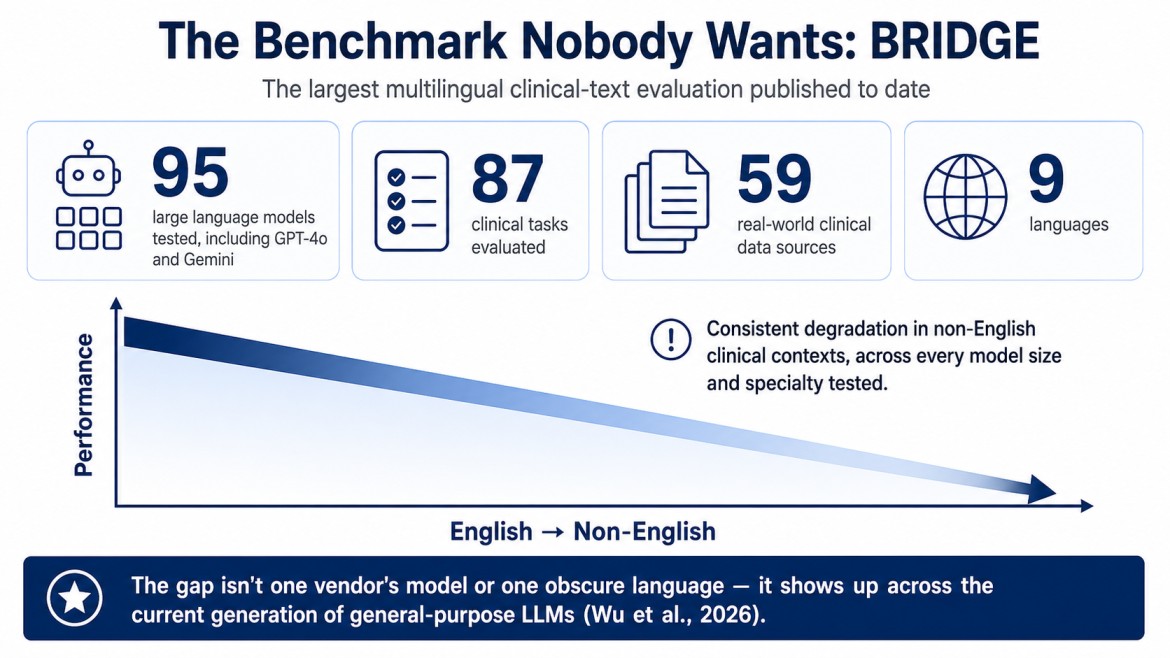
Across 95 large language models, 87 clinical tasks, and 9 languages, the largest multilingual clinical-text benchmark published to date found consistent performance degradation in non-English clinical contexts.
What makes multilingual clinical NLP harder than general multilingual NLP?
General-purpose multilingual models have improved substantially on standard benchmarks: translation, summarization, question answering across dozens of languages. Clinical text is a different kind of task inside each of those languages. A model has to recognize dense, abbreviation-heavy medical vocabulary, classify whether a condition is present, absent, or hypothetical, and anchor events to the right point in a patient’s timeline, in the grammar and documentation conventions of that specific language, not a translation of English conventions into it.
Negation and uncertainty illustrate the problem well. English clinical NLP has years of annotated data built around patterns like “no evidence of,” “rule out,” and “patient denies.” Those are not universal grammatical structures. Equivalent patterns in other languages reflect different sentence construction and different documentation habits, and each one needs its own annotation effort rather than a translation of the English rules.
Low-resource languages add a second layer of difficulty on top of this. The populations most likely to benefit from multilingual clinical AI often live in regions where annotated clinical text is sparse, so building a reliable model requires either transfer learning from a higher-resource language or a dedicated local annotation program, both of which take sustained investment. A 2025 evaluation of clinical NLP built for Spanish, a language with far more clinical text available than most non-English languages, found that models fine-tuned on Spanish clinical text substantially outperformed general-purpose LLMs applied to the same tasks through few-shot prompting, reaching 88.85% macro F1 on referral prioritization against what the authors describe as suboptimal general-LLM performance on the same benchmark (Villena et al., 2025). If a general LLM underperforms a domain-trained model on Spanish, one of the better-resourced non-English clinical languages, the gap is unlikely to close on its own for languages with less annotated data and less commercial attention from the labs training frontier models.
Why is multilingual clinical AI also a cross-border governance problem?
Multilingual clinical AI usually means multi-jurisdiction clinical AI. A health system serving patients across several languages is frequently also operating across national or regional borders, or across states or provinces with different privacy law inside one country. Every jurisdiction involved defines protected health information differently, sets its own consent and de-identification requirements, and constrains cross-border data transfer differently. A 2025 review synthesizing more than 90 sources on global health data privacy found “inconsistent definitions of sensitive data, semantic discrepancies, and a lack of standardized protocols” across regions, and concluded that frameworks such as GDPR provide a useful baseline but require jurisdiction-specific implementation rather than a single global standard (Conduah et al., 2025).
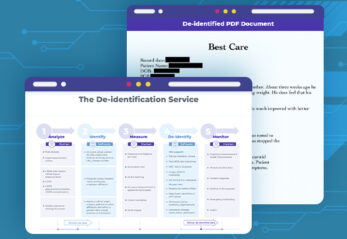
De-identification carries the most operational weight here, because it determines whether multilingual clinical data can be pooled or shared across sites at all. PHI takes different forms in different languages and countries: name structures, national identification-number formats, and geographic references specific to each country’s addressing conventions. A de-identification model trained and validated on English clinical text will miss PHI patterns specific to other languages, so pooling de-identified data from a multilingual deployment without validating each language’s de-identification model separately is a governance gap, not only a technical one. John Snow Labs publishes language-specific de-identification models for German medical text under GDPR for this reason: masking rules for German patient identifiers are not a translation of the English rules.
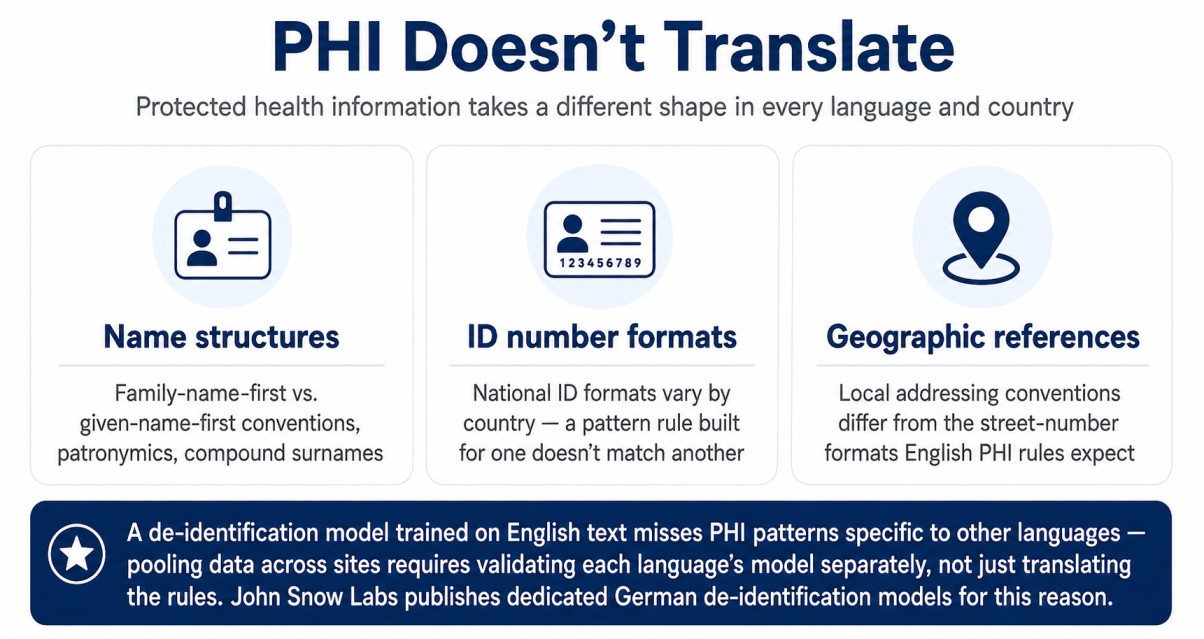
Name structures, ID formats, and geographic references all vary by language and country — a de-identification model trained on English text misses PHI patterns specific to others, so pooling multilingual data requires validating each language separately.
How does John Snow Labs build regulatory-grade multilingual clinical NLP?
The infrastructure requirement for multilingual clinical NLP extends single-language clinical NLP rather than replacing it with a separate architecture. Ingest, de-identify, extract entities, classify assertion and negation, normalize to standard terminology, produce structured output: that pipeline is identical at the architectural level regardless of language. What changes per language is which model performs each step. Healthcare NLP ships production models across multiple languages, including ONNX-optimized clinical NER models for English, Italian, and Spanish that extract medications, diagnoses, procedures, and symptoms in a deployment format built for the on-premises and edge environments that multilingual health systems, particularly outside the U.S., often need to run in.
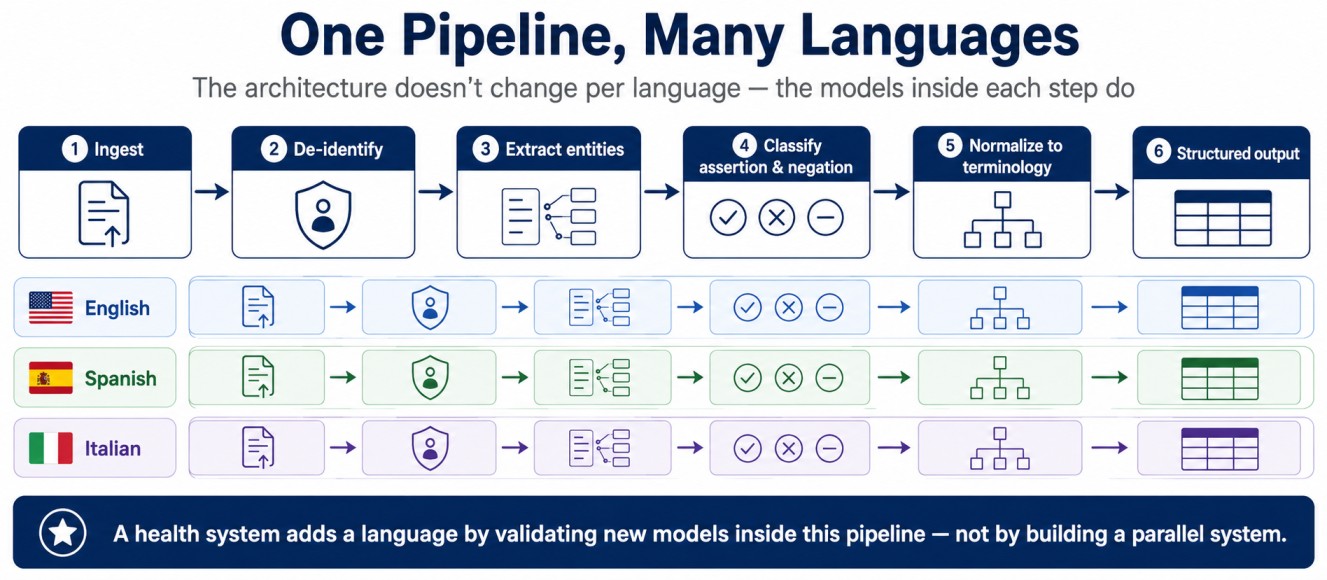
The pipeline architecture is identical across languages — ingest, de-identify, extract, classify, normalize, structure. What changes per language is which model runs at each step.
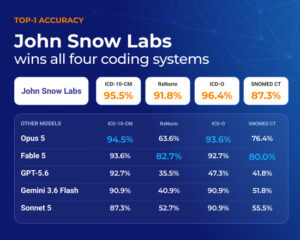
The case for domain-trained models over general-purpose LLMs is strongest where it has been measured most rigorously, which today is largely in English. On PHI detection, an independent 2025 benchmark measured Healthcare NLP at 96% F1, ahead of Azure Health Data Services at 91%, AWS Comprehend Medical at 83%, and GPT-4o at 79%, on the same English clinical documents (Kocaman et al., 2025). The gap holds against newer tooling, too: John Snow Labs’ August 2026 retest on the same benchmark put current frontier LLMs at 0.86–0.91 F1, still behind Healthcare NLP, and a lakehouse platform’s native masking function, the kind a health system might already have in place, at just 0.71 (John Snow Labs, 2026). In a separate, peer-reviewed evaluation, practicing physicians reviewing 500 clinical cases preferred an 8-billion-parameter domain-trained model over GPT-4o by roughly two to one on factuality and clinical relevance (Kocaman et al., 2025). Neither result is a multilingual claim by itself. Read alongside the BRIDGE benchmark’s finding that model performance varies substantially by language, the direction is consistent: domain training closes a gap that scale alone does not, and nothing in the multilingual evidence suggests that gap shrinks as the input language moves away from English.
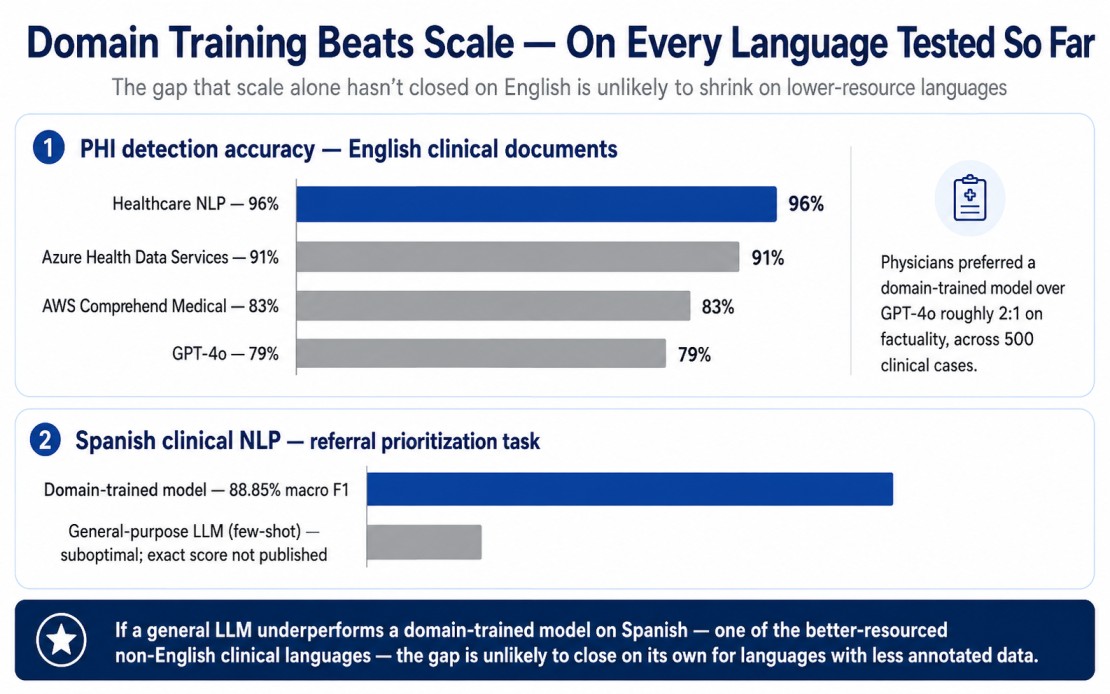
The domain-training advantage holds on every language tested so far: 96% F1 vs. 79% for GPT-4o on English PHI detection, and 88.85% macro F1 on Spanish referral prioritization, with the general-purpose comparison trailing well behind.
What does multilingual clinical NLP look like in production?
Roche Diagnostics Information Solutions has deployed healthcare-specific LLMs inside its Navify Oncology Hub to abstract breast, ovarian, and skin cancer patient timelines from EHR documentation into a structured, longitudinal record. The underlying architecture ingests multi-modal clinical data and normalizes it into a common data model before any reasoning or synthesis step runs, the same normalize-then-reason sequencing a multilingual deployment needs when a single patient’s record spans documents written in more than one language. Building that normalization layer once, and validating it per language as new languages get added, is what makes multilingual clinical reasoning tractable instead of an expanding set of one-off integrations.
Health systems weighing when to invest in multilingual clinical NLP face an asymmetric choice. A pipeline designed for more than one language from the start is comparatively inexpensive to extend to an additional language later. A pipeline retrofitted for multilingual support after years of English-only assumptions baked into schema, annotation guidelines, and downstream reporting is a substantially larger undertaking. The populations that stand to gain the most from multilingual clinical AI, patients whose care is currently the least AI-supported, are also the ones whose benefit keeps getting deferred every year that investment waits.
For health systems evaluating Healthcare NLP, Medical LLM, or de-identification for a multilingual deployment, the questions worth asking a vendor are specific: which languages have validated PHI de-identification models, what is the entity-extraction and normalization accuracy for each language in production rather than in a demo, and how does the pipeline add a new language without a full rebuild. Request a technical consultation scoped to your system’s language mix and note volume to get answers specific to your deployment, not benchmark averages.
Frequently asked questions
What is multilingual clinical NLP? Multilingual clinical NLP is natural language processing built and validated to extract structured data, such as diagnoses, medications, and assertions, from clinical text in more than one language, with each language’s model trained and tested on that language’s clinical documentation rather than translated from an English-trained model.
Why does clinical AI perform worse on non-English clinical text? Clinical vocabulary, negation patterns, and documentation conventions vary by language and are not simply translations of English patterns, so a model trained mostly on English clinical data has not seen the vocabulary and grammatical structures that carry meaning in another language. The BRIDGE benchmark, the largest multilingual clinical-text evaluation published to date, found substantial performance variation by language across all 95 large language models it tested, including GPT-4o and Gemini, with consistent degradation in non-English clinical contexts (Wu et al., 2026).
Can general-purpose LLMs like GPT-4o or Gemini handle non-English clinical text reliably? Not consistently. On English clinical text, an independent 2025 benchmark put GPT-4o’s PHI-detection F1 score at 79%, well behind purpose-built healthcare NLP models—and a John Snow Labs retest in August 2026 put current frontier LLMs at 0.86–0.91 F1 and a lakehouse platform’s native masking function at just 0.71 (John Snow Labs, 2026)—and a peer-reviewed evaluation found physicians preferred a domain-trained model over GPT-4o by roughly two to one on factuality (Kocaman et al., 2025). Non-English clinical text, where general-purpose training data is thinner, would be expected to show at least as large a gap, which lines up with the BRIDGE benchmark’s finding of consistent non-English degradation across the models it tested.
How does de-identification differ for multilingual clinical data? PHI takes different forms in each language and country, including name structures, identification-number formats, and geographic references specific to local addressing conventions, so pattern rules built for English PHI do not transfer directly. Each language needs its own de-identification model, trained and validated separately, before multilingual clinical data can be pooled or shared across sites with confidence.
What governance challenges come with cross-border, multilingual clinical AI? Multilingual clinical AI typically operates across more than one jurisdiction, and jurisdictions differ in how they define protected health information, what they require for consent and de-identification, and what data transfers they permit. A 2025 review of global health data privacy frameworks found inconsistent definitions of sensitive data and a lack of standardized protocols across regions, concluding that frameworks like GDPR need jurisdiction-specific implementation rather than a single global standard (Conduah et al., 2025).
What is the most practical way for a health system to start building multilingual clinical NLP capability? Prioritize by clinical impact rather than aiming for complete language coverage immediately: identify the languages that account for the largest share of non-English documentation, and start with the tasks where the equity gap is most consequential, typically de-identification for data sharing and entity extraction for quality measurement. Domain-specific training on each language’s clinical text, not just broader multilingual pretraining, is what closes the performance gap, as shown in Spanish-language clinical NLP evaluations (Villena et al., 2025).
Does a multilingual clinical NLP pipeline require separate infrastructure for each language? No. The pipeline architecture, ingest, de-identify, extract entities, normalize to standard terminology, produce structured output, is identical across languages. What differs per language is the model performing each step, so a health system can add a language by validating new language-specific models inside the same pipeline rather than building a parallel system.
How does John Snow Labs support multilingual clinical NLP deployments? Healthcare NLP ships production models across multiple languages, including ONNX-optimized clinical named entity recognition for English, Italian, and Spanish and language-specific de-identification models such as the German models built for GDPR compliance. The same architecture validated at 96% F1 for PHI detection on English clinical text (Kocaman et al., 2025), reconfirmed in an August 2026 retest on the same benchmark (John Snow Labs, 2026), extends to additional languages by adding and validating language-specific models rather than rebuilding the pipeline.