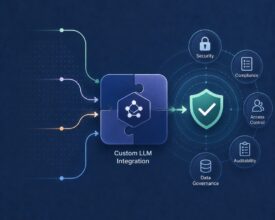
Connect any LLM endpoint to annotation workflows through a secure proxy architecture. Compare models, enforce data sovereignty, optimize costs by 40–60%, and maintain full auditability for HIPAA, GDPR, and regulatory-grade AI operations.
Most annotation platforms restrict teams to a single LLM provider. For healthcare and life sciences organizations, this creates compliance risk, cost inefficiency, and limits the use of domain-specific models required...
Healthcare organizations are under growing pressure to operationalize AI. Clinical NLP pipelines extract diagnoses from notes in seconds. Large language models summarize encounters, draft responses, and classify documents at scale....
Project managers running clinical NLP annotation at scale face a recurring problem: quality issues surface weeks after they become expensive to fix. By the time inconsistent labeling patterns appear in...
Healthcare AI teams annotate thousands of clinical documents every week. Discharge summaries. Procedure notes. Lab reports. Referral letters. Most arrive as PDFs, sometimes scanned, sometimes native, often a mix of...
In the first two posts of this series, we benchmarked OCR on two increasingly demanding tasks: Grounded (BBox) OCR, reading text AND returning its coordinates Image → Markdown OCR, plain-text...



 Demos
Demos

























 See More