Demos
































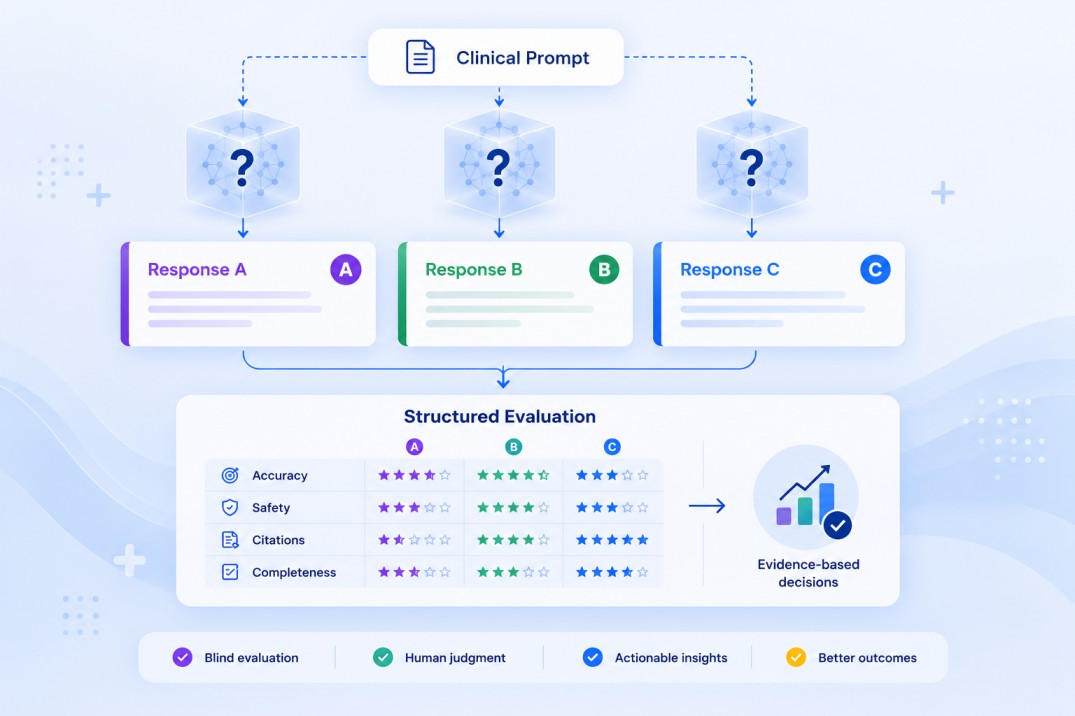
Blind LLM evaluation compares model outputs without revealing which provider produced each response, reducing brand-name bias in human review. Healthcare teams use it when clinicians score candidate models on clinical accuracy, safety, guideline adherence and completeness.
A 2023 study in JAMA Internal Medicine used this design. Ayers and colleagues drew 195 patient questions from Reddit’s r/AskDocs, each answered by a verified physician, and generated a ChatGPT answer to each. Licensed health care professionals rated every pair in triplicate. The responses were anonymized, randomly ordered and labeled response 1 or response 2. Evaluators preferred the chatbot response in 78.6% of 585 evaluations (95% CI, 75.0%–81.8%).
Blinding removed author identity from the scores. Response length remained visible: chatbot answers averaged 211 words and physician answers 52, and the study design does not separate the effect of length from the effect of quality.
Brand, order and length skew reviewer scores
A key challenge in human evaluation is that people do not score text in a vacuum. They score it against expectations, and those expectations are influenced by things that have nothing to do with clinical quality.
A familiar brand name has an inherent advantage. Reviewers who expect a well-known model to perform well tend to read its outputs more generously, a pattern that shows up long before anyone measures accuracy. Order affects judgment too: the first response a reviewer sees often becomes the reference point everything else is compared against. Formatting sways scores, with cleanly structured answers appearing more authoritative than dense ones that may be more correct. Length sways scores, with longer responses feeling more thorough even when the extra text adds nothing. And once a reviewer forms an early impression, confirmation bias quietly pulls later judgments in the same direction.
None of these effects mean reviewers are careless. They mean human judgment is sensitive to context, and evaluation designs that ignore that sensitivity end up measuring the context instead of the model.
Why blind evaluation matters
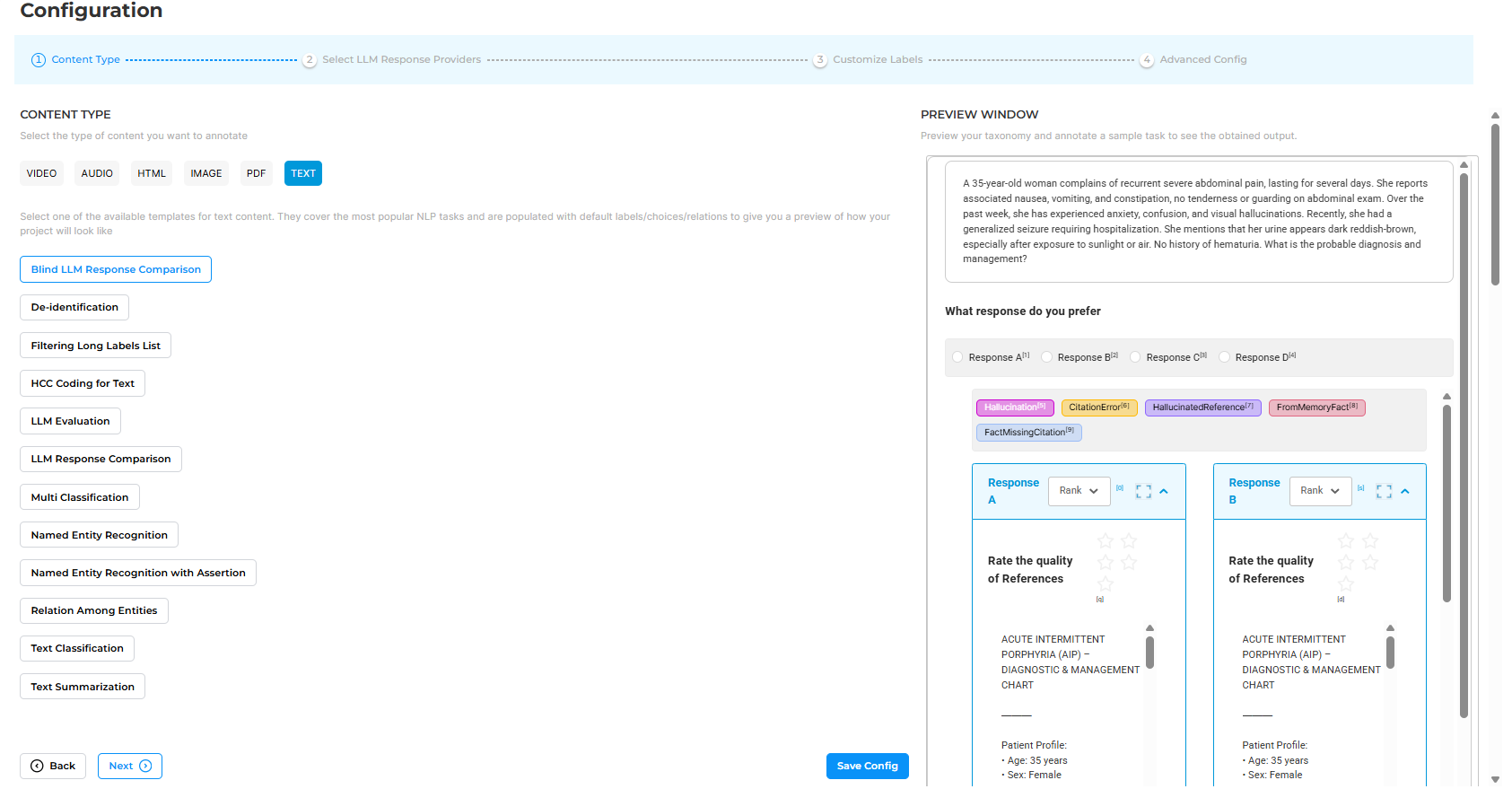
In a blind comparison, reviewers see responses labeled Response A, Response B and so on, with provider names removed. A private fine-tuned model and a commercial foundation model are scored against the same criteria with no identifying label.
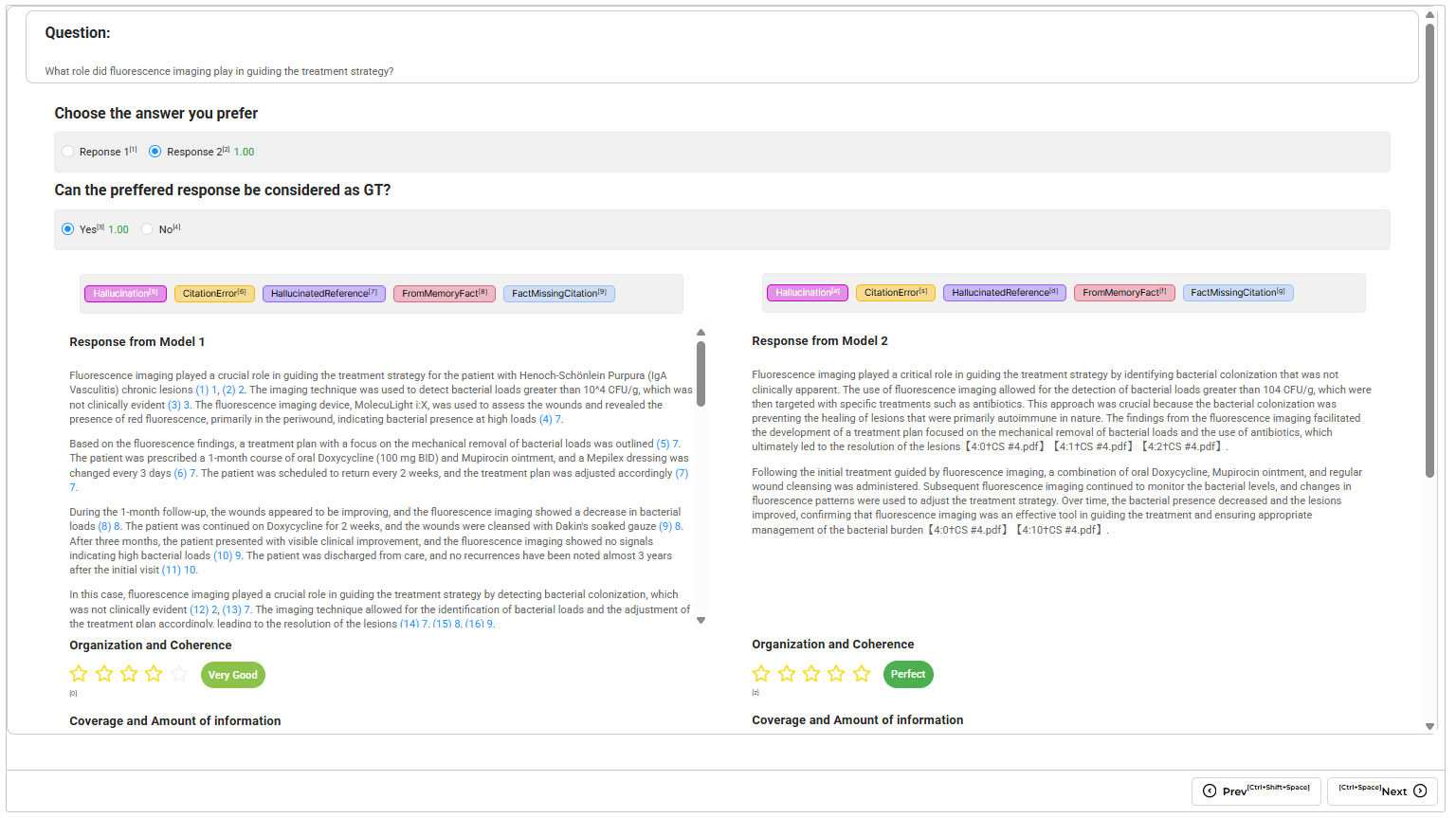
Blind comparison removes provider identity from the review, but teams should also control response order, use the same formatting, define scoring criteria in advance, and monitor reviewer agreement. It also changes the conversation afterward. When a lesser-known model wins a blind evaluation, the result is harder to wave away, because no one can attribute it to brand preference.
Comparing models requires more than picking a winner
Even with names removed, “which model is best” is rarely the right question. Best at what?
Healthcare teams evaluate outputs along several dimensions at once: factual accuracy, completeness, safety, adherence to clinical guidelines, quality of citations, soundness of reasoning, and clinical appropriateness for the specific task. A single response can be strong on some of these and weak on others.
One model may produce the most accurate clinical content while occasionally omitting a required disclaimer. Another may be consistently safe and conservative while missing nuance. A third may cite sources reliably but reason less carefully about edge cases. Ranking these models on a single scale collapses distinctions that matter. A model well suited to drafting patient-facing summaries may be the wrong choice for extracting structured data from clinical notes.
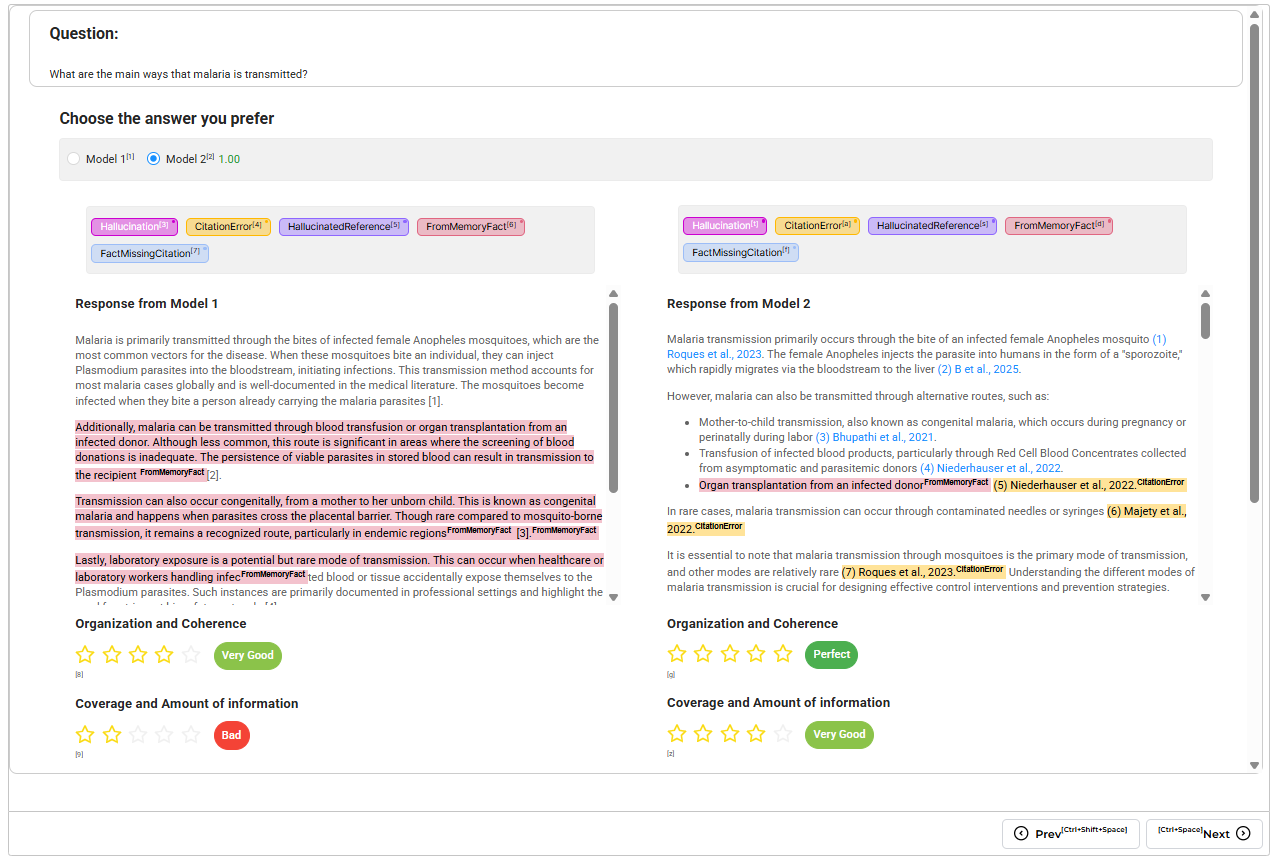
Different tasks require different evaluation criteria, and a robust evaluation captures that instead of forcing every judgment into one number.
Evaluation needs structure
Healthcare organizations increasingly need evaluation workflows that hold up to scrutiny rather than one-off comparisons run in a spreadsheet. In practice, that means the ability to generate responses from multiple providers, compare them blindly, collect structured human judgments, score quality consistently against defined criteria, measure how much evaluators agree, and track how providers perform over time.
Generative AI Lab keeps model generation, blind comparison, structured clinical review, and evaluation analytics in one platform rather than splitting evaluation across provider consoles, spreadsheets, and separate review tools.
Because reviews are collected as structured data, evaluator agreement becomes measurable. Inter-annotator agreement metrics show where reviewers converge and where they diverge. Low agreement can prompt teams to inspect whether a guideline is ambiguous, a criterion is interpreted inconsistently, or the task itself requires more clinical context.
Evaluation does not end after one benchmark
Most teams compare models once, choose one, and move on. Healthcare organizations that depend on these systems cannot.
A new model version ships every few months. Prompts get revised as teams learn what works. Clinical guidelines change. New datasets bring new edge cases. Each of these can change which model performs best, and a comparison run six months ago may no longer describe the models in production today.
Evaluation therefore becomes an operational workflow rather than a one-time event. The same blind comparison, the same criteria, and the same reviewer pool can be run again whenever something material changes, and the results can be tracked over time rather than rediscovered from scratch. Analytics that record how providers score across rounds provide an ongoing view of model performance, showing whether a model genuinely improved after an update or simply produced a different kind of output. Over many rounds, that history becomes a valuable record of how the organization’s models have performed against its own standards, on its own tasks.
The hardest decision is rarely the model
The hardest decision in applied healthcare AI is rarely choosing an LLM. It is building an evaluation process that produces results people trust.
Healthcare organizations increasingly run multiple models at once. Foundation models evolve every few months, and internal models improve continuously. Evaluation becomes an ongoing part of the AI lifecycle rather than a benchmark run once and filed away.
The organizations that gain the most value from LLMs are often not the ones using the newest model. They are the ones with the most reliable process for measuring quality, involving clinicians in review, and repeating that process every time the models or the requirements change. To see structured LLM evaluation in action, watch the Generative AI Lab demo or start a free trial.
Frequently Asked Questions
Q: How do you reduce bias when clinicians compare LLM outputs?
Reviewers see responses labeled neutrally, such as Response A, Response B, and Response C, without knowing which model produced each one. Scores then reflect the quality of the output rather than the reputation of the provider behind it.
Q: Can we evaluate models from different providers in the same comparison?
Yes. With custom LLM integration, teams connect hosted, private, and self-hosted models and generate responses from each within the same evaluation, so outputs from different providers can be compared side by side.
Q: What criteria can reviewers score against?
Teams define criteria that fit the task, such as factual accuracy, completeness, safety, guideline adherence, citation quality, and reasoning. Different tasks warrant different rubrics, and the evaluation is structured around the criteria that matter for the work at hand.
Q: How do we know whether reviewers actually agree?
Reviews are collected as structured data, so inter-annotator agreement can be measured directly. Agreement metrics show where reviewers converge and where they diverge, which often reveals ambiguous criteria or gaps in the guidelines.
Q: Is model evaluation a one-time step?
No. Model versions, prompts, datasets, and clinical guidelines all change over time, so evaluation is set up as a repeatable workflow. Running the same comparison again when something material changes, and tracking results over time, keeps the assessment current instead of frozen at a single benchmark.
Learn more
Full technical details on LLM Evaluation & Response Comparison are in the Generative AI Lab documentation.