

 Demos
Demos























Every framework evaluation for clinical NLP starts with an accuracy question: how well does it extract entities, detect PHI, or classify a document? That question matters, but it is the entry requirement, not the differentiator. For organizations processing hundreds of thousands of clinical notes daily under HIPAA audit obligations, the frameworks that fail in production rarely fail on a benchmark. They fail because they were never built for the scale, governance, and pipeline demands that enterprise clinical NLP puts on them.
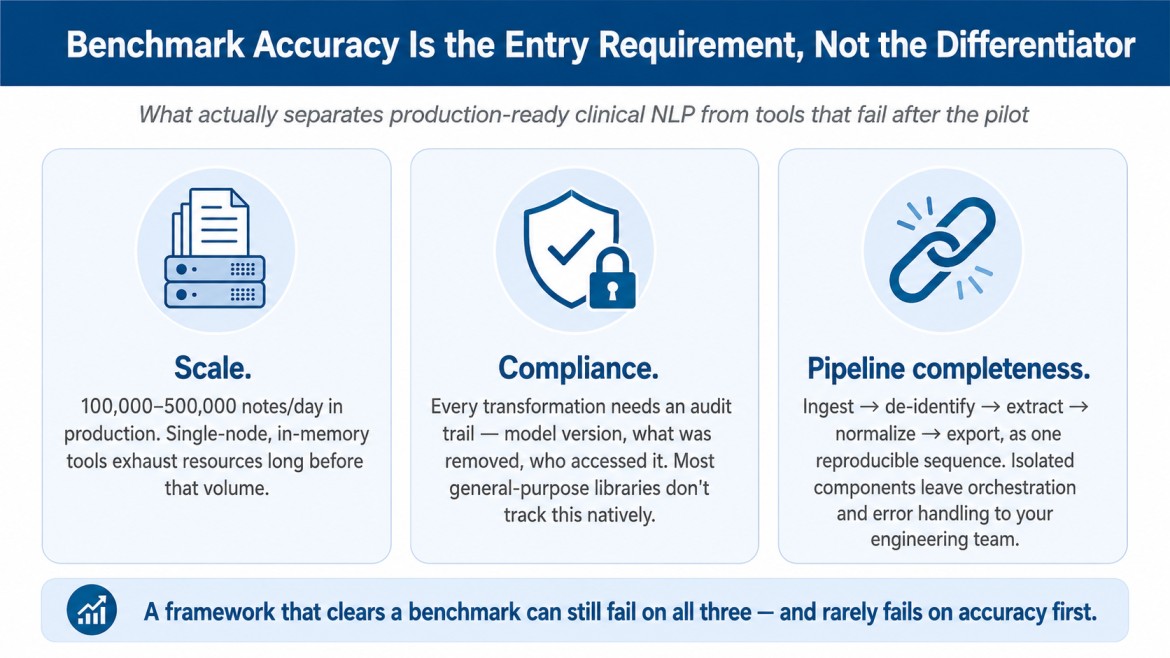
Scale, compliance, and pipeline completeness are the three requirements that separate production-ready clinical NLP from tools that clear a benchmark and then fail in deployment.
What breaks first when volume and compliance enter the picture?
A framework that performs well on a research dataset of a few thousand documents is answering a different question than a health system processing tens of millions of notes for a population health initiative. A de-identification pipeline running in production needs to handle 100,000 to 500,000 notes a day without losing speed, accuracy, or stability. Tools built for single-node, in-memory execution exhaust resources or slow to a crawl well before they reach that volume, because distributed processing across a cluster is not a feature they were designed to add later.
Compliance requirements compound the problem. Every transformation a healthcare NLP pipeline performs on protected health information, extraction, de-identification, normalization to SNOMED CT or ICD-10, storage, has to be auditable: what model version processed a document, what was removed, who accessed the output. General-purpose libraries rarely support pipeline versioning or lineage tracking natively, which pushes that work onto engineering teams as custom infrastructure that has to be built, maintained, and revalidated with every update.
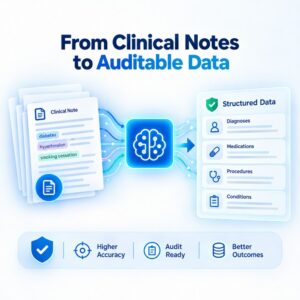
Pipeline completeness is the third gap. Real clinical NLP is not one task. A production workflow ingests scanned documents, de-identifies them, extracts entities, normalizes them to standard terminologies, detects assertion status and temporality, and exports structured output, all as one reproducible sequence. A framework offering isolated components leaves the orchestration, retry logic, and error handling to the customer’s engineering team, and that glue code becomes technical debt with every model update.
How do general-purpose tools score against purpose-built clinical NLP?
Set healthcare-specific NLP against the strongest general-purpose alternatives on tasks that matter in production, and the gap shows up in the data, not in adjectives.
| Task | Purpose-built healthcare NLP | Strongest general-purpose alternative | Source |
|---|---|---|---|
| RxNorm code mapping (top-3 accuracy) | 82.7% | 55.8% (Amazon Comprehend Medical); 8.9% (GPT-4, single candidate only) | Santas, 2024 |
| PHI detection (F1 / recall) | 0.95 F1 / 0.98 recall | 0.55 F1 / 0.64 recall (OpenAI Privacy Filter), 5.8x slower on CPU | Gul, 2026 |
| Assertion classification (combined accuracy) | 0.962 | 0.901 (GPT-4o) | Kocaman et al., 2025 |
Cost has only been benchmarked at this scale for one of these three tasks so far. Where it has, the gap does not close:
| Vendor | Cost per 1M documents (RxNorm mapping) | Source |
|---|---|---|
| Healthcare NLP | ~$4,500 | Santas, 2024 |
| Amazon Comprehend Medical | $24,250 | Santas, 2024 |
| GPT-4o / GPT-4 Turbo API | $22,000–$44,000 | Santas, 2024 |
On mapping clinical terms to RxNorm codes, a purpose-built resolver reached 82.7% top-3 accuracy, compared with 55.8% for Amazon Comprehend Medical and 8.9% for GPT-4, which returns only a single candidate per query rather than a ranked list (Santas, 2024). Cost moved in the same direction: processing 1 million documents through Healthcare NLP ran approximately $4,500, against $24,250 for Amazon Comprehend Medical and $22,000 to $44,000 for GPT-4o and GPT-4 Turbo API calls (Santas, 2024). A framework that costs five times more per document and returns a fraction of the accuracy is not a viable substitute at any volume beyond a pilot.
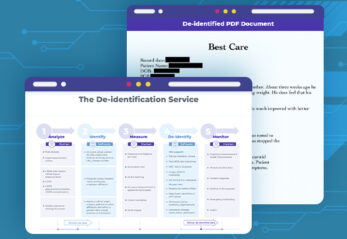
PHI detection shows a comparable pattern. Benchmarked on 381,959 tokens of clinical text with a 3.25% PHI density, a purpose-built de-identification pipeline reached an F1 score of 0.95 and recall of 0.98, against 0.55 F1 and 0.64 recall for a general-purpose LLM privacy filter, while running 5.8 times faster on CPU (Gul, 2026). On a representative note, the general-purpose filter caught the clinician’s name and missed the phone number, hospital name, and address on the same page. Missed PHI in a healthcare context is not a rounding error; it is the specific failure a de-identification pipeline exists to prevent.
Clinical language itself is where general-purpose models, including frontier LLMs, lose the most ground. A model that cannot distinguish a confirmed diagnosis from a ruled-out one, or a current medication from a historical one, produces extractions that read as structurally correct while being clinically wrong. On assertion classification, a healthcare-specific model reached a 0.962 combined accuracy score against GPT-4o’s 0.901, and even the fine-tuned specialist model dropped to 0.599 accuracy on conditional statements like “ruled out pending culture results,” against 0.976 on straightforward present-or-absent cases (Kocaman et al., 2025). That gap between clean cases and the conditional, negated, and temporally qualified language that fills real clinical notes is exactly what a benchmark built on curated examples will not reveal.
Does the accuracy and cost gap hold up against today’s frontier models?
Every comparison above benchmarks against GPT-4-class models, and a reader in August 2026 is right to ask whether a newer general-purpose model closes the gap. Measured against current frontier APIs, GPT-5.4, Gemini-3.1-Pro, and Claude-Opus-4.6, it has not, on either accuracy or cost.
| Model | Average score across 15 clinical benchmarks | Source |
|---|---|---|
| Medical LLM – Medium (John Snow Labs) | 80.9 | John Snow Labs, 2026 |
| OpenAI (GPT) | 76.5 | John Snow Labs, 2026 |
| Anthropic (Claude) | 75.0 | John Snow Labs, 2026 |
| Google (Gemini) | 74.7 | John Snow Labs, 2026 |
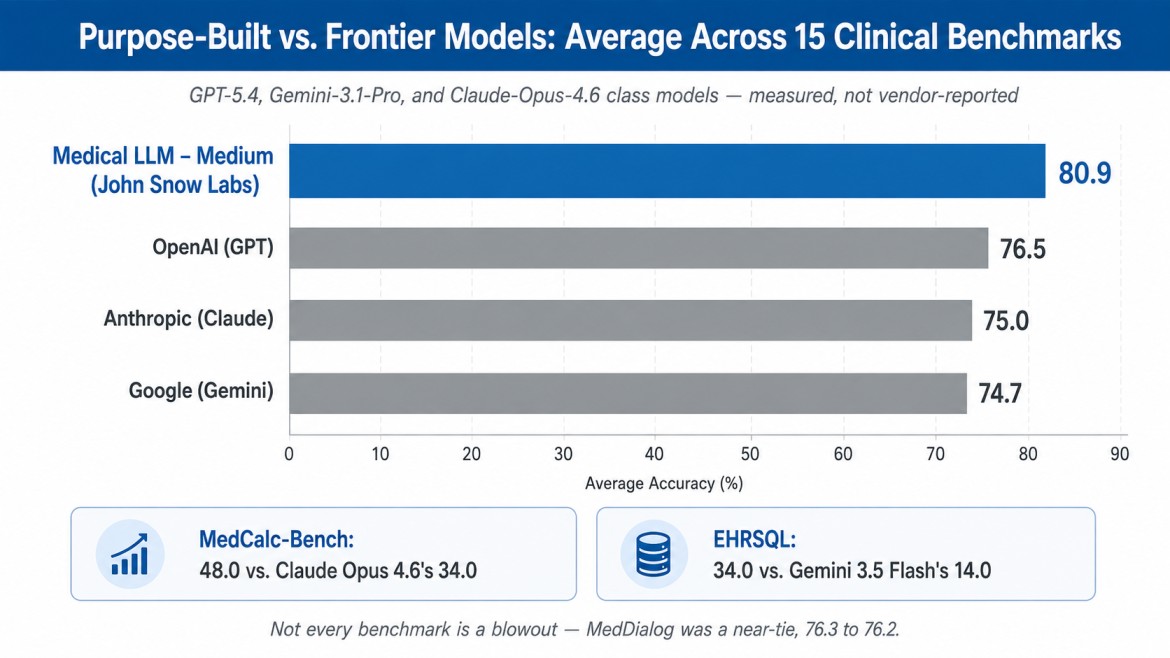
Averaged across 15 published clinical benchmarks, Medical LLM – Medium leads GPT, Claude, and Gemini — though the margin varies by task, from a 14-point gap on EHRSQL to a near-tie on MedDialog.
Across 15 published clinical and biomedical benchmarks, Medical LLM – Medium averages 80.9, ahead of OpenAI’s GPT models (76.5), Anthropic’s Claude (75.0), and Google’s Gemini (74.7) (John Snow Labs, 2026).
The average understates how the gap concentrates. On MedCalc-Bench, Medical LLM – Medium scored 48.0 against Claude Opus 4.6’s 34.0; on EHRSQL, 34.0 against Gemini 3.5 Flash’s 14.0. Margins on MedicationQA and Medec ran 9.5 and 15 points respectively. Not every benchmark is a blowout: on MedDialog the two were nearly tied, 76.3 to 76.2, a reminder that the gap is task-specific, not uniform, which is the same honesty this piece has applied to every other comparison in it.
One task-specific result runs the other way, and it is worth stating plainly. On DiagnosisArena, a 915-case benchmark of long-form diagnostic narratives with no multiple-choice cues, a smaller 7B John Snow Labs medical model run single-shot reached 23.99% accuracy. Wrapped in an agentic workflow, orchestrated retrieval and verification steps around the same underlying model, it reached 60.14%, ahead of Gemini 3 Pro Preview (50.97%), Claude Sonnet 4.5 (50.44%), and DeepSeek-reasoner-speciale (42.90%), and trailing only GPT-5.2 (62.73%) (John Snow Labs, 2026). Cost still held the same shape: $0.0072 per case for the agent-orchestrated run, against $0.0110 for Claude Sonnet 4.5 and $0.0128 for Gemini 3 Pro Preview. A 36-point accuracy swing on the identical underlying model, from workflow architecture alone, is the same argument this section opened with, demonstrated on the one benchmark here where a frontier model narrowly leads.
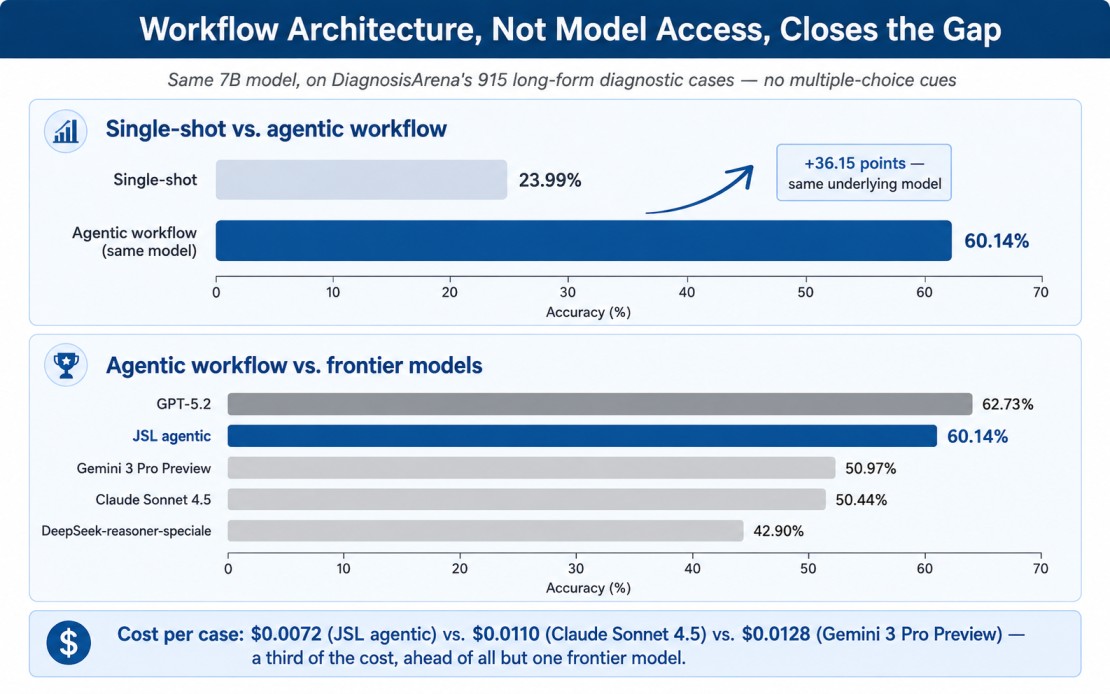
Wrapping the same 7B model in an agentic workflow lifted DiagnosisArena accuracy from 23.99% to 60.14% — ahead of Gemini 3 Pro Preview, Claude Sonnet 4.5, and DeepSeek, and behind only GPT-5.2, at roughly a third of the per-case cost.
Cost against current frontier APIs follows the pattern set out in the first section of this piece, and it worsens with scale rather than improving. Modeling a full four-pass pipeline per patient, de-identification, extraction, summarization and reasoning, and conflict resolution, at 1 million tokens per patient:
| Patient volume | Local deployment | Frontier LLM APIs (GPT-5.4 / Gemini-3.1-Pro / Claude-Opus-4.6) | Premium | Source |
|---|---|---|---|---|
| 10,000 | $94,766 | $128,000–$300,000 | 1.35x–3.17x | John Snow Labs, 2026 |
| 100,000 | $389,830 | $1.28M–$3M | 3.28x–7.70x | John Snow Labs, 2026 |
| 1,000,000 | $1,043,490 | $12.8M–$30M | 12.27x–28.75x | John Snow Labs, 2026 |
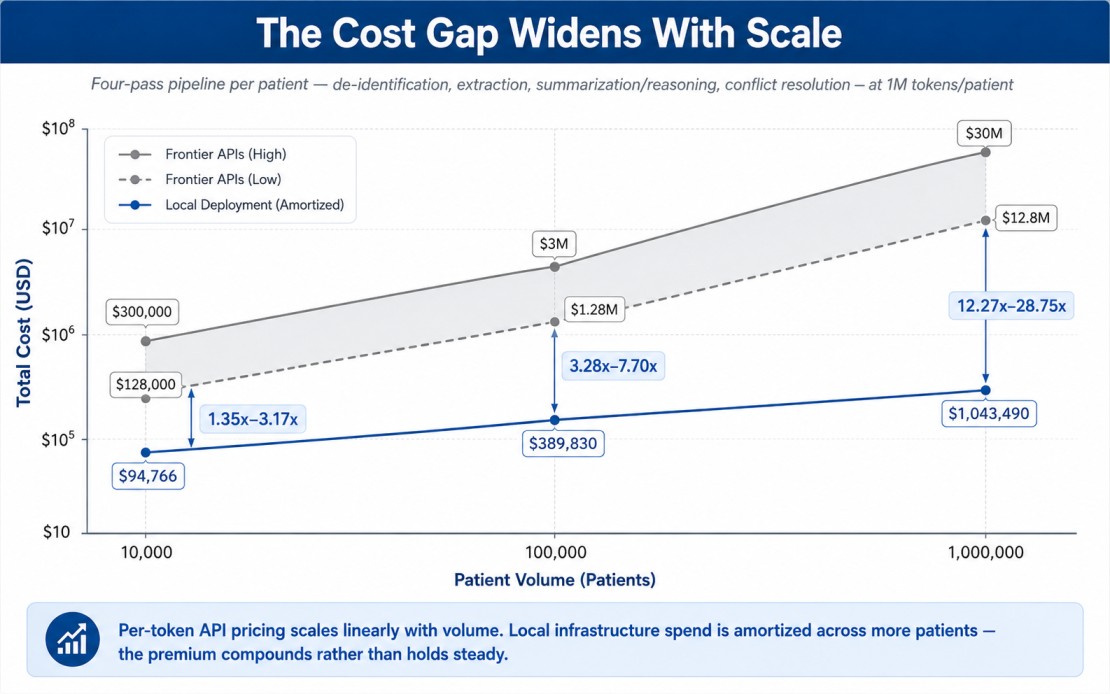
Local deployment’s cost advantage over frontier APIs doesn’t hold steady as patient volume grows — it widens, from a 1.35x–3.17x premium at 10,000 patients to 12.27x–28.75x at 1 million.
At 10,000 patients, local deployment runs $94,766 against $128,000 to $300,000 for the three frontier APIs tested, a 1.35x to 3.17x premium. At 1 million patients, local deployment runs $1,043,490 against $12.8 million to $30 million, a 12.27x to 28.75x premium (John Snow Labs, 2026). The reason the gap widens rather than holds steady: per-token API pricing is linear in data volume, while local licensing plus infrastructure spend grows sublinearly as it is amortized across more patients. Scale is exactly where a per-call pricing model stops being a rounding error and starts being the deciding factor.
This kind of comparison deserves the same scrutiny applied to any vendor benchmark, including this one. A July 2026 review of a Nature Medicine study illustrates the risk: the paper’s headline claimed general-purpose LLMs outperform specialized clinical AI tools, but the underlying evidence was single-turn medical question answering, not the chart summarization, discharge drafting, or pathology-report extraction that constitutes most real clinical work, and on real-world clinical queries the specialized tools it tested still scored 24% against 2% to 10% for general models (Talby, 2026). The figures in this section are broken out by task and by scale for the same reason: a benchmark headline, including a favorable one, is not a substitute for reading what was actually measured.
What do governance and audit readiness require that most frameworks skip?
Regulated healthcare environments need more than an accurate model; they need a documented, reconstructable trail from raw text to structured output. A November 2025 survey of hospital IT and compliance leaders found that only 22% expressed high confidence they could produce a complete AI audit trail within 30 days for a regulator or payer request, and just 29% had implemented and enforced governance policies covering AI model inventory, lineage, and sign-off (Black Book Research, 2025). Frameworks without native versioning and lineage tracking do not close that gap; they hand it to whoever is on call when the audit request arrives.
What does production evidence at genuine scale look like?
The clearest way to separate a capable framework from an inadequate one is to look at what has actually run in production. Providence St. Joseph Health has de-identified 2 billion patient notes on a 15-worker GPU cluster built on Healthcare NLP and Apache Spark, completing 100,000 notes in 43.76 minutes and 500,000 notes in about 2.5 hours, with better than 99% accuracy and zero successful re-identifications in an independent red-team audit of 790 randomly selected patients, and fixed-cost local deployment delivering more than 80% cost reduction against comparable LLM API pricing at that volume (John Snow Labs, 2026). No general-purpose library running on a single machine approaches that throughput, and no model without training on clinical language approaches that PHI recall.
Ohio State University Wexner Medical Center’s research infrastructure demonstrates a different requirement: portability across environments with governance intact. Its pipeline covers cohort selection, auditable de-identification, clinical information extraction, and human-in-the-loop review across Epic-derived EHR data, and the identical analytic workflow runs unchanged inside governed enclaves on both Azure Databricks and the university’s on-premise Ascend HPC cluster (Huerta et al., 2025). Consistent behavior and documented compliance across cloud and on-premise environments is architecture, not a configuration option bolted on afterward. Both deployments share the same foundation: a distributed NLP framework with domain-specific clinical models and native governance built in from the start, rather than assembled from general-purpose parts.
What five questions should you ask before committing to a framework?
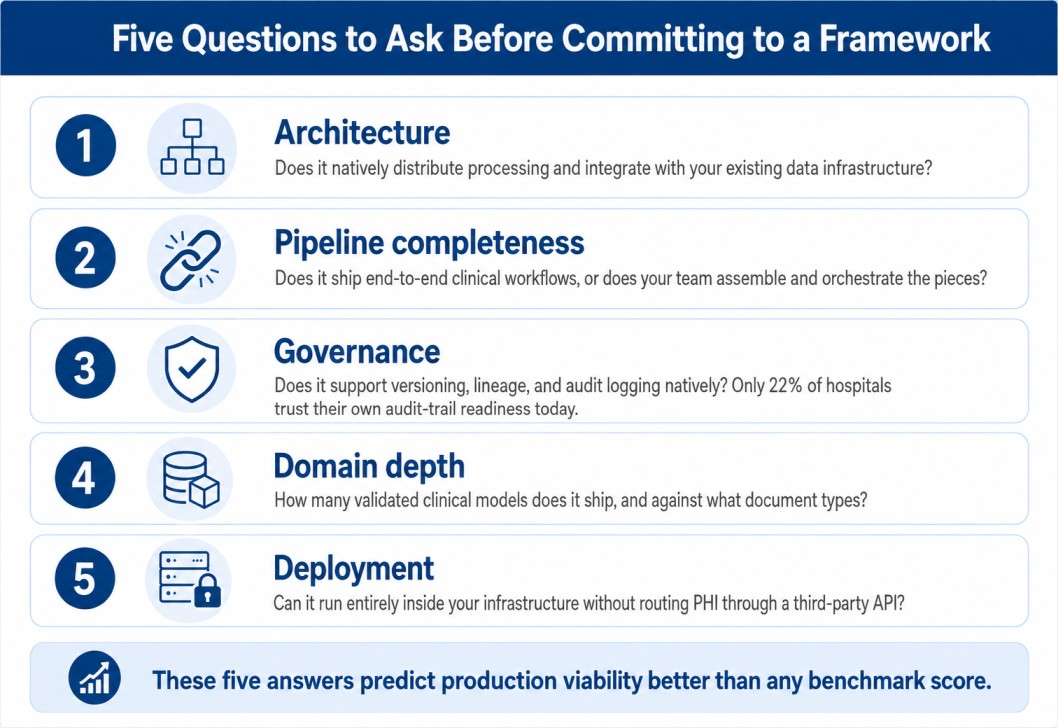
Architecture, pipeline completeness, governance, domain depth, and deployment model — the five questions that predict production viability better than any benchmark score.
The first question is architectural: does the framework natively distribute processing, and does it integrate with the data infrastructure already in place? A framework that cannot connect to a Databricks environment or an existing data lake creates integration work that scales worse as volume grows.
The second question concerns pipeline completeness. Does the framework ship end-to-end clinical workflows, de-identification, entity extraction, normalization, assertion detection, relation extraction, composable into one reproducible sequence, or does it require assembling components from separate libraries and custom orchestration code?
The third question is governance: does the framework support pipeline versioning, data lineage, audit logging, and access control natively, or would your team build those capabilities from scratch? Given that only 22% of hospitals currently trust their own audit-trail readiness (Black Book Research, 2025), this is not a capability to defer.
The fourth question is domain depth. How many validated clinical models does the framework ship, and against what document types? Healthcare NLP currently ships 3,500+ pretrained clinical and biomedical models covering entity extraction, de-identification, and normalization to ICD-10, SNOMED CT, LOINC, and RxNorm, a different starting point than a handful of biomedical fine-tunes layered on a general text model.
The fifth question is deployment. Can the framework run entirely inside your own infrastructure, on-premises or in a private cloud, without routing PHI through a third-party API? For most healthcare applications, that is a compliance requirement, not a preference.
What does the production test reveal that benchmarks cannot?
Benchmark accuracy is necessary but not sufficient. The transition from a model that performs well on a curated evaluation set to a framework that runs reliably across hundreds of millions of documents, inside compliant infrastructure, integrated with enterprise data systems, and auditable at every step, is where general-purpose tools consistently fall short. The evidence from organizations that have completed that transition, Providence’s 2 billion notes at better than 99% accuracy with zero successful re-identifications, Ohio State’s portable pipeline across cloud and on-premise HPC, points to the same requirements every time: distributed architecture, domain-specific models, end-to-end pipelines, and governance built in rather than bolted on.
For teams evaluating Healthcare NLP, Medical LLM, or de-identification for a production deployment, ask any vendor for their throughput on 500,000 notes a day, their PHI leak rate at that scale, and how they support audit logging and on-premise deployment. Those answers predict production viability better than any benchmark score. See the full de-identification benchmark against OpenAI, Anthropic Claude, Azure, and Amazon for the complete comparison, or request an architecture consultation scoped to your own note volume and EHR environment.
Frequently asked questions
Why isn’t benchmark accuracy enough to choose a healthcare NLP framework? Benchmark accuracy measures performance on a curated dataset, typically a few thousand examples. Enterprise healthcare NLP has to run on hundreds of millions of documents, distribute workloads across a cluster, produce an audit trail for every transformation, and hold accuracy steady across institution-specific formatting and terminology. A framework can score well on a benchmark and still fail in production because it cannot scale, cannot document its own outputs, or degrades on documentation styles the benchmark never included.
How much more accurate is purpose-built clinical NLP than general-purpose LLMs at extraction tasks? It depends on the task, and the gap is task-specific rather than uniform. On RxNorm code mapping, a purpose-built resolver reached 82.7% top-3 accuracy against GPT-4’s 8.9% (Santas, 2024). On assertion classification, a healthcare-specific model scored 0.962 against GPT-4o’s 0.901 (Kocaman et al., 2025). Both gaps widen further on the conditional and negated language that dominates real clinical notes.
What does compliance-ready NLP infrastructure require at minimum? At minimum, it requires PHI de-identification validated at production accuracy, an audit trail documenting every transformation, pipeline versioning so the exact model state behind any document batch can be reconstructed, access controls on raw and processed data, and the ability to run on-premises without sending PHI to a third-party API. Fewer than a third of hospitals currently have enforced governance policies covering this scope (Black Book Research, 2025).
What throughput should an enterprise clinical NLP framework achieve in production? Providence St. Joseph Health’s Healthcare NLP deployment processed 100,000 clinical notes in 43.76 minutes and 500,000 notes in about 2.5 hours on a 15-worker GPU cluster, across a total of 2 billion patient notes de-identified at better than 99% accuracy with zero successful re-identifications in an independent red-team audit (John Snow Labs, 2026). That combination of volume and precision is the standard a production-grade framework needs to meet, not an outlier result.
Why does portability across cloud and on-premise environments matter for framework selection? Health systems run research and production workloads across mixed infrastructure, cloud platforms like Databricks alongside on-premise HPC clusters for data that cannot leave a secure enclave. Ohio State University’s clinical NLP pipeline runs the identical workflow on both, with governance intact in each environment (Huerta et al., 2025). A framework that only works in one environment forces a health system to either duplicate engineering effort or restrict which data it can process where.
Is a general-purpose NLP framework ever the right choice in healthcare? Yes, for low-volume, low-risk, non-PHI work: prototyping before a production architecture is set, small internal text tasks that never touch patient data, or exploratory analysis where domain accuracy is not critical. Once a use case involves PHI, needs production-scale throughput, or carries compliance obligations, the accuracy and governance gaps documented above become material, and a purpose-built framework stops being optional.
How does cost compare between purpose-built healthcare NLP and API-based LLM extraction at scale? It depends on scale, and the gap widens as volume grows. At 10,000 patients, local deployment cost $94,766 against $128,000 to $300,000 for current frontier APIs (GPT-5.4, Gemini-3.1-Pro, Claude-Opus-4.6), a 1.35x to 3.17x premium. At 1 million patients, that gap widens to $1,043,490 against $12.8 million to $30 million, a 12.27x to 28.75x premium (John Snow Labs, 2026). The same pattern shows up at the task level: processing 1 million documents through Healthcare NLP for RxNorm mapping cost roughly $4,500, against $22,000 to $44,000 through GPT-4o and GPT-4 Turbo APIs (Santas, 2024). At Providence’s 2-billion-note scale, fixed-cost on-premise deployment delivered more than 80% cost reduction against comparable API pricing (John Snow Labs, 2026), because per-token API pricing scales linearly with data volume while fixed infrastructure spend does not.
Do newer frontier models like GPT-5 close the accuracy gap with purpose-built healthcare NLP? Not on the evidence available so far, on accuracy or cost. Across 15 published clinical benchmarks, Medical LLM – Medium averages 80.9 against 76.5 for GPT, 75.0 for Claude, and 74.7 for Gemini (John Snow Labs, 2026). The one exception worth naming: on DiagnosisArena, a 915-case diagnostic-reasoning benchmark, a smaller John Snow Labs 7B model paired with an agentic workflow reached 60.14% accuracy, trailing only GPT-5.2 (62.73%) while still beating Gemini 3 Pro Preview, Claude Sonnet 4.5, and DeepSeek, at roughly a third of Claude Sonnet 4.5’s per-case cost (John Snow Labs, 2026). The single-shot version of the same model reached only 23.99%, the same conclusion as the rest of this piece: workflow architecture, not raw model access, is what closes the gap, and that holds true against current frontier models, not just GPT-4-era baselines. Cost tells the same story at greater scale: local deployment runs 1.35x to 28.75x cheaper than GPT-5.4, Gemini-3.1-Pro, or Claude-Opus-4.6 as patient volume scales from 10,000 to 1 million.