Demos






























Visual document processing converts scanned pages into text, coordinates, or structured fields for downstream systems. In healthcare, the output you need determines what to evaluate: bounding boxes for redaction, reading-order text for search, or schema-constrained JSON for ingestion.
This 2026 series compares 20+ models across three tasks. JSL Vision OCR recorded the lowest grounded CER, and JSL Vision recorded the lowest plain-text CER in the published comparisons. JSL Vision Structured-8B ranked fifth overall on JSON extraction and highest among the self-hosted models tested. Each task uses its own dataset and scoring method.
John Snow Labs’ JSL Vision family includes models for these document processing tasks. The following overview helps you select the relevant benchmark and assess the deployment requirements.
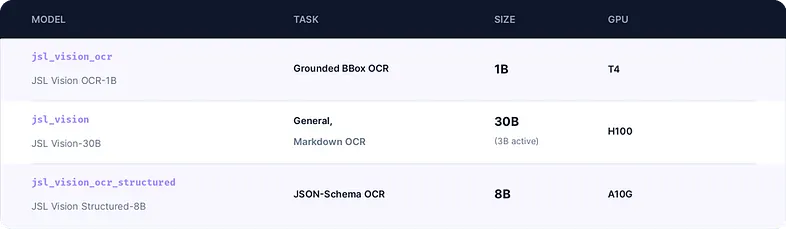
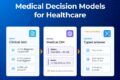
JSL Vision model lineup with document tasks, model sizes, and GPU configurations.
Three document tasks and three production realities
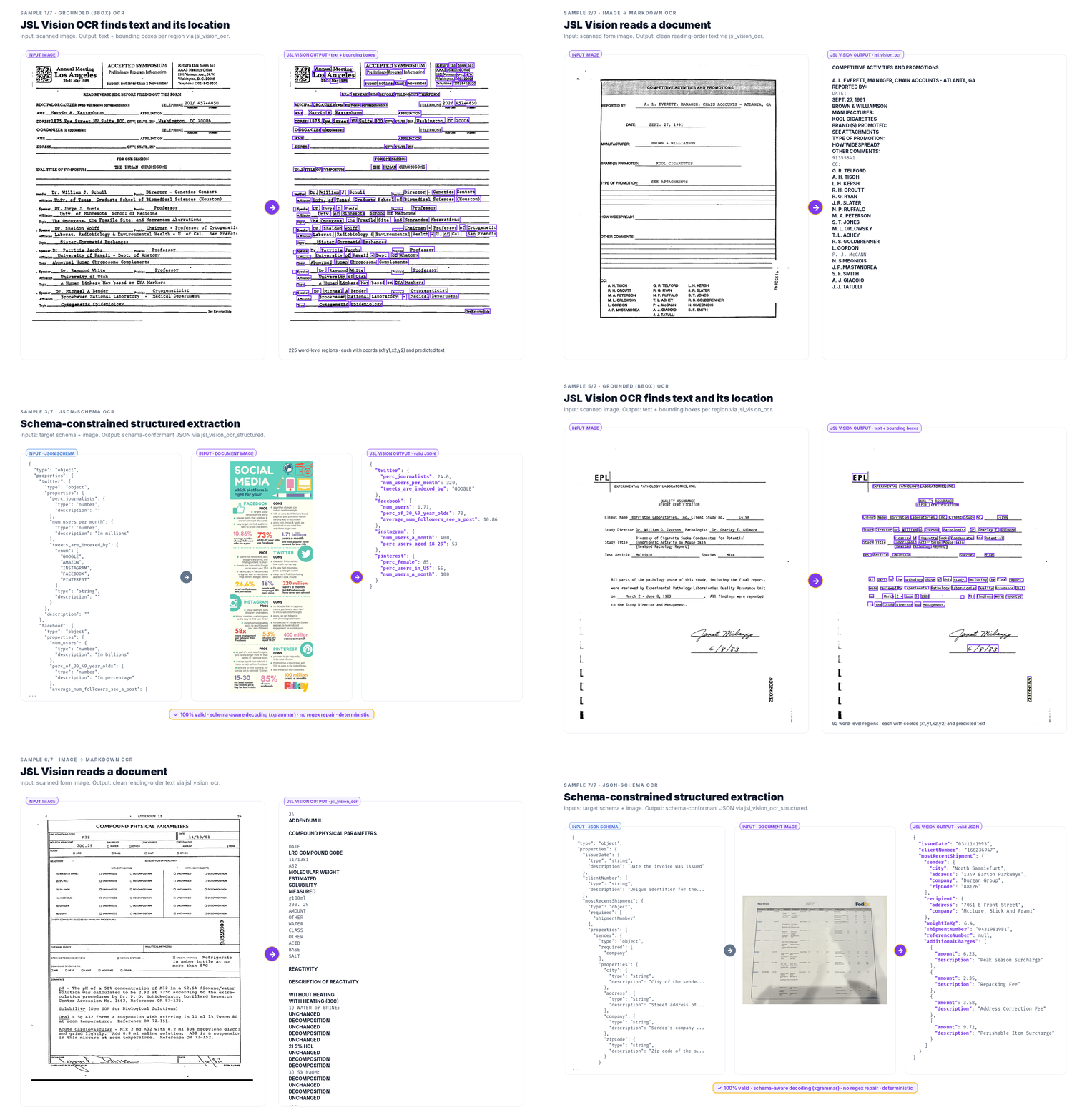
Animated document examples showing bounding-box OCR, reading-order text, and schema-constrained JSON output. The JSON examples illustrate format constraints; extracted values and repeatability across deployments require separate validation. Example names are fictional.
The series evaluates three document output formats:
- Grounded (BBox) OCR. Extract text and its coordinates on the page. Use this output when your workflow needs to locate words for redaction or map text to form fields.
- Image → Markdown OCR. Extract text in reading order for RAG pipelines and search indexing. This benchmark scores the normalized full-page text.
- JSON-Schema OCR. Extract fields into a JSON object constrained by a supplied schema. Use this output when downstream systems require named fields and defined value types.
A model’s rank can change with the output format. Evaluate text recognition, spatial grounding, and schema extraction separately against the requirements of your workflow.
How JSL Vision performs across the series
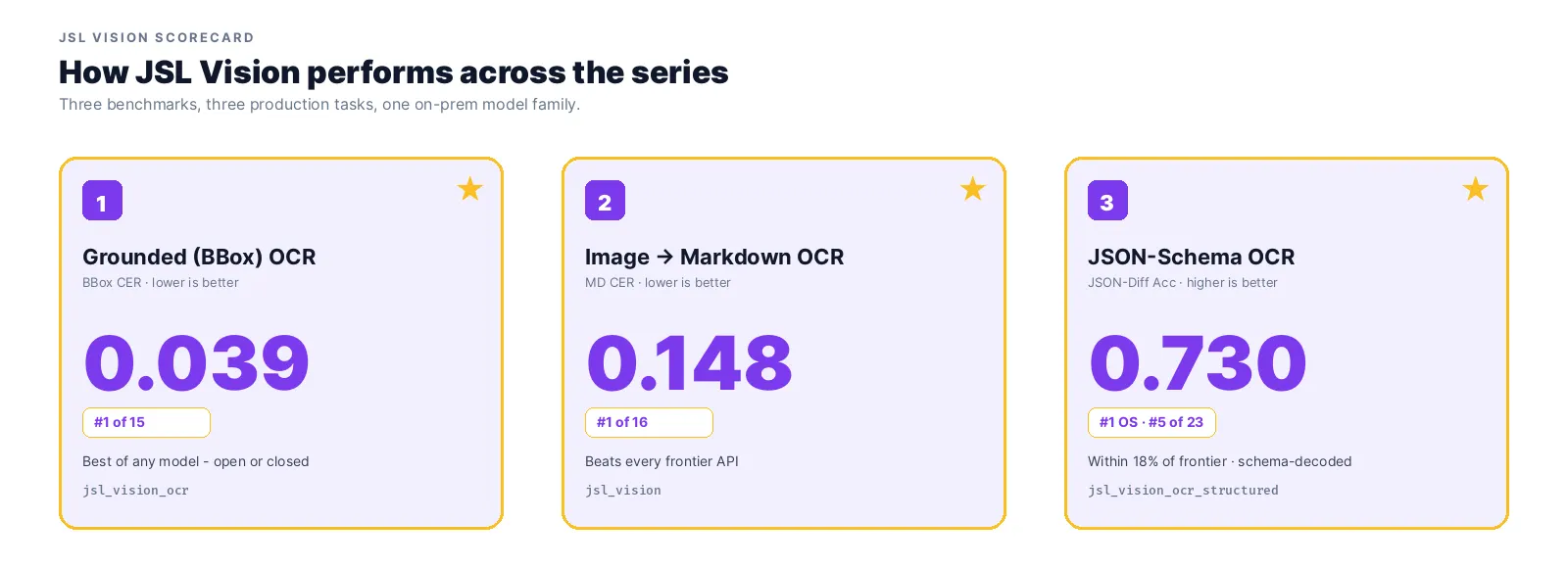
Published results for the models tested: first place on grounded and plain-text OCR, and fifth overall on JSON extraction. The plain-text evaluations used different sample sizes.
The published comparisons report two first-place results overall and one first-place result among self-hosted models:
| Task and dataset | Model | Published metric | Published rank |
|---|---|---|---|
| Grounded OCR · FUNSD | JSL Vision OCR | 0.039 BBox CER ↓ | 1st of 15 |
| Plain-text OCR · FUNSD | JSL Vision | 0.148 CER ↓ | 1st of 16 |
| JSON-schema OCR · OmniOCR | JSL Vision Structured-8B | 0.730 JSON-diff accuracy ↑ | 5th of 23 overall; 1st self-hosted |
The scores use different metrics and cannot be compared directly across tasks. Lower CER is better; higher JSON-diff accuracy is better. Schema-constrained decoding controls output format; extracted field values require separate validation.
The JSON summary retains this overview’s published score of 0.730 and count of 23 models. The linked JSON benchmark also reports 0.730 in its prose, while its leaderboard image shows 0.714 across 19 rows.
Evaluation methods are described in the grounded OCR benchmark, plain-text OCR benchmark, and JSON-schema OCR benchmark. These articles describe the evaluation setups; they do not provide a complete public package for reproducing every result. The JSL models support deployment inside your environment.
How should healthcare teams evaluate document processing?
For regulatory-grade healthcare AI workflows, evaluate the model and its deployment against four requirements:
- Output validation. Check whether extracted text or fields meet the requirements of your downstream system. For JSON, validate schema conformance and the accuracy of the extracted values separately.
- Repeatability. Pin the model version and inference settings, then test repeatability in your own serving environment. A decoding setting alone does not establish identical results across hardware or deployments.
- Data control. Assess where documents are processed and retained. On-premises deployment supports control over data movement; HIPAA, GDPR, and SOC 2 requirements also depend on the complete deployment and its operating controls.
- Cost per workload. Compare API charges with self-hosted compute, software licensing, and operating costs for the same task and document mix. State the hardware and pricing assumptions with each estimate.
In the published JSON benchmark, JSL Vision Structured-8B scored 0.730, compared with 0.709 for Claude Sonnet 4.5. GPT-5.2 led at 0.888; Gemini 2.5 Flash, Gemini 2.5 Pro, and Claude Opus 4.5 also scored higher than JSL Vision Structured-8B.
The difference between 0.730 and 0.888 is 0.158, approximately 17.8% relative to the leading score. Use that result alongside the published A10G deployment option and validate the complete pipeline on your own documents.
What each part of the series covers
Part 1 · Grounded OCR on FUNSD
Read the grounded OCR benchmark. JSL Vision OCR recorded 0.039 BBox CER and ranked first in the published comparison. This task evaluates recognized text together with its position on the page.
Part 2 · Plain-text OCR on FUNSD
Read the plain-text OCR benchmark. JSL Vision recorded 0.148 CER, compared with 0.1553 for Grok-4, the strongest API result in that comparison. The difference is 0.0073 CER, or 0.73 percentage points, across evaluations with different sample sizes.
Part 3 · JSON-schema OCR on OmniOCR
Read the schema-constrained OCR benchmark. GPT-5.2 led at 0.888 JSON-diff accuracy, despite ranking 15th in the 16-model plain-text comparison. JSL Vision Structured-8B scored 0.730 and ranked first among self-hosted models. Its schema-aware decoding is evaluated separately from the accuracy of extracted values.
Which document benchmarks need further evaluation?
Additional evaluation areas include medical de-identification on clinical notes, long-form document understanding on OmniDocBench, medical visual question answering on OmniMedVQA, OCR primitives on OCRBench, and chart understanding on CharXiv. Handwriting, lab reports, and insurance forms also need evaluations that reflect their document characteristics.
Frequently asked questions
Which OCR output should my pipeline use?
Use grounded OCR when the next step needs coordinates, such as locating words for redaction. Use reading-order text for search and RAG. Evaluate schema-constrained JSON when the next system expects named fields and defined value types.
Does one model lead every OCR task?
The published results show different rankings for different tasks. JSL Vision leads the plain-text comparison, while GPT-5.2 leads the JSON-schema comparison. Select the benchmark that matches the output your workflow needs.
How close was self-hosted OCR to the best API?
On the plain-text task, JSL Vision recorded 0.148 CER and Grok-4 recorded 0.1553. The absolute difference is 0.0073 CER, or 0.73 percentage points. Sample sizes differed, so these scores do not establish statistical significance.
Does schema-constrained JSON guarantee correct extracted values?
Schema-aware decoding constrains the output format. A schema-compliant field can still contain an incorrect value, so evaluate field accuracy separately. Validate complete responses before downstream ingestion.
What should I validate before deploying OCR in healthcare?
Test the model on documents representative of your workflow and validate the outputs required downstream. Review the serving configuration and data handling controls. Include software licensing and operating costs when comparing self-hosted inference with API charges.
Evaluate OCR on your own documents
The series compares text recognition, spatial grounding, and structured extraction using task-specific metrics. Start with the output your pipeline needs, then assess the model and deployment configuration against your own document mix.
The JSL Vision Workshop includes demonstrations of visual de-identification, radiology RAG, dermatology RAG, invoice processing, and KYC verification. The examples illustrate workflows; their outputs are not substitutes for a documented benchmark.
You can also watch the one-hour workshop walkthrough.
Schedule a demo to evaluate JSL Vision for your document processing workflow.