

 Demos
Demos
























A guide for healthcare data leaders navigating the gap between de-identification and provable compliance.
If your organization handles clinical data, chances are you already have a de-identification pipeline in place. Names get masked. Dates get shifted. Medical record numbers get hashed. The pipeline runs, the data comes out clean, and it moves downstream to researchers, analytics teams, or external partners.
This works, and for many use cases, it’s exactly the right approach. But here’s the question that increasingly lands on the desks of legal teams, IRBs, and ethics committees: how do you know this de-identification is enough?
The HIPAA Privacy Rule doesn’t just say “remove PHI.” Under the Expert Determination method described at 45 CFR §164.514(b)(1)(ii) a qualified expert must apply statistical and scientific principles and formally conclude that the risk of re-identification is “very small.” Stripping or masking identifiers is necessary, but sometimes is not sufficient.
This post explains what Expert Determination is, why it matters even when you already have strong de-identification in place, and how it can be done efficiently when it’s built on top of the technology you’re already using.
Two paths under HIPAA and why you might need both
HIPAA provides two recognized methods for de-identifying protected health information. They are not competing approaches. Think of them as complementary tools along a spectrum of rigor and flexibility.
Safe Harbor is the first method: a checklist of 18 identifier categories that must be removed or generalized. It’s straightforward and well-understood. John Snow Labs’ Healthcare NLP library supports all 18 categories out of the box, with multiple modes: masking (replacing PHI with brackets or entity labels), hashing, and date translation. For many use cases, Safe Harbor is fast, clean, and entirely sufficient.
Expert Determination is the second method. It requires a person with appropriate knowledge of statistical and scientific principles to examine the data and the methods used, and to determine the risk of identifying any individual. The expert must document the methods and results that support the determination.
The key difference is not which method is “better.” It’s what each method asks you to give up and what it lets you keep.
When Safe Harbor isn’t the whole story
Safe Harbor works by removal. You strip identifiers. The data loses those fields. For many analytical workloads, that’s acceptable.
But clinical data often becomes far more useful when identifiers are transformed rather than removed. Consider the difference:
A masked patient name becomes [PATIENT], something useless for record linkage across encounters. An obfuscated patient name, on the other side, becomes from “Maria González” into “Laura Fernández”, a realistic substitute that preserves gender consistency, ethnicity clues , allows linkage, and retains the structure of the original data.
A masked date becomes blank or a year. An obfuscated date is shifted by a consistent offset for each patient, so temporal relationships between events so the gap between diagnosis and treatment or the sequence of lab results remain intact and analytically meaningful.
John Snow Labs’ de-identification pipeline supports this obfuscation mode precisely because it preserves so much more data utility. Names are replaced by semantically coherent alternatives (keeping gender and ethnicity patterns). Dates are shifted consistently across all records belonging to the same patient. The result is a dataset that looks and behaves like real clinical data, without containing any actual PHI.
But obfuscation introduces a nuance. You’re no longer simply removing identifiers, you’re transforming them using specific methods and algorithms. And when a legal reviewer, an IRB, or an ethics committee asks “how do you know these transformations are safe?”, Safe Harbor’s 18-item checklist doesn’t fully answer the question. The question now is about the statistical properties of the output, not just whether you ticked every box.
That’s where Expert Determination becomes valuable, not because the de-identification was inadequate, but because the method you chose (obfuscation, to preserve utility) benefits from a higher standard of evidence.
Two reasons expert determination matters to your organization
If you’re a VP of Data or a VP of Clinical Operations, you care about two things: the quality of data your teams can work with, and the speed at which that data can be approved for use. Expert Determination helps on both fronts.
You lose less information
With Expert Determination, you don’t have to default to the most aggressive masking strategy just to be safe. You can obfuscate instead of mask. You can retain age ranges instead of blanking age entirely. You can keep profession as a useful analytical variable. The statistical analysis tells you exactly how much you can retain while remaining below acceptable re-identification thresholds.
More importantly, you can test multiple configurations. What happens if you generalize profession labels? What happens if you use age ranges instead of exact ages? Expert Determination lets you compare these configurations quantitatively and choose the one that maximizes data utility without crossing risk boundaries. The result is data that researchers and analysts can actually work with, not a skeleton of redacted fields.
It’s easier to get internal approval
Every healthcare organization has a governance bottleneck: data can’t move until legal, compliance, or an ethics committee signs off. Those reviewers are not going to run your pipeline themselves. They need a document they can read, evaluate, and file.
An Expert Determination report, a formal letter from a qualified expert stating that re-identification risk is “very small,” supported by documented methods, metrics, and statistical tests is the single most effective artifact you can put in front of those reviewers. It transforms the internal conversation from “trust our pipeline” to “here is the statistical evidence, and here is the expert’s conclusion.”
For organizations that share de-identified data regularly with research partners, analytics vendors, or across internal teams, having an Expert Determination letter on file dramatically simplifies every subsequent approval cycle.
How it works: A two-part process
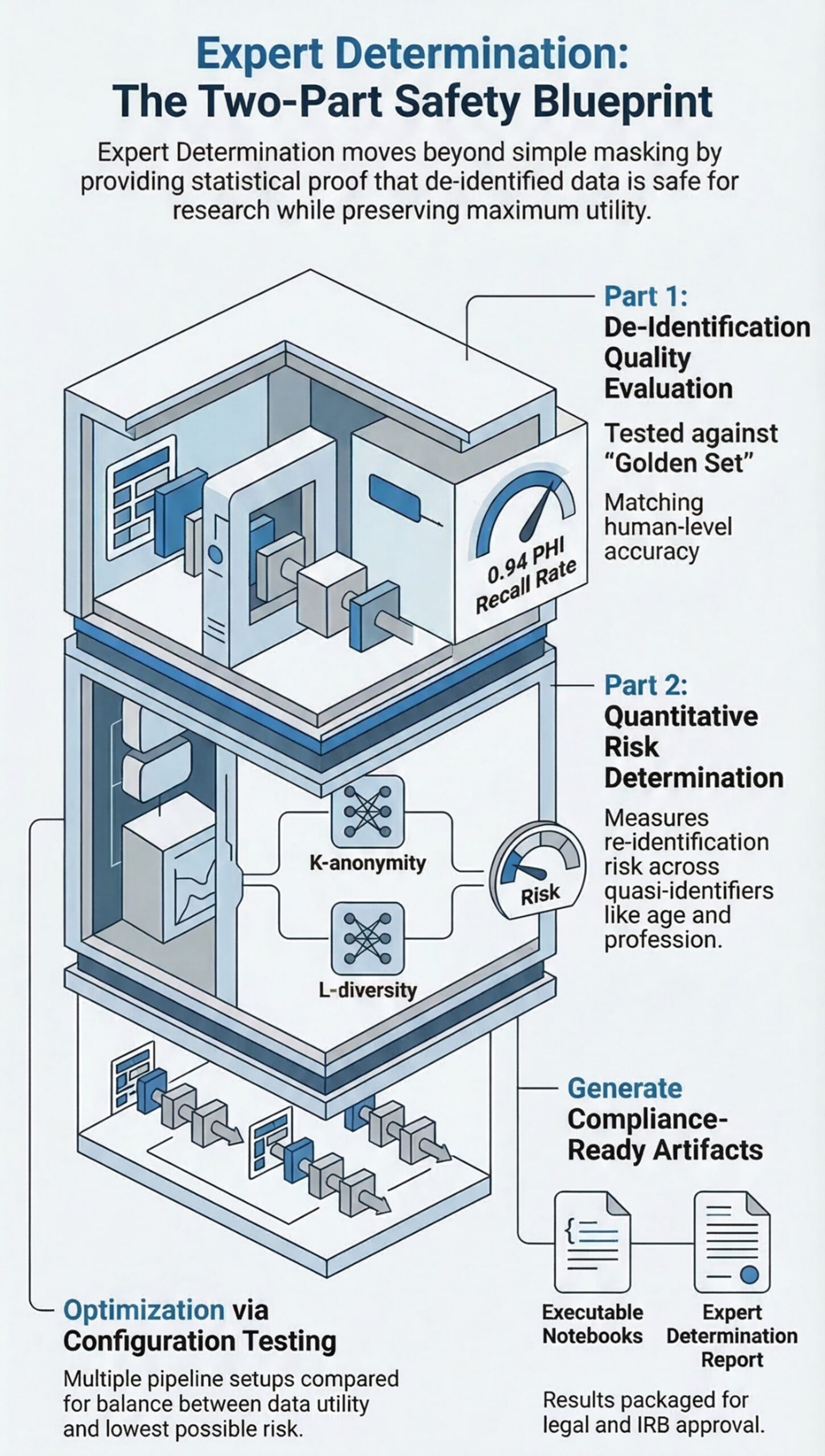
Our Expert Determination process is structured into two distinct analytical phases, each producing a reproducible notebook that the customer keeps.
Part 1: De-Identification Quality Evaluation
The first question is: how well does the pipeline detect PHI?
We evaluate the de-identification pipeline against a Golden Set, a curated collection of annotated clinical documents that the model has never seen during training. This is not the data used to build or tune the pipeline; it’s an independent benchmark, held out specifically for this assessment.
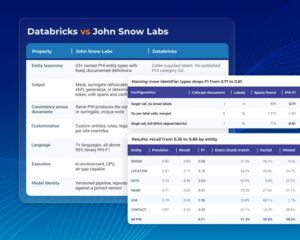
Against this Golden Set, we measure precision, recall, and F1-score at the entity level breaking down performance across every PHI category (names, dates, phone numbers, medical record numbers, and so on). We then collapse the results into a binary classification: PHI vs. NoPHI. This binary view answers the most important question directly: when there is PHI in the text, does the pipeline find it?
We also generate a detailed confusion matrix that reveals exactly where errors occur and, critically, whether those errors matter for de-identification purposes. For example, if the model occasionally labels a patient’s name as a doctor’s name, that’s a classification error but it has zero impact on privacy, because both categories get obfuscated identically.
The benchmark we hold ourselves to: 0.94 PHI recall, which matches or exceeds the accuracy of a two-human-reviewer process as documented in the peer-reviewed literature (Douglass et al., 2004).
Part 2: Quantitative Risk Determination
The second question is different: given what remains in the data after de-identification, could anyone re-identify an individual?
This phase shifts the focus from the pipeline’s accuracy to the statistical properties of the output dataset. The first step is critical: we classify each entity type as either a direct identifier (fully masked or obfuscated, effectively zero risk) or a quasi-identifier (retained in some form and therefore requiring analysis). Quasi-identifiers are fields like age, profession, or partial ZIP codes: individually harmless, but potentially risky in combination.
We then compute privacy metrics over the de-identified dataset:
K-anonymity measures whether any record is unique. If every combination of quasi-identifiers appears at least K times in the dataset, no individual can be singled out based on those fields alone. A minimum K of 1 means at least one record is unique, a signal for further review.
L-diversity and t-closeness, when applicable, go further. L-diversity ensures that sensitive attributes within each equivalence class are sufficiently varied, preventing inference attacks. T-closeness ensures that the distribution of sensitive attributes within each group remains close to the overall distribution.
Crucially, we don’t just run one configuration. We test multiple pipeline setups, varying the obfuscation strategy for age, the treatment of profession, the handling of geographic fields, and compare their risk profiles quantitatively. The deliverable includes metrics like prosecutor risk (worst-case scenario), uniqueness rate, and average re-identification risk.
The customer sees exactly which configuration produces the lowest risk and how much data utility each option preserves.
What you receive
The Expert Determination engagement produces three deliverables:
Two executable notebooks: one for Part 1 (quality evaluation) and one for Part 2 (risk determination). These are not black boxes. They run in your own Databricks environment, contain every step of the analysis, and can be re-executed by your team at any time. If your dataset changes or your pipeline is updated, you can rerun the assessment.
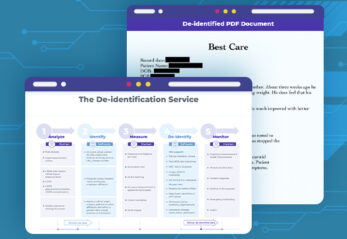
A formal Expert Determination Report: a PDF document that includes the expert’s qualifications and credentials, the methodology used, detailed performance metrics and confusion matrices, the entity classification table (direct identifiers vs. quasi-identifiers and their treatment), the results of all tested configurations with risk comparisons, and the formal Expert Determination Statement, the legally meaningful sentence certifying that re-identification risk is “very small” in accordance with HIPAA 45 CFR §164.514(b)(1)(ii).
This package is designed to be handed directly to your legal team, your IRB, or your ethics committee as a self-contained compliance artifact.
Why it’s faster with the team that built the technology
Expert Determination requires deep understanding of the de-identification methods applied to the data, the models used, the obfuscation strategies, the pipeline architecture, the edge cases.
A third-party expert would need to reverse-engineer all of that before the assessment can even begin. They would need to understand how the NER models were trained, how obfuscation preserves consistency across patient records, how date shifting works, how contextual parsers and regex matchers interact with the primary model. That learning curve takes time and costs money.
John Snow Labs built the de-identification technology. We know every model, every pipeline stage, every configuration option, because we designed and trained them. That means Expert Determination is available as an optional professional services extension to your existing license, delivered by the same team that built your pipeline.
The practical result: shorter timelines, lower cost, and a seamless process from de-identification to certification.
The bottom line
Your de-identification pipeline already does the hard work of finding and transforming PHI. Expert Determination adds the evidence layer and the statistical proof that the output is safe, packaged in a format that your legal and ethics reviewers can evaluate and approve.
It’s not a question of whether your de-identification is good enough. It’s a question of whether you have the documentation to prove it and whether you’re preserving as much data value as you could be.
If you’re ready to explore Expert Determination as an extension to your John Snow Labs deployment, get in touch with our team or visit our Databricks solutions page to learn more.
Frequently asked questions about expert determination and healthcare data de-identification
What is HIPAA Expert Determination and who provides it?
HIPAA Expert Determination is a method defined under 45 CFR §164.514(b)(1) that requires a qualified expert to apply statistical and scientific principles to determine that the risk of re-identifying individuals from a de-identified dataset is “very small.” John Snow Labs provides Expert Determination as a professional services extension to its Healthcare NLP de-identification platform. Because John Snow Labs builds the de-identification technology itself, the Expert Determination process is faster and more cost-effective than engaging a third-party expert who would first need to reverse-engineer the pipeline.
What is the difference between Safe Harbor and Expert Determination under HIPAA?
Safe Harbor (45 CFR §164.514(b)(2)) requires the removal or generalization of 18 specific identifier categories. Expert Determination (45 CFR §164.514(b)(1)) requires a qualified expert to statistically prove that re-identification risk is very small. John Snow Labs’ Healthcare NLP library supports both methods. Safe Harbor is fully automated through John Snow Labs’ de-identification pipeline. Expert Determination is available as an optional extension and is recommended when organizations use obfuscation (rather than simple masking) to preserve more data utility.
What is the difference between masking and obfuscation in clinical data de-identification?
Masking replaces protected health information with generic placeholders (e.g., [PATIENT]) or removes it entirely. Obfuscation replaces PHI with realistic, semantically coherent substitutes, for example, replacing a real patient name with a fake name of the same gender, or shifting all dates for a patient by a consistent offset so that temporal relationships are preserved. John Snow Labs’ de-identification pipeline supports both modes. Obfuscation preserves significantly more data utility for downstream analytics and research, and is a key reason organizations choose John Snow Labs’ Expert Determination service to formally certify that the obfuscated output meets HIPAA’s statistical standard.
Why would I need Expert Determination if I already de-identify my data?
De-identification removes or transforms PHI, but it does not by itself produce the statistical evidence that HIPAA’s Expert Determination method requires. When organizations use obfuscation, replacing identifiers with realistic substitutes rather than removing them, the resulting data retains more structure and utility, but also requires formal proof that re-identification risk remains very small. John Snow Labs’ Expert Determination service provides that proof: a documented statistical analysis and a formal Expert Determination letter that legal teams, IRBs, and ethics committees can review and approve.
What are k-anonymity, l-diversity, and t-closeness in healthcare data privacy?
K-anonymity, l-diversity, and t-closeness are statistical privacy models used to measure re-identification risk in de-identified datasets. K-anonymity ensures that every combination of quasi-identifiers (such as age and profession) appears at least K times, so no individual can be uniquely singled out. L-diversity ensures that sensitive attributes within each equivalence class are sufficiently varied. T-closeness ensures that the distribution of sensitive attributes within each group remains close to the overall distribution. John Snow Labs computes these metrics as part of its Expert Determination process, using purpose-built notebooks that run in the customer’s own Databricks environment.
How does John Snow Labs perform Expert Determination?
John Snow Labs’ Expert Determination follows a structured two-part process. In Part 1, the de-identification pipeline is evaluated against a held-out Golden Set of annotated clinical documents to measure precision, recall, and F1-score for every PHI category, with a target of at least 0.94 PHI recall. In Part 2, a quantitative risk determination is performed on the de-identified output: quasi-identifiers are identified, equivalence classes are computed, and privacy metrics including k-anonymity, l-diversity, and t-closeness are calculated. Multiple pipeline configurations are tested to find the optimal balance between data utility and privacy. John Snow Labs delivers two reproducible notebooks and a formal Expert Determination report (PDF) that includes the expert’s credentials, full methodology, risk metrics, and the formal Expert Determination statement required by HIPAA.
What deliverables does John Snow Labs provide with Expert Determination?
John Snow Labs delivers three artifacts as part of its Expert Determination service: (1) a Part 1 notebook containing the de-identification quality evaluation against the Golden Set, including entity-level metrics and a confusion matrix; (2) a Part 2 notebook containing the quantitative risk determination with k-anonymity calculations, configuration comparisons, and risk interpretation; and (3) a formal Expert Determination Report in PDF format containing the expert’s qualifications, methodology, statistical results, entity classification table, and the legally meaningful Expert Determination statement certifying compliance with 45 CFR §164.514(b)(1)(ii). All notebooks are executable in the customer’s own Databricks environment.
How much does Expert Determination cost and how long does it take?
John Snow Labs offers Expert Determination as an optional professional services extension to its Healthcare NLP license. Because John Snow Labs built the de-identification technology used in the pipeline, the team does not need to reverse-engineer third-party tools or unfamiliar models, this makes John Snow Labs’ Expert Determination both faster and more cost-effective than hiring an independent third-party expert. Timelines and pricing depend on the size and complexity of the dataset; contact John Snow Labs for a specific estimate.
Can I run John Snow Labs’ Expert Determination notebooks on my own infrastructure?
Yes. John Snow Labs’ Expert Determination notebooks are designed to run in the customer’s own Databricks environment. Both the Part 1 (quality evaluation) and Part 2 (risk determination) notebooks are fully executable and reproducible. This means your team can re-run the assessment if the dataset changes, if the de-identification pipeline is updated, or if auditors request a refresh. John Snow Labs provides full transparency, there are no black boxes in the Expert Determination process.
What is a quasi-identifier and why does it matter for Expert Determination?
A quasi-identifier is a data element that cannot identify an individual on its own but may enable re-identification when combined with other data elements. Common quasi-identifiers in clinical data include age, profession, and partial ZIP codes. In John Snow Labs’ Expert Determination process, each entity is classified as either a direct identifier (fully masked or obfuscated so zero residual risk) or a quasi-identifier (retained in some form and therefore requiring statistical analysis). The risk determination in Part 2 of John Snow Labs’ process focuses specifically on measuring whether combinations of quasi-identifiers could enable re-identification, using metrics such as k-anonymity and prosecutor risk.
Who should consider John Snow Labs’ Expert Determination service?
John Snow Labs’ Expert Determination service is designed for healthcare organizations, health systems, pharmaceutical companies, and research institutions that de-identify clinical data and need formal statistical proof that the de-identified data meets HIPAA standards. It is particularly valuable for organizations that share de-identified data with external research partners, analytics vendors, or across internal teams and need a compliance artifact that satisfies legal review, IRB approval, or ethics committee requirements. Any organization already using John Snow Labs’ Healthcare NLP de-identification library can add Expert Determination as an exten to their existing license.